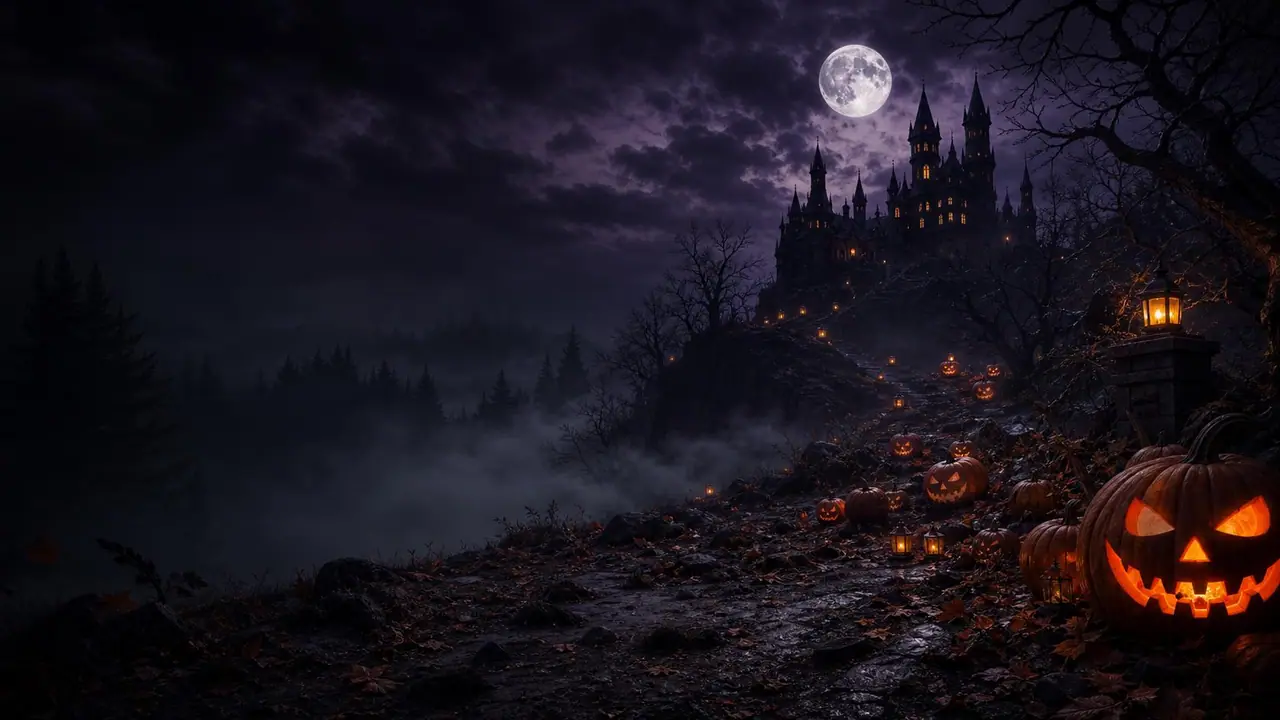
Halloween Countdown
(v) Scroll to discover more insights
How many days until Halloween?
Halloween
Halloween is on Saturday, October 31, 2026. The live timer below gives the exact remaining time first, then this page helps with costumes, trick-or-treat timing, nearby observances and the strongest Halloween planning paths.
114Days
00Hours
00Minutes
00Seconds
Quick Facts
History of Halloween
Introduction
Modern Halloween did not grow out of one event, one religion, or one uninterrupted custom. Its present form combines seasonal folklore, older Gaelic and British traditions, Christian feast days, regional household practices, migration, neighborhood ritual, mass entertainment, and retail culture. That is why Halloween can look like a remembrance season in one place, a community children's event in another, and a horror-themed media spectacle somewhere else.
That complexity matters because the holiday is often flattened into a simple origin story. Halloween is related to Samhain, but it is not identical to ancient Samhain. It also cannot be explained only through church history, only through Irish migration, or only through American commercialization.
What is known about Samhain
What historians and folklorists can say with confidence is that Samhain occupied an important seasonal position in Irish tradition. The National Museum of Ireland describes it as the first day of winter, marked on November 1, with much of the celebration taking place on the evening before. That helps explain why Halloween remained strongly tied to the night of October 31 even after Christian feast-day language became dominant.
But the surviving evidence is limited and uneven. Much of what is said about early Samhain depends on medieval Irish texts, later folklore collections, and scholarly interpretation rather than a full contemporary record from ancient communities themselves. Library of Congress folklife commentary also notes that scholarship has moved away from overconfident claims, including the once-popular idea that Samhain can be neatly defined as the Celtic New Year.
Seasonal customs and the transition into winter
The older importance of Samhain makes sense in an agricultural world. It marked the close of harvest and the beginning of the dark season, when work patterns, food storage, animal movement, and household life all changed. The National Museum of Ireland's folklife materials connect the period with harvest foods, nuts, apples, games, and evening gathering.
Seasonal transition helps explain why later folklore often connected the night with death, ancestors, danger, and divination. That does not mean every popular supernatural claim can be projected straight back into antiquity.
All Saints' Day, All Souls' Day and All Hallows' Eve
The name Halloween comes from All Hallows' Eve, the evening before All Hallows or All Saints' Day. Library of Congress and National Museum of Ireland materials both emphasize that point. In the Christian calendar, All Saints' Day honored saints, and All Souls' Day became associated with prayer and remembrance for the dead.
That relationship should not be reduced to a slogan about the church simply replacing a pagan festival. Christian feast days and local seasonal customs often coexisted, influenced one another, and were reinterpreted over long periods. The overlap is real, but it is historically layered rather than mechanically substituted.
Medieval and early modern customs
By the medieval and early modern periods, people in different parts of Britain and Ireland observed a range of customs around the season. These included souling, guising, prayer for the dead, seasonal food exchanges, fortune-telling games, bonfires, and household or village entertainments. None of these practices was universal, and not all belonged equally to every region, class, or century.
Some practices are especially important because they resemble later Halloween behavior without being identical to it. Souling involved going door to door in return for food and prayers for the dead. Guising in Scotland and elsewhere brought disguise, performance, and reward into the mix. These customs help explain why Halloween later adapted so easily to costumed visiting and treat-giving, but they should not be described as a single invention of modern trick-or-treating.
Masks, disguises and guising
Masks and disguises have a long place in Halloween-related custom, but their meanings were never singular. Historic UK and Library of Congress materials both connect guising or disguise with seasonal performance and supernatural imagination. In some places, disguise may have offered playful protection in a night associated with uncanny forces; in others, it functioned more like community drama, comic mischief, or ritualized visiting.
That is why it is too simple to say that people dressed up only to hide from spirits. Costumes could entertain, scare, perform, mock, test social boundaries, or mark the night as exceptional.
The origins of trick-or-treating
The origins of trick-or-treating are mixed, not singular. Library of Congress summaries present several lines of influence, including food offerings connected to spirit beliefs, medieval souling for the dead, and Scottish guising in which people received rewards after songs, jokes, or performances. Smithsonian coverage of trick-or-treating similarly stresses that the modern custom has roots reaching across centuries rather than one neat point of invention.
The modern North American form, however, was standardized much later. Smithsonian reporting and other historical summaries place recognizable trick-or-treating in the twentieth century, especially from the 1920s through the postwar decades, when neighborhoods, schools, and civic groups helped domesticate Halloween for children. No single inventor or exact founding household can be named with confidence.
Jack-o'-lanterns before pumpkins
Before pumpkins became the dominant Halloween lantern in North America, carved lanterns in Ireland and Britain were often made from turnips or other root vegetables. The National Museum of Ireland's "Ghost turnip" object page is especially valuable because it preserves concrete evidence: the museum received a turnip lantern associated with local Halloween making around 1900 in County Donegal.
The same source also links the term "Jack o' Lantern" to the folktale of a wandering Jack who was welcome neither in heaven nor in hell. That story belongs to folklore, not verified biography. Lantern-carving existed before pumpkin carving became standard, and pumpkins became popular in North America because they were larger, easier to hollow out, and visually dramatic.
Irish and Scottish immigration to North America
Irish and Scottish migration was crucial to Halloween's North American development, especially in the nineteenth century, but it was not the whole story. Migrants carried stories, seasonal games, disguise customs, lantern traditions, and festive habits into new settings. Once in the United States and Canada, these practices interacted with existing autumn celebrations, local community calendars, school life, and commercial entertainment.
That blending matters because American Halloween was not simply imported intact. A tradition that may once have centered on village visiting or local mischief could, in a North American city or suburb, become a party holiday, a school event, a neighborhood candy route, or a media-driven costume occasion.
Halloween becomes a community celebration
In the late nineteenth and early twentieth centuries, Halloween in North America increasingly shifted from scattered folk observance and youth mischief toward organized community celebration. Smithsonian writing on earlier American Halloween describes a holiday once associated with pranks, rough play, and public disorder. That helps explain why civic leaders, schools, and local organizations later had strong incentives to reshape it.
Community parties, parades, supervised games, and public events offered a way to keep Halloween festive while reducing vandalism and damage.
The rise of children's Halloween
Halloween was not always primarily a children's holiday. Earlier forms could be youth-driven, rowdy, courtship-oriented, or family-centered in different combinations. Over time, however, twentieth-century North American culture increasingly recast Halloween as a child-friendly and family-managed event. Costume contests, school parties, neighborhood routes, and treat distribution made the holiday legible to parents and institutions.
This change was gradual rather than sudden. By the mid-twentieth century, the child trick-or-treater had become one of the dominant public images of Halloween.
Candy, costumes and commercialization
Commercialization did not invent Halloween, but it gave the holiday scale, consistency, and visual saturation. Candy manufacturers, costume makers, paper-goods companies, department stores, and advertisers all helped standardize participation. Smithsonian writing on candy history notes that candy did not fully dominate trick-or-treating from the start; earlier treats could include homemade items, nuts, fruit, or drinks.
Once manufacturers could mass-produce masks, printed invitations, party kits, lawn decor, and themed candy, Halloween became more predictable and more portable. Commercial culture widened the holiday and changed how people entered it, but it did not erase the older folk layers.
Halloween in film, television and popular culture
Popular culture gave Halloween much of its modern visual language. Witches, ghosts, black cats, monsters, skeletons, bats, haunted houses, and glowing lantern faces all existed in earlier folklore and seasonal symbolism, but film, television, illustrated magazines, comic art, music, and theme entertainment amplified them.
This is also one reason Halloween traveled so effectively. A local bonfire custom or regional guising tradition does not globalize easily on its own, but a costume icon or horror character can.
Halloween outside the United States
Halloween outside the United States is best understood as a set of related but distinct stories. In Ireland, the season still carries strong associations with Samhain memory, local games, food, and lantern lore. In Scotland, guising and seasonal supernatural themes remained especially visible, and writers such as Robert Burns helped preserve a specifically Scottish Halloween imagination. In England, Halloween has expanded unevenly and sometimes uneasily alongside Bonfire Night and older autumn customs.
Canada shares many North American patterns of trick-or-treating, costumes, school events, and commercial decoration, but these developed through its own mix of British, Irish, French, and later continental influences. Mexico should be discussed separately: Smithsonian's "It's not Halloween" treatment of Day of the Dead is a useful corrective, because Dia de los Muertos is not a Mexican branch of Halloween but a distinct remembrance tradition. In Australia and parts of continental Europe, Halloween has often been adopted, resisted, or reinterpreted through imported media, retail culture, and local autumn festivals.
Debates about religion, culture and safety
Halloween still generates debate because its meanings are so mixed. Some religious communities reject it because of its association with spirits, occult imagery, or commercial excess. Others redesign it into harvest festivals, church alternatives, or trunk-or-treat events that preserve dressing up and treats while changing the setting and tone.
Safety debates have also shaped the holiday. Urban legends about poisoned candy and hidden threats have circulated for decades, often with little evidence behind the broadest fears. Even so, they encouraged tamper-proof packaging, adult supervision, and neighborhood trust rituals.
Historical timeline
Early Irish tradition: Samhain is remembered as the threshold into winter. Significance: It anchors Halloween's seasonal timing without making the modern holiday identical to the ancient festival.
Medieval period: All Saints' Day and All Souls' Day become established Christian observances near the same calendar point. Significance: Halloween takes shape within a wider Hallowmas framework.
Medieval and early modern Britain and Ireland: Souling, guising, seasonal visiting, and food exchange appear in regional practice. Significance: Later Halloween customs draw on several older lines of behavior rather than one origin.
Early modern period: Masks, disguises, fires, games, and divination customs remain active in local observance. Significance: Halloween develops as a night of performance, luck-testing, and social inversion.
18th century: Writers such as Robert Burns preserve and popularize Scottish Halloween custom in literature. Significance: Regional practice enters print culture and national memory.
19th century: Irish and Scottish migration helps carry Halloween customs to North America. Significance: Migration becomes a major channel for later transformation.
Late 19th to early 20th century: North American Halloween parties and local festivities become more visible. Significance: The holiday begins shifting from folk survivals to organized community culture.
1920s-1940s: "Trick or treat" spreads in North America. Significance: Door-to-door child participation becomes one of the defining forms of the holiday.
Mid-20th century: Candy, school activities, and suburban neighborhood ritual strengthen children's Halloween. Significance: The holiday becomes more family-managed and less centered on vandalism or youth disorder.
20th century: Mass-produced costumes, decorations, and seasonal advertising expand. Significance: Commercialization standardizes participation and broadens the market season.
Late 20th century: Film, television, and horror branding intensify Halloween's monster imagery. Significance: Popular culture pushes the holiday beyond local custom into global recognition.
21st century: Halloween grows internationally, sometimes alongside resistance or reinterpretation. Significance: The holiday becomes both global and contested rather than universally uniform.
Halloween today
Today Halloween carries several identities at once. It is a folklore season, a neighborhood ritual, a children's entertainment night, an adult costume culture, a horror-media showcase, and a commercial autumn peak. Some people meet it through prayer and remembrance; others through lanterns, candy bowls, parties, or cinema.
That variety is not a mistake in the history. It is the history. Halloween survived and spread because it could absorb different meanings without becoming only one thing.
Sources and further reading
- National Museum of Ireland, Traditions and customs of Halloween / Samhain
- National Museum of Ireland, Ghost turnip
- Library of Congress Folklife Today, Welcome to Folklife Today, and...Happy Halloween!
- Library of Congress, The Origins of Halloween Traditions
- Library of Congress, Halloween & Dia de Muertos Resources
- Historic UK, History and Traditions of Halloween in Britain
- Historic UK, Halloween in Scotland
- Smithsonian National Museum of American History, Day of the Dead at the Smithsonian: It's not Halloween
- Smithsonian Magazine, When Halloween Was All Tricks and No Treats
- Smithsonian Magazine, A Cultural History of Candy
Halloween Traditions
Open guide →Pumpkin lanterns create the warm orange glow most closely associated with Halloween night.
People dress as monsters, characters, myths or elegant gothic figures for parties and community events.
Children visit homes for candy in neighborhoods where Halloween is celebrated as a family event.
How It Is Celebrated
Halloween is celebrated through a mix of neighborhood rituals and entertainment. Families decorate porches with pumpkins, lights, spiderwebs and atmospheric props. Schools and local groups may host costume parades or autumn fairs. Adults often celebrate with costume parties, horror movie nights, themed dinners and late October travel to haunted attractions.
Around the world, Halloween adapts to local culture. In some countries it is mostly a retail and entertainment event; in others it overlaps with older autumn or remembrance traditions. The holiday is not the same as Day of the Dead or All Saints' Day, but they appear close together on the calendar and are often compared because each deals with memory, mortality and seasonal transition in different ways.
Interesting Facts
Halloween always falls on October 31.
Pumpkins became a major Halloween symbol after the holiday developed in North America.
The word Halloween comes from All Hallows' Eve.
Orange and black are common because they suggest harvest light and autumn darkness.
Related Holiday Guides
All guides →Questions
Halloween Countdown FAQ
Quick answers for holiday date, countdown, calendar and celebration questions.
How many days until Halloween?
There are 114 days until Halloween on Saturday, October 31, 2026.
What date is Halloween?
Halloween is observed every year on October 31.
Is Halloween a public holiday?
Halloween is not usually a national public holiday, but it is a major cultural and seasonal celebration in many countries.
Where is Halloween celebrated?
Halloween is especially popular in the United States, Canada, the United Kingdom, Ireland and Australia, with growing recognition elsewhere.
What are common Halloween traditions?
Common traditions include costumes, pumpkin carving, trick-or-treating, haunted houses and seasonal parties.