Remembrance Countdown
(v) Scroll to discover more insights
How many days until
Day of the Dead
Day of the Dead, or Dia de los Muertos, is a remembrance tradition most closely associated with Mexico and Mexican communities. The observance commonly spans November 1 and November 2. This countdown uses November 1 as the clearly labeled start of the main remembrance period.
More holidays in November
79Days
00Hours
00Minutes
00Seconds
Quick Facts
About Day of the Dead
Day of the Dead is a time for remembering loved ones through altars, flowers, candles, food, photographs, and visits to cemeteries or family gathering places. It is often joyful, reflective, colorful, and deeply personal rather than simply spooky.
History of Day of the Dead
Introduction
Day of the Dead, or Día de Muertos, is a family- and community-centered tradition for remembering deceased relatives and welcoming their symbolic return. It is most closely associated with Mexico, although related practices are found in other parts of Latin America and in Mexican and Latino communities abroad. The observance usually reaches its height around November 1 and 2, but dates, beliefs, foods, and rituals vary greatly by region.
The modern festival cannot be explained as an unchanged Aztec ceremony or as a purely Catholic import. It developed through centuries of interaction among Indigenous traditions, Spanish colonial Christianity, local agricultural cycles, family memory, public art, migration, tourism, and national cultural policy.
Indigenous traditions of death and remembrance
Before the Spanish conquest, Mesoamerican peoples maintained diverse beliefs about death, ancestors, sacred landscapes, and the afterlife. Mexica, Maya, Purépecha, Mixtec, Zapotec, and many other societies did not share one uniform religion or funeral calendar.
Offerings of food, flowers, objects, music, and prayer formed part of many mortuary practices. These traditions provide important historical roots, but scholars caution against drawing a straight line from one pre-Hispanic festival to every modern Day of the Dead custom.
Spanish conquest and Catholic observances
Spanish colonization brought Catholic festivals including All Saints’ Day on November 1 and All Souls’ Day on November 2. Missionaries encouraged Indigenous communities to observe the Christian calendar, pray for souls, attend Mass, and use church-approved forms of commemoration.
Conversion was uneven and creative. Indigenous communities adapted Catholic symbols to local languages, kinship systems, agricultural rhythms, and relationships with ancestors. Colonial authorities did not simply erase older practices, nor did communities preserve them unchanged.
A tradition formed in colonial society
Many features now associated with Day of the Dead took shape during the colonial and postcolonial periods. Church festivals, cemetery visits, food offerings, bells, candles, processions, household altars, and local markets became connected in different ways.
The result was not one national ceremony but many regional traditions. Practices in Michoacán, Oaxaca, Puebla, Yucatán, central Mexico, and northern states may differ in timing, decoration, music, and religious emphasis.
November 1 and November 2
November 1 is often associated with deceased children and November 2 with deceased adults, but this distinction is not universal. Some communities begin preparations in late October and continue through November 3 or longer.
The calendar reflects Catholic observance while local customs shape who is welcomed, when offerings are placed, and when families visit cemeteries. It is more accurate to speak of a ritual season than of one identical two-day event.
Ofrendas and household memory
An ofrenda is an offering arrangement created in a home, cemetery, school, museum, workplace, or public space. It may include photographs, candles, water, salt, flowers, incense, food, religious images, paper decorations, and objects connected with the deceased.
The ofrenda is not worship of death. It is a structured act of remembrance and hospitality. Families use familiar foods and personal objects to represent the lives, preferences, and relationships of people who have died.
Marigolds, candles, and paths
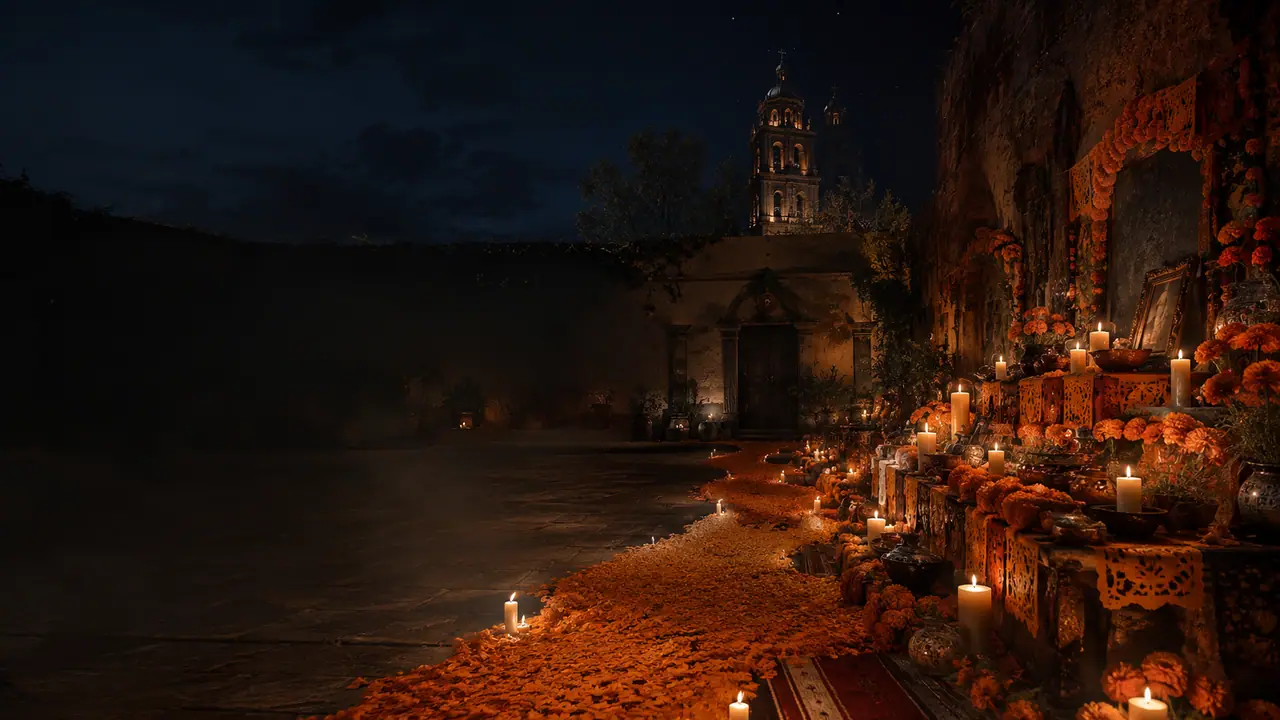
The orange marigold commonly called cempasúchil is strongly associated with the season. Petals may decorate altars, graves, arches, and paths. Their color and fragrance are often understood as helping guide the returning dead.
Candles provide light and prayerful atmosphere, while incense may purify or mark sacred space. Meanings vary among families, and modern displays often combine religious symbolism, inherited custom, and artistic choice.
Food and the shared table
Food connects the living and the dead. Families may prepare tamales, mole, fruit, maize dishes, beverages, and favorite foods of relatives. Pan de muerto, a sweet bread associated with the season, appears in many regional forms.
Offerings are symbolic, but meals also nourish living participants and sustain community gatherings. Markets, bakers, cooks, farmers, and artisans play major roles in preserving and changing the festival.
Sugar skulls and calaveras
Decorated skulls made from sugar, clay, chocolate, or other materials represent death in a playful and personalized form. Names may be written on the forehead, and the skull can serve as a gift, decoration, or reminder of mortality.
Literary calaveras are humorous verses imagining the deaths of living people, often used for political or social satire. These practices show how the festival can approach death with affection, wit, criticism, and familiarity rather than fear alone.
La Catrina and modern visual culture
José Guadalupe Posada created influential skeleton images during the late nineteenth and early twentieth centuries. The figure later known as La Catrina became famous through Diego Rivera’s mural work and subsequent popular art.
La Catrina was not an ancient deity. She belongs to modern Mexican printmaking, satire, nationalism, and visual culture. Her image is now widely used in costumes, face painting, tourism, and commercial design.
Cemeteries and community participation
In many communities, families clean and decorate graves, bring food and music, pray, and remain in cemeteries for extended periods. These visits can be solemn, festive, or both.
Cemetery observance differs sharply across Mexico. Some communities emphasize quiet prayer; others include bands, candles, storytelling, or communal meals. Public visitors should treat these spaces as living family and religious environments rather than performances arranged for tourists.
Nation-building and Mexican identity
After the Mexican Revolution, artists, educators, and officials promoted selected Indigenous and popular traditions as symbols of national identity. Day of the Dead became increasingly visible in schools, museums, murals, print culture, and tourism.
This recognition helped preserve public interest but also simplified regional differences. A national image of skulls, marigolds, and altars can obscure the fact that some Mexican communities observe the season differently or not at all.
UNESCO recognition
UNESCO proclaimed the Indigenous festivity dedicated to the dead in 2003 and placed it on the Representative List of the Intangible Cultural Heritage of Humanity in 2008. The recognition emphasized living community practices rather than a frozen national display.
Heritage status can support preservation and education, but it can also increase tourism and commercialization. Safeguarding requires attention to the people who maintain the tradition, not only to its most marketable images.
Day of the Dead in the United States
Mexican and Mexican American communities have long maintained remembrance traditions in the United States. Public celebrations expanded during the Chicano movement, when artists and organizers used the festival to express cultural pride, political memory, and community identity.
Museums, schools, cities, and arts organizations now create public ofrendas and festivals. These events can support cultural understanding, but they can also detach symbols from family, religious, and community meanings.
Day of the Dead is not Mexican Halloween
The holiday occurs near Halloween, and modern events may borrow costumes or entertainment practices. Their histories and central purposes are different. Halloween developed from Christian and European seasonal traditions, while Day of the Dead centers on maintaining relationships with deceased family and community members.
The two holidays may coexist and influence one another, especially in border and migrant communities, but describing Day of the Dead as Mexican Halloween erases its religious, Indigenous, colonial, and family history.
Historical timeline
Before the sixteenth century: Mesoamerican societies maintain diverse mortuary and ancestor traditions.
Sixteenth century: Spanish colonization introduces Catholic All Saints’ and All Souls’ observances.
Colonial period: Local communities combine, adapt, and reinterpret Indigenous and Catholic practices.
Nineteenth century: Cemetery visits, seasonal markets, food customs, and public remembrance continue in regional forms.
Late nineteenth century: José Guadalupe Posada develops influential skeleton imagery.
1947: Diego Rivera’s mural helps popularize the figure now called La Catrina.
Mid-twentieth century: Schools, museums, artists, and tourism promote Day of the Dead as a national symbol.
1960s–1970s: Chicano artists and communities expand public observance in the United States.
2003–2008: UNESCO proclaims and lists the Indigenous festivity dedicated to the dead.
Twenty-first century: Global visibility grows through migration, film, tourism, museums, and digital culture.
Day of the Dead today
Day of the Dead remains a living and changing tradition. Families remember particular people, communities maintain local ritual calendars, and artists continually reinterpret familiar symbols.
Its history is best understood through diversity rather than a single origin myth. Indigenous beliefs, Catholic observances, colonial change, national identity, migration, and modern media all contributed to the festival recognized today.
Sources and further reading
- UNESCO, Indigenous Festivity Dedicated to the Dead
- INAH, Día de Muertos, un sincretismo religioso
- INAH, El culto a los muertos en la época prehispánica
- Smithsonian National Museum of the American Latino, Day of the Dead Resources
- Smithsonian National Museum of American History, Day of the Dead Festival
- Smithsonian American Art Museum, Traditions and Change
- Smithsonian Folklife, Altered Altars
- Smithsonian Institution, Five Facts about Día de los Muertos
Traditions
Visiting gravesites
Sharing stories across generations
Building ofrendas with photographs and candles
How It Is Celebrated
Families may create home altars, decorate graves, light candles, prepare pan de muerto, display marigolds, and gather to remember ancestors. Public parades and artistic displays exist in some places, but the heart of the holiday is family remembrance.
Interesting Facts
- This countdown uses November 1 as the start date.
- The wider observance often spans November 1 and November 2.
- Marigolds are one of the most recognizable symbols.
- Ofrendas are personal remembrance altars.
- Practices vary by region and family.
Related Holiday Guides
Holiday directory →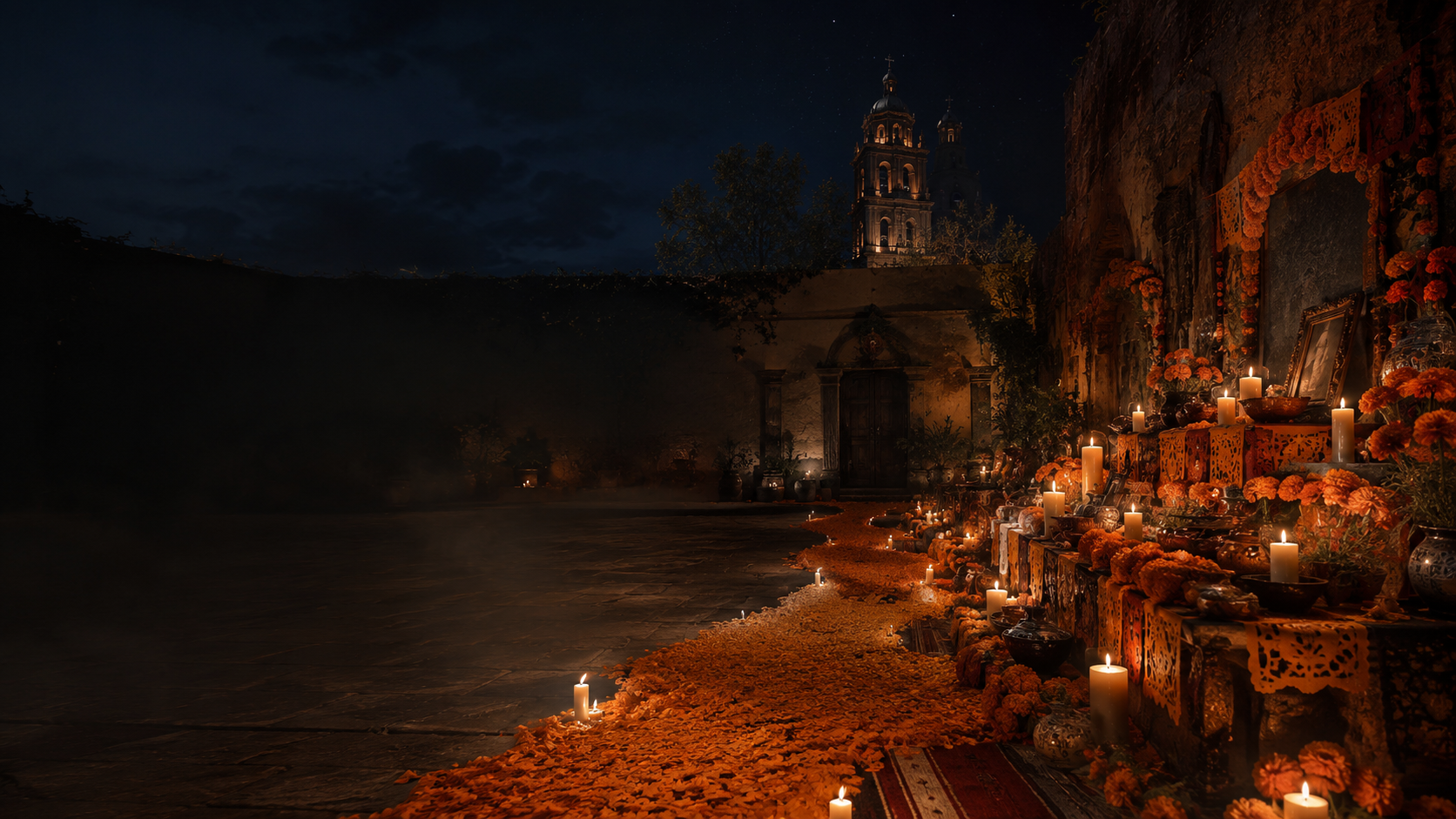 Holiday DirectoryBrowse remembrance, religious, and seasonal countdowns connected to early November observances.→
 Upcoming HolidaysFollow the calendar from Halloween through All Saints' Day, All Souls' Day, and late-autumn holidays.→
 Halloween CountdownCompare the October 31 countdown with the remembrance-focused pages that follow in early November.→
 Thanksgiving CountdownContinue from the early-November remembrance season into the next major late-autumn holiday.→
Questions
Day of the Dead FAQ
Clear answers about the date, countdown target and seasonal context.
What date does this countdown use?
It counts down to November 1, the start of the main Day of the Dead observance period.
Is Day of the Dead one day or two days?
It is commonly observed across November 1 and November 2, with customs varying by community.
Is Day of the Dead the same as Halloween?
No. It is a distinct remembrance holiday, though it falls near Halloween on the calendar.
Where is Day of the Dead most associated?
It is most closely associated with Mexico and Mexican communities worldwide.
Does the countdown update every year?
Yes. After November 1 passes, it rolls forward to the next November 1.