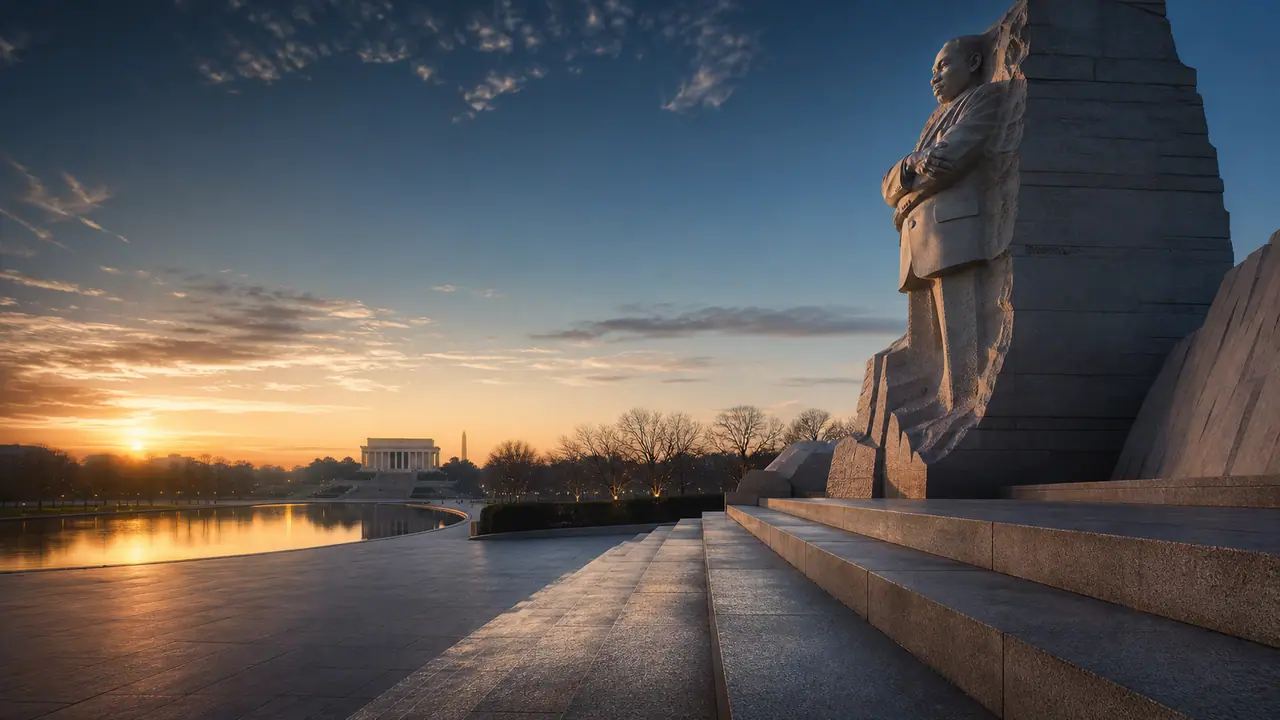
United States Holiday
(v) Scroll to discover more insights
How many days until
Martin Luther King Jr. Day
Martin Luther King Jr. Day is a United States federal holiday observed on the third Monday in January. This countdown uses that federal date rule and updates automatically each year.
More holidays in January
157Days
00Hours
00Minutes
00Seconds
Quick Facts
About Martin Luther King Jr. Day
The holiday honors the life and legacy of Dr. Martin Luther King Jr. and is often associated with reflection, education, community service, civil rights history, and public commemorations. Programs commonly connect his leadership with continuing work on equality, voting rights, nonviolence, and public service.
History of Martin Luther King Jr. Day
Introduction
Martin Luther King Jr. Day is a federal holiday in the United States honoring the life, leadership, and continuing influence of the Reverend Dr. Martin Luther King Jr. It is observed on the third Monday in January, near King’s birthday on January 15. The holiday commemorates his role in the struggle against racial segregation and disenfranchisement, but it also reflects a separate history: the long political campaign required to persuade Congress, presidents, states, employers, and the public to recognize his birthday nationally.
The movement for the holiday began almost immediately after King’s assassination in 1968. Supporters introduced legislation, organized annual birthday observances, gathered signatures, held marches, produced music, and confronted political opposition for fifteen years before a federal law was enacted in 1983. The first federal observance took place in 1986. In 1994, Congress also connected the holiday with community service, encouraging Americans to treat it as a day of civic action rather than only a day away from work.
Martin Luther King Jr.’s early life
Martin Luther King Jr. was born Michael King Jr. in Atlanta, Georgia, on January 15, 1929. He grew up in a family deeply connected to Ebenezer Baptist Church. His father and maternal grandfather were Baptist ministers, and the church became an important center of family, religious, and community life.
King attended segregated schools and entered Morehouse College at a young age. He later studied at Crozer Theological Seminary and Boston University. His education brought together Christian theology, Black church traditions, social ethics, democratic ideals, and ideas about nonviolent resistance that would influence his leadership.
The civil rights movement was larger than one leader
King became the most internationally recognizable leader of the modern American civil rights movement, but the movement was not created or directed by one person. Black communities, local organizers, women’s groups, students, churches, lawyers, labor organizations, journalists, and national civil rights groups had resisted segregation and racial violence for decades.
Figures including Ella Baker, Rosa Parks, Bayard Rustin, Fannie Lou Hamer, Fred Shuttlesworth, Jo Ann Robinson, John Lewis, Diane Nash, and many others shaped campaigns and institutions. Understanding this wider movement prevents the holiday from becoming a story in which one heroic individual acted while everyone else simply followed.
The Montgomery Bus Boycott
King emerged as a national figure during the Montgomery Bus Boycott of 1955–1956. After Rosa Parks was arrested for refusing to surrender her seat under Montgomery’s segregated bus system, local Black leaders and residents organized a sustained boycott. King, then a young pastor at Dexter Avenue Baptist Church, was selected to lead the Montgomery Improvement Association.
The boycott depended on mass participation, carpools, fundraising, legal action, church networks, and months of personal sacrifice by Black residents. King’s home was bombed, participants faced arrests and intimidation, and the protest continued for more than a year. A Supreme Court decision ultimately ended segregation on Montgomery buses.
Nonviolence as strategy and moral discipline
King advocated nonviolent direct action as both a practical strategy and an ethical commitment. Nonviolence did not mean passivity or avoidance of conflict. It involved organized boycotts, marches, sit-ins, mass meetings, voter registration, civil disobedience, negotiation, and the deliberate creation of public pressure.
King drew from Christian teachings, Black religious traditions, the example of Mohandas Gandhi, and the experience of American protest movements. Participants trained to endure arrests, insults, and violence without responding in kind. Debate nevertheless continued within the movement about self-defence, militancy, political strategy, and the limits of nonviolent persuasion.
The Southern Christian Leadership Conference
In 1957, King and other ministers helped establish the Southern Christian Leadership Conference. The organization sought to coordinate civil rights campaigns across the South through churches and local community networks. King served as its first president.
The organization supported protests in cities including Albany, Birmingham, and Selma. Results varied, and local leaders sometimes criticized national organizations for arriving after years of community work. Even so, the SCLC helped connect local struggles to national media, federal politics, fundraising, and broader demands for civil and voting rights.
Birmingham and the Letter from Birmingham Jail
The 1963 Birmingham campaign challenged segregation in one of the South’s most resistant cities. Demonstrators faced arrests, police dogs, and high-pressure fire hoses. Images of attacks on young protesters increased national attention and intensified pressure on political leaders.
While jailed for participating in demonstrations, King wrote the text later known as the “Letter from Birmingham Jail.” Responding to white religious leaders who urged patience, he argued that unjust laws demanded direct action and that delayed justice preserved injustice. The letter became one of the most widely studied statements of his political and religious philosophy.
The March on Washington
On August 28, 1963, hundreds of thousands of people gathered in Washington, D.C., for the March on Washington for Jobs and Freedom. The event was organized by a coalition of civil rights, labor, and religious groups and reflected demands involving employment, voting rights, education, public accommodations, and federal civil rights legislation.
King delivered his best-known address from the steps of the Lincoln Memorial. The “I Have a Dream” passages became central to public memory, but the march’s economic and legislative demands were equally important. Treating the event only as an inspirational speech can obscure its organized political purpose.
Federal civil rights legislation
The movement helped create the political conditions for the Civil Rights Act of 1964 and the Voting Rights Act of 1965. The Civil Rights Act prohibited several forms of discrimination and segregation, while the Voting Rights Act targeted practices used to prevent Black citizens from voting.
These laws were major achievements, but they did not eliminate racial inequality. Enforcement remained contested, and discrimination continued in housing, employment, policing, education, lending, and political representation. King increasingly emphasized that formal legal equality had to be accompanied by economic and social change.
King’s later campaigns
King’s work after 1965 extended beyond the campaigns most often highlighted during the holiday. He supported fair housing efforts in Chicago, opposed poverty, defended labor organizing, and criticized the Vietnam War. These positions sometimes reduced his popularity and strained relationships with political leaders and sections of the press.
He helped organize the Poor People’s Campaign, which aimed to bring people from different racial and regional backgrounds to Washington to demand jobs, income, housing, and economic security. His later work demonstrates that his vision was broader than desegregating public facilities.
Memphis and King’s assassination
In 1968, King travelled to Memphis, Tennessee, to support Black sanitation workers striking for safer conditions, fair treatment, and union recognition. The campaign joined racial justice with labor rights and human dignity.
King was assassinated in Memphis on April 4, 1968. His death produced grief, anger, memorial services, protests, and uprisings across the United States. It also prompted immediate calls for a permanent national commemoration of his birthday and work.
The first holiday legislation
Representative John Conyers of Michigan introduced legislation for a federal King holiday only days after the assassination. The proposal did not pass. Conyers and other supporters continued introducing bills in later sessions of Congress.
Early opposition took several forms. Some lawmakers objected to creating another federal holiday, questioned its cost, opposed honoring a private citizen, or attacked King’s politics and reputation. The repeated failure of the legislation showed that admiration expressed after his death did not automatically translate into official recognition.
Coretta Scott King and the long campaign
Coretta Scott King became a central leader of the campaign. She founded the Martin Luther King Jr. Center for Nonviolent Social Change and worked with civil rights organizations, labor unions, churches, elected officials, educators, entertainers, and community groups.
The campaign combined lobbying with public education and annual observances of King’s birthday. Supporters presented the proposed holiday not merely as a memorial to one man but as recognition of the civil rights movement and its unfinished work. The King family’s sustained involvement helped prevent the issue from disappearing during years of congressional inaction.
Labor unions and public organizing
Organized labor provided significant institutional support. Some unions had worked closely with civil rights groups during King’s lifetime and viewed the holiday campaign as connected with voting rights, workplace equality, and King’s support for striking workers in Memphis.
Unions negotiated observance in employment contracts, organized marches, supported lobbying, and helped build coalitions. Cities, schools, churches, and community organizations began recognizing King’s birthday even without a federal holiday, creating a national observance from below while Congress continued debating the proposal.
Stevie Wonder and the national petition
Musician Stevie Wonder became one of the campaign’s most visible public supporters. His 1980 song “Happy Birthday” was written in support of establishing a national King holiday. Music helped carry the campaign beyond legislative hearings and civil rights organizations to a much wider popular audience.
Wonder participated in rallies and helped promote a petition that gathered millions of signatures. Coretta Scott King, the Congressional Black Caucus, entertainers, unions, and other supporters used the petition to demonstrate that the proposal had broad national backing. Smithsonian records describe a campaign that ultimately assembled approximately six million signatures. :contentReference[oaicite:1]{index=1}
Congress passes the holiday bill
Momentum increased in the early 1980s. The House of Representatives approved the holiday bill in 1983 by a large margin. Opponents in the Senate attempted to delay or defeat it, including through accusations directed at King and warnings about the financial effects of an additional federal holiday.
The legislation ultimately passed Congress. President Ronald Reagan, who had earlier expressed concerns about the proposal, signed it into law on November 2, 1983. The law placed the holiday on the third Monday in January rather than fixing it every year on King’s actual birthday.
The first federal observance in 1986
The first federal Martin Luther King Jr. Day was observed on January 20, 1986. Ceremonies, church services, school programs, concerts, marches, and community events marked the occasion across the country.
Federal recognition did not mean every state immediately adopted the same name, date, or paid-holiday rules. Some states resisted the holiday, combined it with other observances, or used different titles. The struggle over state recognition continued for years after the federal law took effect.
State resistance and gradual nationwide recognition
Debates were especially visible in states that resisted creating a separate King holiday. Arizona lost the opportunity to host a Super Bowl after voters rejected competing holiday proposals in 1990, then approved the holiday in 1992. Other states used combined names that honored King alongside Confederate figures or broader civil rights themes.
By 2000, all fifty states officially recognized a holiday associated with King, although naming and local practices were not always identical. The additional seventeen-year process after federal enactment demonstrates that national acceptance developed unevenly rather than through one legislative moment. :contentReference[oaicite:2]{index=2}
From remembrance to a National Day of Service
In 1994, Congress passed the King Holiday and Service Act. The law encouraged the federal holiday to be observed through community service and charged the national service system with supporting that purpose. Representative John Lewis and Senator Harris Wofford were leading sponsors.
The service emphasis produced the widely used phrase “a day on, not a day off.” Projects may include food distribution, neighborhood improvement, education, disaster preparation, mentoring, environmental work, and support for community organizations. The idea links remembrance with participation, although service projects do not replace the need to study civil rights history or address structural inequality. :contentReference[oaicite:3]{index=3}
How the holiday shapes public memory
Martin Luther King Jr. Day has helped make civil rights history part of the national calendar. Schools, museums, churches, libraries, governments, parks, and community groups use the occasion for speeches, performances, historical programs, volunteer work, and discussions of race and democracy.
The holiday can also simplify King’s legacy. Public programs sometimes emphasize harmony and individual kindness while giving less attention to organized protest, economic inequality, opposition to war, labor rights, arrests, state surveillance, and the resistance King encountered. A historically complete commemoration must recognize both his language of hope and the conflicts that made his work necessary.
Historical timeline
January 15, 1929: Martin Luther King Jr. is born in Atlanta, Georgia.
1955–1956: The Montgomery Bus Boycott brings King to national prominence and ends legal segregation on the city’s buses.
1957: King and other ministers establish the Southern Christian Leadership Conference.
1963: The Birmingham campaign, the Letter from Birmingham Jail, and the March on Washington strengthen national pressure for civil rights legislation.
1964: King receives the Nobel Peace Prize, and the Civil Rights Act becomes law.
1965: The Selma campaign contributes to passage of the Voting Rights Act.
April 4, 1968: King is assassinated in Memphis while supporting striking sanitation workers.
April 1968: Representative John Conyers introduces an early bill proposing a federal holiday honoring King.
1980–1983: Stevie Wonder, Coretta Scott King, the Congressional Black Caucus, labor organizations, and millions of petition supporters intensify the national campaign.
November 2, 1983: President Ronald Reagan signs the federal holiday legislation.
January 20, 1986: The United States observes the first federal Martin Luther King Jr. Day.
1994–2000: Congress establishes the holiday as a National Day of Service, and state recognition gradually extends across all fifty states.
Martin Luther King Jr. Day today
Martin Luther King Jr. Day now combines historical remembrance, religious observance, education, protest, public ceremony, and volunteer service. People may attend marches, listen to King’s speeches, study civil rights history, visit historic sites, participate in community projects, or organize around present-day inequalities.
The holiday’s own history is part of its meaning. It took sustained organizing after King’s death to secure federal and state recognition. Remembering that campaign prevents the day from becoming a passive tribute. It shows that public memory, like civil rights reform itself, is created through collective action, political struggle, and decisions about whose history a nation chooses to honor.
Sources and further reading
- The King Center, King Holiday
- National Archives, Martin Luther King, Jr.
- Library of Congress, Today in History: January 15
- Library of Congress, Martin Luther King, Jr.
- Smithsonian National Museum of African American History and Culture, The 15-Year Battle for Martin Luther King Jr. Day
- Smithsonian Institution, Dr. Martin Luther King Jr.—A Drum Major for Justice
- National Park Service, Birthday of Martin Luther King, Jr.
- National Park Service, Martin Luther King, Jr. National Historical Park
- Library of Congress, Martin Luther King, Jr. and His National Day of Service
- AmeriCorps, Americans Mark Weekend of Service
Traditions
Civil rights history events
Reflection on service and equality
Community service projects
How It Is Celebrated
Many communities mark the day with service events, speeches, school programs, museum activities, and local commemorations. Observance styles vary by city, school, workplace, and organization. Responsible programs connect volunteer activity with civil rights education rather than treating the date as a generic winter long weekend.
Interesting Facts
- It is observed on the third Monday in January.
- It is a U.S. federal holiday.
- Many communities treat it as a day of service.
- The date is near Dr. King's January birthday.
- The countdown follows the federal Monday rule.
Related Holiday Guides
United States holidays →


Questions
Martin Luther King Jr. Day FAQ
Clear answers about the date, countdown target and seasonal context.
When is Martin Luther King Jr. Day?
It is observed on the third Monday in January.
Is MLK Jr. Day a federal holiday?
Yes. It is a United States federal holiday.
What does this countdown target?
It targets the federal observance date each year.
How is the day commonly observed?
Many communities hold service projects, educational events, and commemorations.
Does the date change each year?
Yes. It moves because it is tied to the third Monday in January.