United Kingdom and Ireland Countdown
(v) Scroll to discover more insights
How many days until
Burns Night
Burns Night is tracked through January 25, with the page centered on the Robert Burns supper tradition and Scottish literary culture.
More holidays in January
164Days
00Hours
00Minutes
00Seconds
Quick Facts
About Burns Night
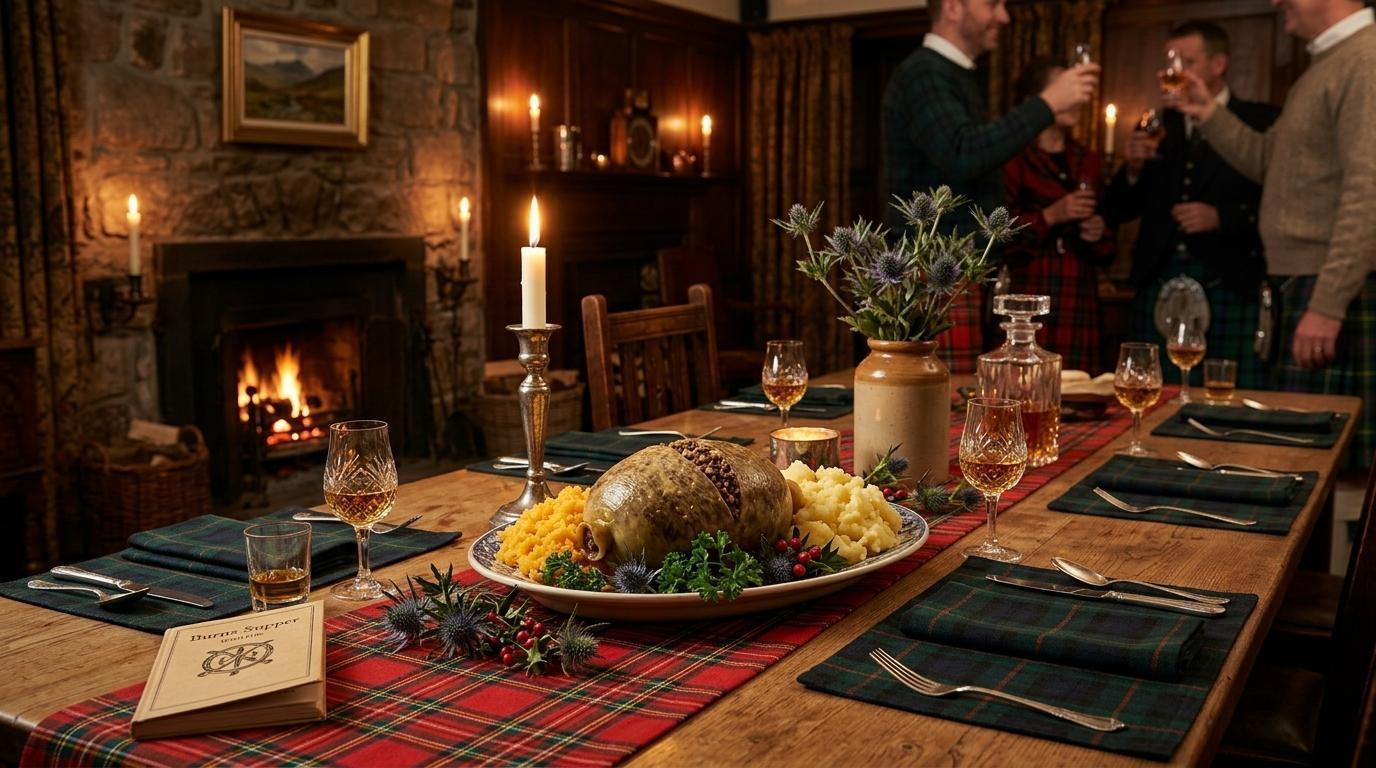
the Robert Burns supper tradition and Scottish literary culture is the defining context for Burns Night. The site's calendar target is January 25, and common public activity includes haggis suppers, poetry recitations, toasts and music. Burns Night is a cultural supper date, not a public bank holiday.
History of Burns Night
Introduction
Burns Night is observed on or around January 25, the birthday of the Scottish poet Robert Burns. It is marked through Burns suppers, poetry, music, speeches, haggis, and the singing of “Auld Lang Syne.”
The tradition began after Burns's death and developed into a global celebration of Scottish literature, language, identity, and diaspora culture.
Robert Burns
Robert Burns was born in Alloway, Ayrshire, on January 25, 1759.
He wrote in Scots and English and drew on song, farming life, politics, love, humor, religion, and social inequality.
Scots language
Burns helped preserve and elevate Scots in literary culture.
His work also adapted older songs and oral traditions rather than emerging in isolation.
Poems and songs
His best-known works include “Auld Lang Syne,” “To a Mouse,” “Tam o' Shanter,” and “Address to a Haggis.”
He collected and revised songs as well as writing original poetry.
Politics and social criticism
Burns wrote about freedom, class, hypocrisy, war, and human dignity.
His politics were complex and should not be reduced to one modern party or ideology.
Burns's death
Burns died in Dumfries in 1796 at the age of thirty-seven.
His reputation grew rapidly through editions, clubs, monuments, and public commemoration.
The first Burns supper
Friends of Burns held a memorial supper at Burns Cottage in Alloway in 1801.
The gathering originally took place in July because participants used an incorrect birth date.
Moving to January 25
After the correct birth date was established, later suppers were held on January 25.
The date became the standard anniversary.
Burns clubs
Burns clubs formed in Scotland and among emigrant communities.
They preserved poems, organized suppers, raised monuments, and created formal ceremonial traditions.
The piping in of the haggis
A haggis is often carried into the room to the sound of bagpipes.
The ritual gives theatrical form to Burns's poem “Address to a Haggis.”
Address to a Haggis
The poem is recited before the haggis is cut and served.
The performance celebrates Scots language, humor, food, and Burns's literary style.
The Immortal Memory
A formal speech known as the Immortal Memory reflects on Burns's life and work.
The quality of the supper often depends on whether the speech engages critically with the poet rather than repeating clichés.
Toasts and replies
Traditional suppers may include a Toast to the Lassies and a Reply from the Lassies.
Modern organizers increasingly adapt these speeches to avoid sexist stereotypes and include different genders and relationships.
Auld Lang Syne
The evening commonly ends with participants joining hands and singing “Auld Lang Syne.”
The song became internationally associated with friendship, memory, and New Year celebrations.
Food and drink
Menus often feature haggis, neeps, tatties, soup, dessert, and whisky.
Vegetarian, alcohol-free, and locally adapted versions are now common.
Scottish diaspora
Burns Night spread across the British Empire and through Scottish migration.
It is now observed by clubs, schools, universities, cultural societies, and families around the world.
Historical timeline
January 25, 1759: Robert Burns is born in Alloway.
1786: The Kilmarnock edition brings Burns wide recognition.
1796: Burns dies in Dumfries.
1801: Friends hold the first memorial supper.
Early nineteenth century: The event moves to January 25.
Nineteenth century: Burns clubs and diaspora suppers expand.
Twentieth century: Radio, education, and tourism broaden participation.
Today: Burns Night is celebrated internationally.
Burns Night today
Events range from formal dinners to school programs, poetry readings, concerts, family meals, and informal community gatherings.
The strongest observances celebrate Burns while engaging honestly with his language, politics, contradictions, literary sources, and changing relevance.
Sources and further reading
- Robert Burns World Federation, Burns Supper
- National Trust for Scotland, Robert Burns Birthplace Museum
- National Library of Scotland, Robert Burns
- Scotland.org, Burns Night
- Encyclopaedia Britannica, Robert Burns
- Poetry Foundation, Robert Burns
- University of Glasgow, Robert Burns Collections
- University of Glasgow, Editing Robert Burns for the 21st Century
Traditions
Historical focus: the Robert Burns supper tradition and Scottish literary culture.
Cluster context: United Kingdom and Ireland.
haggis suppers, poetry recitations, toasts and music.
How It Is Celebrated
haggis suppers, poetry recitations, toasts and music are associated with Burns Night. They reflect the Robert Burns supper tradition and Scottish literary culture. Burns Night is a cultural supper date, not a public bank holiday. Closure rules, school programs, travel patterns, and ceremony schedules depend on the responsible authority.
Interesting Facts
- Date focus: January 25.
- Burns Night is a cultural supper date, not a public bank holiday.
- Primary context: the Robert Burns supper tradition and Scottish literary culture.
- Observed cluster: United Kingdom and Ireland.
- Burns Night authorities may publish additional observed-day or event details.
Related Holiday Guides
Christmas guide → Christmas GuideA clear overview of Christmas history, dates, symbols and traditions.→
Christmas TraditionsExplore trees, gifts, meals, carols and family rituals.→
Christmas HistoryLearn how Christmas developed through religious and cultural history.→
Christmas Around the WorldSee how Christmas customs vary across countries and communities.→
Christmas GuideA clear overview of Christmas history, dates, symbols and traditions.→
Christmas TraditionsExplore trees, gifts, meals, carols and family rituals.→
Christmas HistoryLearn how Christmas developed through religious and cultural history.→
Christmas Around the WorldSee how Christmas customs vary across countries and communities.→Questions
Burns Night FAQ
Clear answers about the date, countdown target and seasonal context.
When is Burns Night?
Burns Night uses January 25 for this countdown.
What is Burns Night mainly about?
This page focuses on the Robert Burns supper tradition and Scottish literary culture, with common public context including haggis suppers, poetry recitations, toasts and music. This guidance applies specifically to Burns Night.
How is Burns Night different from related countdowns?
Burns Night is a cultural supper date, not a public bank holiday. Its own calendar focus is January 25.
How is Burns Night commonly marked?
Common activity includes haggis suppers, poetry recitations, toasts and music. Burns Night is a cultural supper date, not a public bank holiday.
Why does this page use this date?
January 25 is the stored rule because the page concerns the Robert Burns supper tradition and Scottish literary culture. This guidance applies specifically to Burns Night.