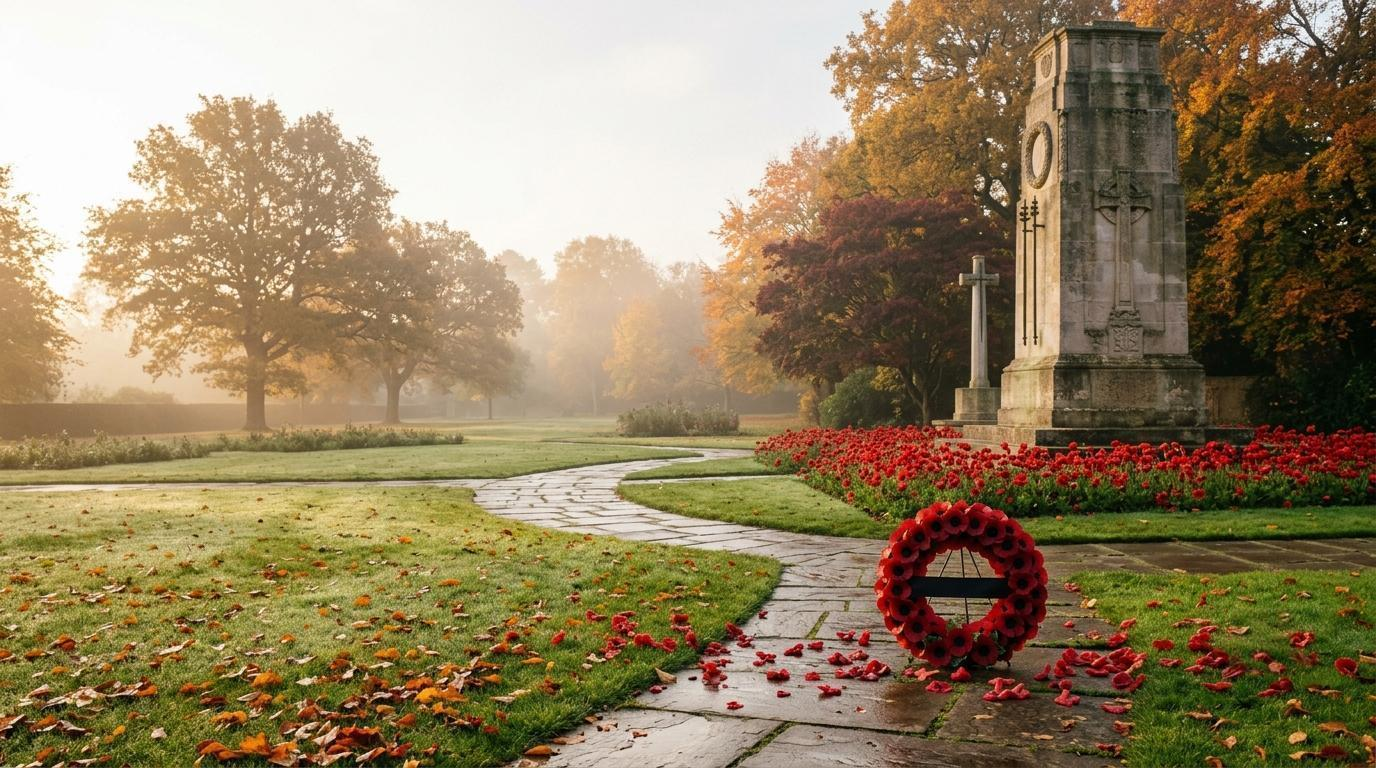
United Kingdom and Ireland Countdown
(v) Scroll to discover more insights
How many days until
Armistice Day UK
Armistice Day UK is tracked through November 11, with the page centered on the First World War armistice anniversary in the UK.
More holidays in November
89Days
00Hours
00Minutes
00Seconds
Quick Facts
About Armistice Day UK
the First World War armistice anniversary in the UK is the defining context for Armistice Day UK. The site's calendar target is November 11, and common public activity includes two-minute silence, poppies and workplace or school remembrance. Armistice Day UK is fixed on November 11, unlike Remembrance Sunday.
History of Armistice Day in the United Kingdom
Introduction
Armistice Day is observed on November 11 to mark the end of major fighting in the First World War. In the United Kingdom, the central act of remembrance is the two-minute silence at 11:00 a.m., recalling the armistice that took effect at the eleventh hour of the eleventh day of the eleventh month in 1918. The date is distinct from Remembrance Sunday, which is held on the second Sunday in November and carries the principal national ceremony at the Cenotaph.
The history of Armistice Day reflects the scale of wartime loss, the need for public mourning, and changing approaches to commemoration. What began as remembrance of the First World War dead expanded after later conflicts to include military and civilian victims of war. The day remains associated with silence, poppies, memorials, and reflection on both sacrifice and peace.
The First World War
The First World War began in 1914 and involved mass armies, industrial weapons, naval warfare, aerial combat, and fighting across Europe, the Middle East, Africa, and other regions. Britain mobilized personnel from across the United Kingdom and the wider empire.
Millions were killed or wounded. Communities experienced loss on a scale that transformed family life, politics, religion, medicine, and public memory.
The armistice of November 11, 1918
Germany and the Allied powers agreed to an armistice that came into effect at 11:00 a.m. on November 11, 1918. The agreement ended major fighting on the Western Front but was not itself the final peace treaty.
Celebrations broke out in Britain and elsewhere, but relief was mixed with grief. Families continued to receive news of deaths, and many service members remained overseas.
The first anniversary in 1919
In 1919, King George V called for a two-minute silence at 11:00 a.m. on the first anniversary of the armistice. The silence allowed people across the country and empire to participate in a shared act without requiring one location or one form of religious belief.
Traffic stopped, workplaces paused, and public gatherings fell silent. The practice became one of the most enduring features of British remembrance.
The Cenotaph
A temporary Cenotaph designed by Edwin Lutyens was erected in Whitehall for the 1919 Peace Day events. Its simple form became a powerful focus for mourning.
Public response led to the construction of a permanent stone Cenotaph, unveiled in 1920. The monument does not contain bodies; its name means an empty tomb, allowing it to represent the dead whose graves were overseas or unknown.
The Unknown Warrior
On November 11, 1920, the remains of an unidentified British serviceman were buried in Westminster Abbey. The Unknown Warrior represented the many dead whose bodies had not been identified or returned to their families.
The burial and the unveiling of the permanent Cenotaph created a powerful national ritual. Large crowds lined the route, and families could imagine that the unknown grave might represent their own missing relative.
Why bodies were not repatriated
British policy generally buried the war dead near where they had fallen rather than returning bodies to Britain. The Imperial War Graves Commission created cemeteries and memorials based on principles of uniform commemoration.
This policy meant that many families had no nearby grave. Local war memorials, the Cenotaph, and the Unknown Warrior therefore became especially important places of symbolic mourning.
The poppy
The red poppy became associated with remembrance through the imagery of flowers growing in disturbed battlefield soil and the influence of the poem “In Flanders Fields.” Veterans’ organizations adopted artificial poppies to raise funds and commemorate the dead.
In Britain, the Royal British Legion’s Poppy Appeal began in the early 1920s. The poppy became a widely recognized symbol, although people may interpret or choose to wear it in different ways.
Armistice Day between the wars
During the 1920s and 1930s, November 11 was marked by silence, religious services, wreath-laying, broadcasts, and ceremonies at memorials. The day carried both patriotic and pacifist meanings.
Some people emphasized military sacrifice and national unity, while others treated the armistice as a warning against future war. These interpretations often existed together.
The Second World War and the shift to Sunday
During the Second World War, large weekday gatherings and public interruption became less practical. Commemoration moved toward the nearest Sunday.
After 1945, the government established Remembrance Sunday as the principal national occasion for honoring the dead of both world wars. Armistice Day on November 11 nevertheless continued, especially through the silence.
Armistice Day and Remembrance Sunday
The two observances are related but not identical. Armistice Day always falls on November 11 and preserves the exact anniversary of the 1918 ceasefire. Remembrance Sunday falls on the second Sunday in November and is the setting for the major national ceremony.
Some years the dates are close together, and communities may hold events on both. The distinction allows historical precision while supporting broad public participation.
The two-minute silence
The silence remains the central national practice. At 11:00 a.m., people may pause in workplaces, schools, shops, transport systems, military establishments, and public spaces.
Silence creates room for private reflection within a collective act. Participants may think about relatives, military personnel, civilians, peace, or the consequences of conflict.
From the First World War to later conflicts
British remembrance expanded after the Second World War to include those who died in later wars and military operations. Ceremonies may also recognize civilians affected by conflict and terrorism.
This broader meaning does not erase the date’s First World War origins. The armistice remains the historical foundation of November 11.
Commonwealth remembrance
Britain’s wartime forces included personnel from across the empire and Commonwealth. Soldiers, sailors, air personnel, laborers, medical staff, and civilians came from South Asia, Africa, the Caribbean, Canada, Australia, New Zealand, and many other places.
Modern remembrance increasingly addresses contributions that were previously minimized. It also examines colonial inequality, discrimination, and the varied experiences of people who served under imperial rule.
Women and remembrance
Women served as nurses, factory workers, agricultural workers, clerks, drivers, intelligence staff, and in many other wartime roles. They also carried much of the burden of family care and bereavement.
Women organized fundraising, memorial activity, veterans’ welfare, and peace campaigns. Their participation broadens remembrance beyond the image of the male front-line soldier.
Religion, civic ritual, and inclusion
Armistice ceremonies often include Christian prayers and hymns because of Britain’s historical institutions. Modern events may also involve representatives of other faiths and people with no religious affiliation.
The silence is especially inclusive because it does not prescribe a single belief. It allows participants to join a shared civic act while interpreting remembrance personally.
Debate about remembrance
Public debate sometimes concerns whether ceremonies glorify war, whether poppy wearing is treated as compulsory, or whether enough attention is paid to peace and civilian suffering.
These debates are part of the history of remembrance. Commemoration can honor sacrifice without presenting war as desirable or avoiding difficult questions about policy and responsibility.
Historical timeline
1914: Britain enters the First World War.
November 11, 1918: The armistice ends major fighting on the Western Front.
November 11, 1919: The first anniversary is marked by a national two-minute silence.
1919: A temporary Cenotaph becomes the focus of Peace Day commemoration.
November 11, 1920: The permanent Cenotaph is unveiled and the Unknown Warrior is buried in Westminster Abbey.
Early 1920s: The Poppy Appeal becomes a major feature of remembrance.
1920s–1930s: Armistice Day develops through silence, services, broadcasts, and memorial ceremonies.
1939–1945: Wartime conditions shift the main national observance toward Sunday.
After 1945: Remembrance expands to include the dead of both world wars and later conflicts.
1990s onward: Public observance of the November 11 silence experiences renewed attention.
2018: The centenary of the armistice is marked across Britain and internationally.
Today: Armistice Day remains fixed on November 11, distinct from but connected with Remembrance Sunday.
Armistice Day today
Armistice Day continues through the two-minute silence, wreath-laying, school programs, military ceremonies, and local services. Its fixed date keeps public memory connected to the precise moment when fighting ceased in 1918.
The observance is not only about the past. It asks how societies remember loss, support those affected by war, and preserve the hope for peace that shaped the earliest armistice commemorations.
Sources and further reading
- GOV.UK, Remembrance Day
- The Royal Family, Remembrance Events
- Imperial War Museums, Why Do We Have a Two-Minute Silence?
- Imperial War Museums, What Is the Cenotaph?
- Westminster Abbey, The Unknown Warrior
- Royal British Legion, About Remembrance
- Commonwealth War Graves Commission, Commemoration
- National Army Museum, Armistice Day
- UK Parliament, Armistice and Remembrance
- British Library, Remembrance and Memorials
Traditions
Historical focus: the First World War armistice anniversary in the UK.
Cluster context: United Kingdom and Ireland.
two-minute silence, poppies and workplace or school remembrance.
How It Is Celebrated
two-minute silence, poppies and workplace or school remembrance are associated with Armistice Day UK. They reflect the First World War armistice anniversary in the UK. Armistice Day UK is fixed on November 11, unlike Remembrance Sunday. Closure rules, school programs, travel patterns, and ceremony schedules depend on the responsible authority.
Interesting Facts
- Date focus: November 11.
- Armistice Day UK is fixed on November 11, unlike Remembrance Sunday.
- Primary context: the First World War armistice anniversary in the UK.
- Observed cluster: United Kingdom and Ireland.
- Armistice Day UK authorities may publish additional observed-day or event details.
Related Holiday Guides
Christmas guide → Christmas GuideA clear overview of Christmas history, dates, symbols and traditions.→
Christmas TraditionsExplore trees, gifts, meals, carols and family rituals.→
Christmas HistoryLearn how Christmas developed through religious and cultural history.→
Christmas Around the WorldSee how Christmas customs vary across countries and communities.→
Christmas GuideA clear overview of Christmas history, dates, symbols and traditions.→
Christmas TraditionsExplore trees, gifts, meals, carols and family rituals.→
Christmas HistoryLearn how Christmas developed through religious and cultural history.→
Christmas Around the WorldSee how Christmas customs vary across countries and communities.→Questions
Armistice Day UK FAQ
Clear answers about the date, countdown target and seasonal context.
When is Armistice Day UK?
Armistice Day UK uses November 11 for this countdown.
What is Armistice Day UK mainly about?
This page focuses on the First World War armistice anniversary in the UK, with common public context including two-minute silence, poppies and workplace or school remembrance. This guidance applies specifically to Armistice Day UK.
How is Armistice Day UK different from related countdowns?
Armistice Day UK is fixed on November 11, unlike Remembrance Sunday. Its own calendar focus is November 11.
How is Armistice Day UK commonly marked?
Common activity includes two-minute silence, poppies and workplace or school remembrance. Armistice Day UK is fixed on November 11, unlike Remembrance Sunday.
Why does this page use this date?
November 11 is the stored rule because the page concerns the First World War armistice anniversary in the UK. This guidance applies specifically to Armistice Day UK.