United Kingdom and Ireland Countdown
(v) Scroll to discover more insights
How many days until
Battle of Britain Day
Battle of Britain Day is tracked through September 15, with the page centered on the air campaign anniversary from the Second World War.
More holidays in September
32Days
00Hours
00Minutes
00Seconds
Quick Facts
About Battle of Britain Day
the air campaign anniversary from the Second World War is the defining context for Battle of Britain Day. The site's calendar target is September 15, and common public activity includes RAF remembrance, history education and memorial services. Battle of Britain Day is a wartime anniversary, not a general remembrance template.
History of Battle of Britain Day
Introduction
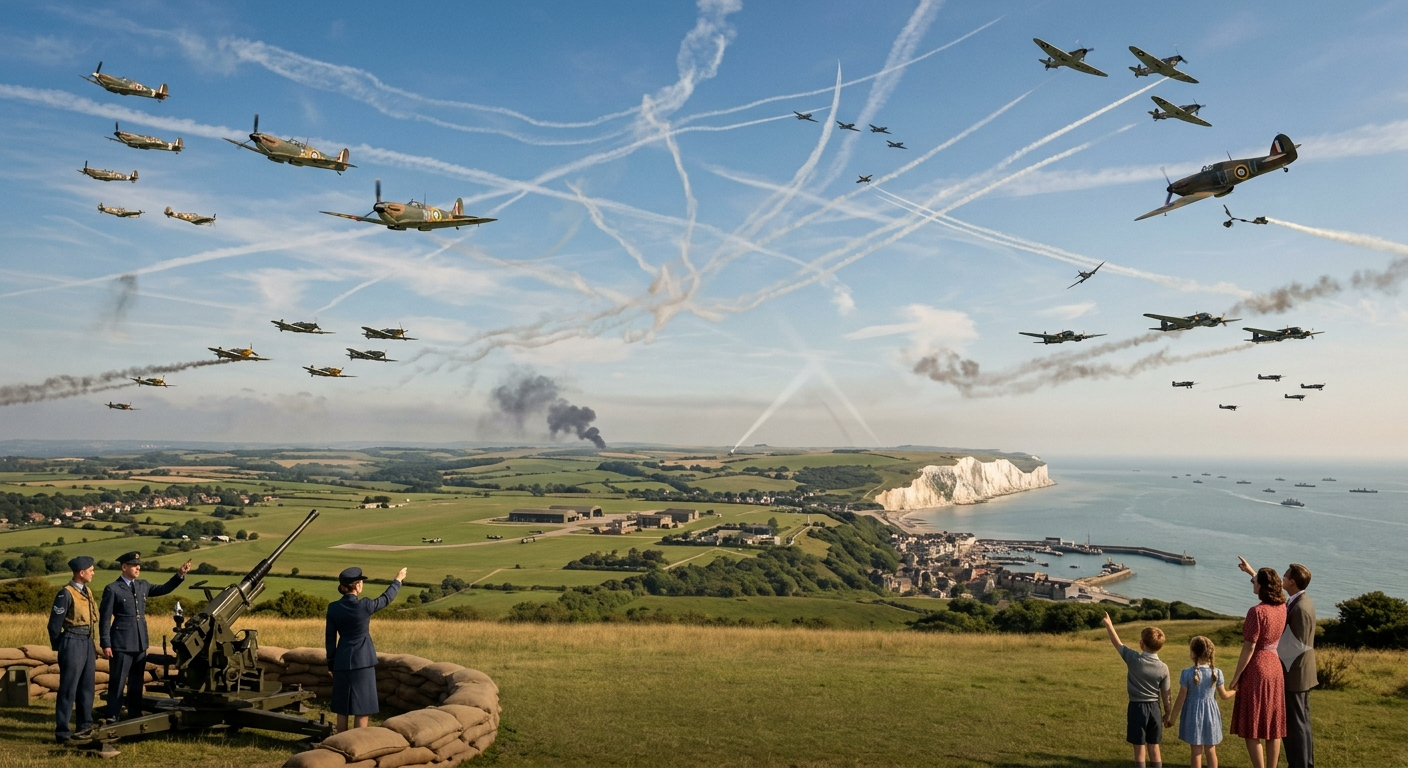
Battle of Britain Day is observed in the United Kingdom on September 15. It commemorates the major air battles fought over southern England on September 15, 1940, during the wider Battle of Britain.
The day is not a statutory public holiday. It is a military and national remembrance associated with the Royal Air Force, Allied aircrew, ground personnel, civilians, and the defence of the United Kingdom against Nazi Germany during the Second World War.
Europe at war
Germany invaded Poland in September 1939, leading Britain and France to declare war. During spring 1940, German forces defeated or occupied Denmark, Norway, the Netherlands, Belgium, Luxembourg, and France.
The evacuation from Dunkirk saved large numbers of Allied troops, but Britain faced the possibility of invasion while much of Western Europe remained under Nazi control.
Operation Sea Lion
Adolf Hitler ordered preparations for an invasion of Britain under the code name Operation Sea Lion.
German planners needed air superiority over the English Channel and southern Britain before a major amphibious landing could be attempted with acceptable risk.
The Luftwaffe and Fighter Command
The German Luftwaffe had experience from campaigns in Poland, Scandinavia, and Western Europe. It deployed fighters, dive bombers, and medium bombers from bases across occupied Europe.
RAF Fighter Command defended Britain through numbered groups, sector stations, squadrons, radar, observers, communications, maintenance, and centralized control.
The Dowding system
Air Chief Marshal Hugh Dowding oversaw an integrated defensive system that combined radar information, the Royal Observer Corps, filter rooms, operations rooms, radio control, and fighter airfields.
The system allowed commanders to direct limited fighter resources where they were most needed instead of keeping aircraft continuously airborne.
Radar and Chain Home
The Chain Home radar network detected approaching formations at long range.
Radar did not work alone. Human observers, telephone operators, plotters, controllers, engineers, and intelligence staff converted signals into usable warnings.
The Few and the many
Winston Churchill's phrase about the Few became closely associated with fighter pilots.
Pilots were essential, but the battle also depended on mechanics, armourers, radar operators, plotters, factory workers, anti-aircraft crews, firefighters, medical teams, and civilians.
International aircrew
Fighter Command included pilots from Poland, Czechoslovakia, Canada, New Zealand, Australia, South Africa, Belgium, France, Ireland, the United States, and other countries.
Polish and Czechoslovak pilots brought valuable combat experience, although language, rank, and administrative barriers initially limited how quickly some could be deployed.
Women and the Women's Auxiliary Air Force
Women in the Women's Auxiliary Air Force served as radar operators, plotters, communications workers, drivers, clerks, and balloon personnel.
Their work was operationally critical even though women were not then permitted to serve as RAF fighter pilots.
Phases of the battle
The Battle of Britain unfolded in phases rather than as one continuous engagement. Early fighting focused on Channel shipping, followed by attacks on radar stations and airfields.
German strategy later shifted toward London and other cities, reducing pressure on some Fighter Command bases while beginning the sustained bombing known as the Blitz.
Adlertag
On August 13, 1940, the Luftwaffe launched Adlertag, or Eagle Day, as part of a major attempt to destroy Fighter Command.
German attacks caused damage but failed to eliminate Britain's fighter defence or command system.
September 7 and the bombing of London
The Luftwaffe began a large daylight attack on London on September 7.
The shift had political and strategic motives and marked a new phase in which civilians became increasingly exposed to mass bombing.
September 15, 1940
On September 15, German formations launched major raids against London.
Fighter Command committed numerous squadrons, and German losses helped convince Luftwaffe leaders that British fighter strength remained substantial.
Why September 15 became symbolic
September 15 did not end the Battle of Britain, which continued into October.
It became the commemorative date because the day's large engagements demonstrated that the Luftwaffe had not achieved decisive air superiority.
King George VI and the commemoration
King George VI designated September 15 as Battle of Britain Day in 1943.
Annual services developed during the war, and Westminster Abbey became a central location for national remembrance.
Civilian bombing
The battle and the Blitz killed and injured civilians, destroyed homes, disrupted transport, and forced emergency services to work under dangerous conditions.
Remembering air defence should not turn bombing into spectacle or ignore the suffering of people in Britain, Germany, occupied Europe, and later Allied bombing campaigns.
Race, empire, and wartime service
Britain's war effort relied on the resources and people of an empire that denied equal political rights to many colonial subjects.
Commemoration can recognize service from across the Commonwealth while also acknowledging colonial inequality, racism, and the later struggles of veterans.
Aircraft and technology
The Supermarine Spitfire and Hawker Hurricane became famous symbols of the battle.
The Hurricane equipped more squadrons and destroyed many enemy aircraft, while the Spitfire's performance and design made it especially prominent in public memory.
Myth and historical interpretation
Popular memory sometimes presents Britain as standing entirely alone.
The United Kingdom faced grave danger, but it drew on an empire, occupied European pilots, overseas resources, intelligence cooperation, naval power, and industrial production.
The result
The Luftwaffe failed to destroy Fighter Command or secure air superiority.
Operation Sea Lion was postponed and never carried out, though Britain remained under bombing and the wider war continued for nearly five more years.
Additional historical context 1
Battle of Britain memory is shaped by films, memoirs, museums, memorials, aircraft restoration, family archives, and official ceremony. These sources preserve valuable evidence but can privilege fighter combat over civilian survival, industrial labour, colonial resources, and the long strategic context. Historical interpretation improves when it compares operational records with later national mythology.
Battle of Britain memory is shaped by films, memoirs, museums, memorials, aircraft restoration, family archives, and official ceremony. These sources preserve valuable evidence but can privilege fighter combat over civilian survival, industrial labour, colonial resources, and the long strategic context. Historical interpretation improves when it compares operational records with later national mythology.
Additional historical context 2
Battle of Britain memory is shaped by films, memoirs, museums, memorials, aircraft restoration, family archives, and official ceremony. These sources preserve valuable evidence but can privilege fighter combat over civilian survival, industrial labour, colonial resources, and the long strategic context. Historical interpretation improves when it compares operational records with later national mythology.
Battle of Britain memory is shaped by films, memoirs, museums, memorials, aircraft restoration, family archives, and official ceremony. These sources preserve valuable evidence but can privilege fighter combat over civilian survival, industrial labour, colonial resources, and the long strategic context. Historical interpretation improves when it compares operational records with later national mythology.
Additional historical context 3
Battle of Britain memory is shaped by films, memoirs, museums, memorials, aircraft restoration, family archives, and official ceremony. These sources preserve valuable evidence but can privilege fighter combat over civilian survival, industrial labour, colonial resources, and the long strategic context. Historical interpretation improves when it compares operational records with later national mythology.
Battle of Britain memory is shaped by films, memoirs, museums, memorials, aircraft restoration, family archives, and official ceremony. These sources preserve valuable evidence but can privilege fighter combat over civilian survival, industrial labour, colonial resources, and the long strategic context. Historical interpretation improves when it compares operational records with later national mythology.
Additional historical context 4
Battle of Britain memory is shaped by films, memoirs, museums, memorials, aircraft restoration, family archives, and official ceremony. These sources preserve valuable evidence but can privilege fighter combat over civilian survival, industrial labour, colonial resources, and the long strategic context. Historical interpretation improves when it compares operational records with later national mythology.
Battle of Britain memory is shaped by films, memoirs, museums, memorials, aircraft restoration, family archives, and official ceremony. These sources preserve valuable evidence but can privilege fighter combat over civilian survival, industrial labour, colonial resources, and the long strategic context. Historical interpretation improves when it compares operational records with later national mythology.
Historical timeline
September 1939: Britain enters the Second World War after Germany invades Poland.
May–June 1940: Germany defeats France and the Low Countries; Allied troops evacuate Dunkirk.
July 10, 1940: The official RAF historical period for the Battle of Britain begins.
August 13, 1940: The Luftwaffe launches Adlertag.
September 7, 1940: Large-scale bombing of London begins.
September 15, 1940: Major daylight raids are repelled in the battle's best-known engagement.
October 31, 1940: The official RAF period for the Battle of Britain ends.
1943: King George VI designates September 15 as Battle of Britain Day.
1944: The annual national service begins at Westminster Abbey.
Today: The date commemorates aircrew, ground personnel, civilians, and Allied resistance.
Battle of Britain Day today
Services, wreath laying, museum events, flypasts, school programs, and veteran remembrance mark September 15.
The strongest accounts preserve the importance of fighter pilots while including international aircrew, women, ground personnel, civilians, colonial resources, technological systems, and the fact that the wider battle continued beyond September 15.
Sources and further reading
- Royal Air Force, Battle of Britain Day
- Royal Air Force Museum, Battle of Britain
- Imperial War Museums, Battle of Britain
- National Archives, Battle of Britain
- Westminster Abbey, Battle of Britain Service
- Commonwealth War Graves Commission, Battle of Britain
- Royal Observer Corps Association
- Polish History Museum, Polish Pilots in Britain
Traditions
Historical focus: the air campaign anniversary from the Second World War.
Cluster context: United Kingdom and Ireland.
RAF remembrance, history education and memorial services.
How It Is Celebrated
RAF remembrance, history education and memorial services are associated with Battle of Britain Day. They reflect the air campaign anniversary from the Second World War. Battle of Britain Day is a wartime anniversary, not a general remembrance template. Closure rules, school programs, travel patterns, and ceremony schedules depend on the responsible authority.
Interesting Facts
- Date focus: September 15.
- Battle of Britain Day is a wartime anniversary, not a general remembrance template.
- Primary context: the air campaign anniversary from the Second World War.
- Observed cluster: United Kingdom and Ireland.
- Battle of Britain Day authorities may publish additional observed-day or event details.
Related Holiday Guides
Christmas guide → Christmas GuideA clear overview of Christmas history, dates, symbols and traditions.→
Christmas TraditionsExplore trees, gifts, meals, carols and family rituals.→
Christmas HistoryLearn how Christmas developed through religious and cultural history.→
Christmas Around the WorldSee how Christmas customs vary across countries and communities.→
Christmas GuideA clear overview of Christmas history, dates, symbols and traditions.→
Christmas TraditionsExplore trees, gifts, meals, carols and family rituals.→
Christmas HistoryLearn how Christmas developed through religious and cultural history.→
Christmas Around the WorldSee how Christmas customs vary across countries and communities.→Questions
Battle of Britain Day FAQ
Clear answers about the date, countdown target and seasonal context.
When is Battle of Britain Day?
Battle of Britain Day uses September 15 for this countdown.
What is Battle of Britain Day mainly about?
This page focuses on the air campaign anniversary from the Second World War, with common public context including RAF remembrance, history education and memorial services. This guidance applies specifically to Battle of Britain Day.
How is Battle of Britain Day different from related countdowns?
Battle of Britain Day is a wartime anniversary, not a general remembrance template. Its own calendar focus is September 15.
How is Battle of Britain Day commonly marked?
Common activity includes RAF remembrance, history education and memorial services. Battle of Britain Day is a wartime anniversary, not a general remembrance template.
Why does this page use this date?
September 15 is the stored rule because the page concerns the air campaign anniversary from the Second World War. This guidance applies specifically to Battle of Britain Day.