Islamic Holidays Countdown
(v) Scroll to discover more insights
How many days until
Ashura
Ashura is tracked here through 10 Muharram in the mapped Hijri calendar, with the page focused on Sunni and Shia traditions with distinct meanings and sensitivities.
More holidays in June
305Days
00Hours
00Minutes
00Seconds
Quick Facts
About Ashura
Sunni and Shia traditions with distinct meanings and sensitivities is the central subject of Ashura. The 10 Muharram in the mapped Hijri calendar reference places it within Islamic Holidays. Ashura requires careful wording across traditions. It is not simply another New Year observance.
History of Ashura
Introduction
Ashura is observed on the tenth day of Muharram, the first month of the Islamic lunar calendar. The word derives from the Arabic term for ten.
The day has different but overlapping meanings across Muslim communities. For many Sunni Muslims it is associated with voluntary fasting and traditions concerning Moses. For Shia Muslims it is the central day of mourning for Imam Husayn ibn Ali, who was killed at Karbala in 680 CE. Because the calendar is lunar, the Gregorian date changes each year.
Muharram and the sacred months
Muharram is one of the four sacred months recognized in Islamic tradition.
The month begins the Hijri year, but Ashura is not simply an Islamic equivalent of a secular New Year's celebration.
Early fasting traditions
Hadith collections preserve traditions that Muhammad encountered fasting on the tenth of Muharram and encouraged fasting connected with God's deliverance of Moses and the Israelites.
Accounts and legal interpretations differ, and scholars discuss how the practice related to Jewish fasting, Arabian custom, and the later obligation of Ramadan.
Ashura before Ramadan fasting
Some reports indicate that fasting Ashura held a stronger status before Ramadan fasting became obligatory.
In most Sunni legal traditions it later remained recommended rather than mandatory.
The crisis of succession
After Muhammad's death, disputes over leadership shaped the early Muslim community.
Shia Muslims hold that Ali and his descendants possessed a divinely grounded claim to leadership, while Sunni historical traditions developed different understandings of the caliphate.
Muawiya and Yazid
Muawiya established Umayyad rule and designated his son Yazid as successor.
Opponents objected to hereditary succession, Yazid's legitimacy, or both, creating a crisis after Muawiya's death.
Husayn ibn Ali
Husayn was the grandson of Muhammad through Fatimah and Ali.
He refused to pledge allegiance to Yazid and received messages of support from Kufa, leading him to travel from Mecca toward Iraq.
The road to Karbala
Umayyad authorities intercepted Husayn's small group near Karbala.
Negotiations failed, access to water was restricted, and the group faced a much larger force.
October 680 CE
On the tenth of Muharram in 61 AH, Husayn and most of his male companions were killed.
Women and surviving family members were taken captive. The event became one of the defining traumas of Shia history.
Zaynab and memory
Husayn's sister Zaynab bint Ali is remembered for protecting survivors and speaking publicly after the battle.
Her role is central to Shia narratives of witness, courage, and resistance to unjust power.
Mourning rituals
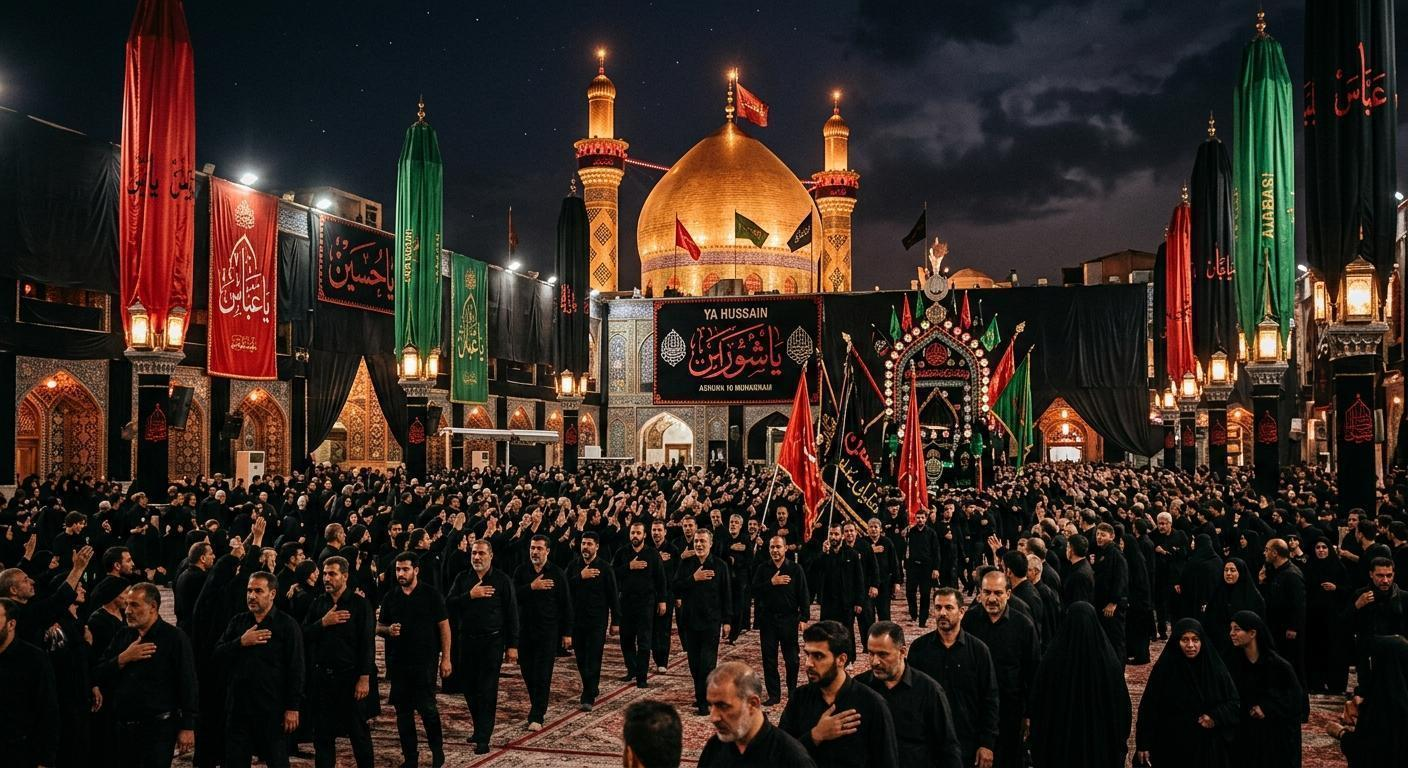
Shia communities hold majalis, sermons, elegies, Quran recitation, processions, passion narratives, and acts of charity.
Practices differ by country, legal school, family, and political history; no single ritual represents all Shia Muslims.
Ta'ziyeh
Iranian traditions developed dramatic performances known as ta'ziyeh that recount the suffering at Karbala.
These performances combine devotion, theater, poetry, music, costume, and community memory.
Self-flagellation debate
Some mourners practice forms of chest beating or bodily mortification.
Many Shia religious authorities discourage practices that cause serious injury or damage the dignity of the observance, and blood donation has been promoted as an alternative in some communities.
Sunni observance
Many Sunni Muslims fast on Ashura and may add the ninth or eleventh of Muharram.
The day may include prayer, charity, remembrance, and study, while the death of Husayn is also respected even where formal mourning differs.
Other regional customs
In parts of North Africa, South Asia, the Caribbean, and elsewhere, Ashura includes foods, children's activities, processions, water distribution, or local devotional forms.
Some customs developed through interaction among Sunni, Shia, Sufi, local, and diasporic traditions.
Ashura and political language
Karbala became a powerful symbol for resistance, martyrdom, tyranny, justice, and moral courage.
Political movements have invoked Husayn for very different causes, so historical writing should distinguish religious memory from later political appropriation.
Sectarian violence
Ashura gatherings have sometimes been targeted by extremist attacks.
Security measures may be necessary, but governments should protect worship without criminalizing communities or turning religious gatherings into partisan instruments.
Public holiday status
Ashura is a public holiday in some countries and not in others.
Even where officially recognized, the number of days, closures, processions, and legal rules vary.
Calendar calculation
Islamic months begin through crescent sighting or accepted calendar calculation.
Different authorities may announce Muharram and Ashura on different civil dates, so one global Gregorian date should not be presented as universally binding.
Additional historical context 1
The material culture of Ashura includes standards, banners, miniature shrines, black clothing, poetry books, water stations, food vessels, and memorial architecture. These objects are not decorative alone; they organize memory, community service, mourning, and public identity. Their meanings vary, and museums should interpret them with community knowledge rather than isolate them as exotic spectacle.
The material culture of Ashura includes standards, banners, miniature shrines, black clothing, poetry books, water stations, food vessels, and memorial architecture. These objects are not decorative alone; they organize memory, community service, mourning, and public identity. Their meanings vary, and museums should interpret them with community knowledge rather than isolate them as exotic spectacle.
Additional historical context 2
The material culture of Ashura includes standards, banners, miniature shrines, black clothing, poetry books, water stations, food vessels, and memorial architecture. These objects are not decorative alone; they organize memory, community service, mourning, and public identity. Their meanings vary, and museums should interpret them with community knowledge rather than isolate them as exotic spectacle.
The material culture of Ashura includes standards, banners, miniature shrines, black clothing, poetry books, water stations, food vessels, and memorial architecture. These objects are not decorative alone; they organize memory, community service, mourning, and public identity. Their meanings vary, and museums should interpret them with community knowledge rather than isolate them as exotic spectacle.
Additional historical context 3
The material culture of Ashura includes standards, banners, miniature shrines, black clothing, poetry books, water stations, food vessels, and memorial architecture. These objects are not decorative alone; they organize memory, community service, mourning, and public identity. Their meanings vary, and museums should interpret them with community knowledge rather than isolate them as exotic spectacle.
The material culture of Ashura includes standards, banners, miniature shrines, black clothing, poetry books, water stations, food vessels, and memorial architecture. These objects are not decorative alone; they organize memory, community service, mourning, and public identity. Their meanings vary, and museums should interpret them with community knowledge rather than isolate them as exotic spectacle.
Additional historical context 4
The material culture of Ashura includes standards, banners, miniature shrines, black clothing, poetry books, water stations, food vessels, and memorial architecture. These objects are not decorative alone; they organize memory, community service, mourning, and public identity. Their meanings vary, and museums should interpret them with community knowledge rather than isolate them as exotic spectacle.
The material culture of Ashura includes standards, banners, miniature shrines, black clothing, poetry books, water stations, food vessels, and memorial architecture. These objects are not decorative alone; they organize memory, community service, mourning, and public identity. Their meanings vary, and museums should interpret them with community knowledge rather than isolate them as exotic spectacle.
Additional historical context 5
The material culture of Ashura includes standards, banners, miniature shrines, black clothing, poetry books, water stations, food vessels, and memorial architecture. These objects are not decorative alone; they organize memory, community service, mourning, and public identity. Their meanings vary, and museums should interpret them with community knowledge rather than isolate them as exotic spectacle.
The material culture of Ashura includes standards, banners, miniature shrines, black clothing, poetry books, water stations, food vessels, and memorial architecture. These objects are not decorative alone; they organize memory, community service, mourning, and public identity. Their meanings vary, and museums should interpret them with community knowledge rather than isolate them as exotic spectacle.
Additional historical context 6
The material culture of Ashura includes standards, banners, miniature shrines, black clothing, poetry books, water stations, food vessels, and memorial architecture. These objects are not decorative alone; they organize memory, community service, mourning, and public identity. Their meanings vary, and museums should interpret them with community knowledge rather than isolate them as exotic spectacle.
The material culture of Ashura includes standards, banners, miniature shrines, black clothing, poetry books, water stations, food vessels, and memorial architecture. These objects are not decorative alone; they organize memory, community service, mourning, and public identity. Their meanings vary, and museums should interpret them with community knowledge rather than isolate them as exotic spectacle.
Historical timeline
622 CE: The Hijra becomes the reference point for the Islamic calendar.
656 CE: Ali becomes caliph amid civil conflict.
661 CE: Muawiya establishes Umayyad rule.
680 CE: Husayn is killed at Karbala on 10 Muharram 61 AH.
Eighth–tenth centuries: Mourning poetry, pilgrimage, and sectarian memory expand.
Safavid period: Public Shia ritual and Karbala commemoration become central in Iran.
Nineteenth century: Ta'ziyeh performance reaches major public prominence.
Twentieth century: Ashura symbolism influences political and anti-colonial movements.
Twenty-first century: Global diaspora observance expands amid security and health debates.
Today: Ashura combines fasting, mourning, charity, memory, and diverse regional practice.
Ashura today
Muslims may fast, attend mourning assemblies, hear sermons, recite poetry, distribute water or food, give charity, visit shrines, or spend the day in prayer and reflection.
The strongest descriptions distinguish Sunni and Shia traditions without portraying either as monolithic, explain the lunar date, center the history of Karbala, and avoid sensationalizing mourning practices.
Sources and further reading
Traditions
It is not simply another New Year observance.
Islamic Holidays authorities or communities may publish specific timing.
Sunni and Shia traditions with distinct meanings and sensitivities.
How It Is Celebrated
Sunni and Shia traditions with distinct meanings and sensitivities guides the observance of Ashura. It is not simply another New Year observance. Ashura requires careful wording across traditions. Worship, study, family practice, charity, processions, meals, fasting, candles, or public events depend on the community involved.
Interesting Facts
- Date focus: 10 Muharram in the mapped Hijri calendar.
- It is not simply another New Year observance.
- Ashura requires careful wording across traditions.
- Religious group: Islamic Holidays.
- Ashura observance can vary by community and calendar practice.
Related Holiday Guides
Christmas guide → Christmas GuideA clear overview of Christmas history, dates, symbols and traditions.→
Christmas TraditionsExplore trees, gifts, meals, carols and family rituals.→
Christmas HistoryLearn how Christmas developed through religious and cultural history.→
Christmas Around the WorldSee how Christmas customs vary across countries and communities.→
Christmas GuideA clear overview of Christmas history, dates, symbols and traditions.→
Christmas TraditionsExplore trees, gifts, meals, carols and family rituals.→
Christmas HistoryLearn how Christmas developed through religious and cultural history.→
Christmas Around the WorldSee how Christmas customs vary across countries and communities.→Questions
Ashura FAQ
Clear answers about the date, countdown target and seasonal context.
When is Ashura?
Ashura uses annual year-map 10 Muharram date for this countdown, with local religious calendars sometimes adding more detail.
What is the main focus of Ashura?
The page focuses on Sunni and Shia traditions with distinct meanings and sensitivities. This guidance applies specifically to Ashura.
How is Ashura different from nearby observances?
Ashura requires careful wording across traditions.
Which calendar detail matters for Ashura?
10 Muharram in the mapped Hijri calendar is the site's reference. It is not simply another New Year observance. This guidance applies specifically to Ashura.
Is Ashura observed the same way everywhere?
Ashura requires careful wording across traditions. Practices may also differ in language, liturgy, public status, and household observance.