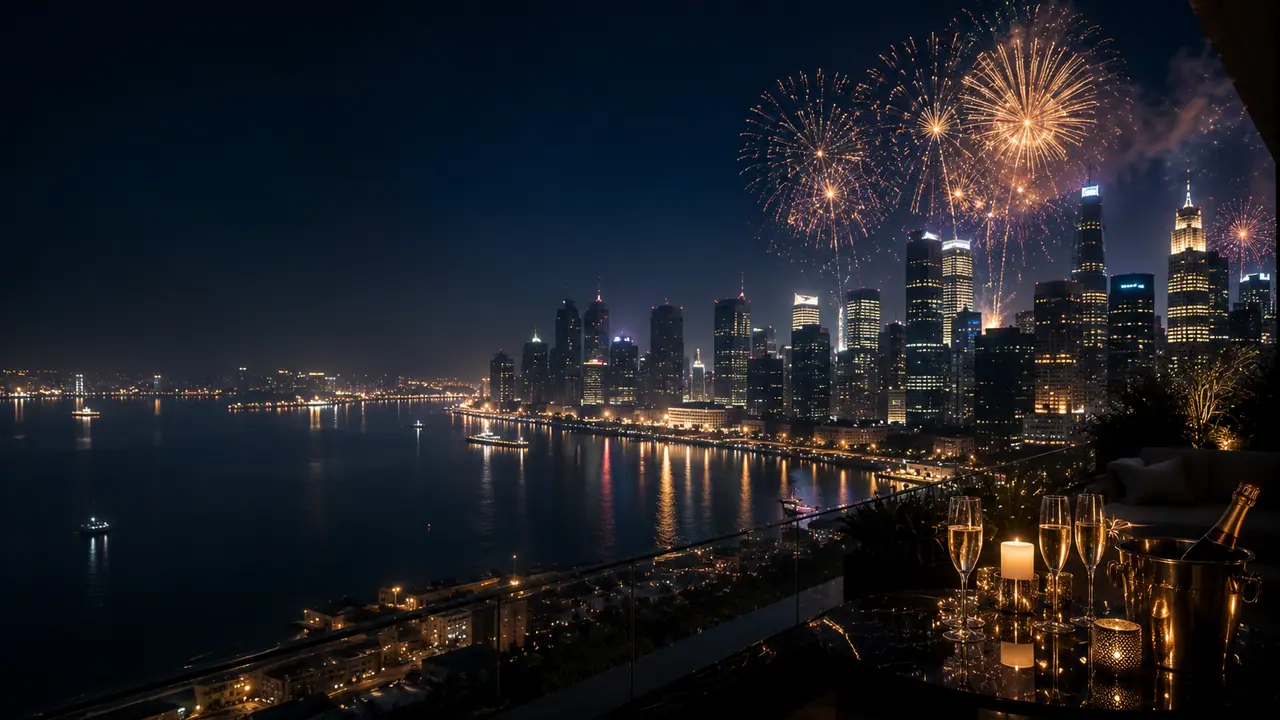
New Year's Eve Countdown
(v) Scroll to discover more insights
How many days until
New Year's Eve
New Year's Eve is observed on December 31, the final night of the Gregorian calendar year. This countdown targets the fixed December 31 date and rolls forward automatically after the celebration passes.
More holidays in December
139Days
00Hours
00Minutes
00Seconds
Quick Facts
About New Year's Eve
New Year's Eve is a global year-end celebration associated with countdowns, fireworks, parties, reflection, resolutions, midnight gatherings, and watching the calendar turn to January 1. The page follows the Gregorian civil calendar while recognizing that many cultures also observe different new year dates.
History of New Year's Eve
Introduction
New Year's Eve is observed on December 31 in societies using the Gregorian civil calendar. It is the final day of the year and leads into New Year's Day on January 1.
The evening combines public countdowns, parties, worship, family meals, fireworks, television, reflection, and resolutions. It is global in visibility but not universal in cultural meaning because many communities also maintain religious, lunar, agricultural, or regional new-year calendars.
Ancient new-year traditions
Ancient societies marked new years at different seasonal points, including spring planting, harvest, solstices, royal accessions, or religious festivals.
There was no single ancient New Year's Eve shared by all cultures.
The Roman calendar
Early Roman calendars changed over time and did not always begin in January.
January became increasingly important because it was associated with Janus, the deity of doorways, beginnings, and transitions.
The Julian calendar
Julius Caesar introduced calendar reform that took effect in 45 BCE.
The Julian calendar placed January 1 at the beginning of the civil year, although local and religious practices continued to vary.
Medieval Christian calendars
Medieval European societies used several dates to begin the year, including Christmas, March 25, and Easter-related dates.
January 1 remained a feast in the church calendar but was not always the official start of the legal year.
The Gregorian reform
Pope Gregory XIII introduced the Gregorian calendar in 1582 to correct accumulated drift in the Julian calendar.
Countries adopted the reform at different times, so December 31 became a shared civil year-end gradually rather than all at once.
Watch-night traditions
Christian communities developed services of prayer and reflection on the final night of the year.
Methodist watch-night services are especially associated with John Wesley and covenant renewal, though other denominations have their own forms.
Hogmanay
Scotland developed strong New Year's Eve and New Year's Day customs known as Hogmanay.
Traditions include first-footing, singing, fire ceremonies, hospitality, and regional foods.
Auld Lang Syne
“Auld Lang Syne,” associated with Robert Burns, became an international song of remembrance and friendship at the turn of the year.
The modern singing tradition spread through Scottish networks, public gatherings, radio, and popular culture.
Public clocks and synchronized time
Mechanical clocks, railways, telegraphy, radio, and standardized time zones made a precise midnight countdown possible.
Earlier celebrations often focused more broadly on the night or dawn than on one universally synchronized second.
Times Square
New York's Times Square celebration began in the early twentieth century.
The illuminated ball drop, first held in 1907, became one of the world's best-known televised countdown traditions.
Fireworks
Fireworks symbolize celebration, light, sound, and the driving away of misfortune in many cultures.
Large displays create concerns involving burns, crowd safety, pollution, noise, wildlife, pets, and wildfire.
Television and global countdowns
Radio and television turned local celebrations into national broadcasts.
Satellite and internet coverage now follow midnight across time zones, creating a rolling global spectacle.
New Year's resolutions
People use the year-end to evaluate habits and set goals.
Modern resolutions often focus on health, work, money, relationships, learning, or public service, though the practice has older religious and moral precedents.
Food and good-luck customs
Communities eat foods symbolizing wealth, longevity, fertility, or good fortune.
Examples differ widely and should not be presented as one universal global menu.
Alcohol and road safety
Alcohol is common at many parties but is not essential to the observance.
Public-health campaigns emphasize designated drivers, public transport, consent, emergency planning, and alternatives for people who do not drink.
Public-holiday status
December 31 is a public holiday or shortened workday in some jurisdictions.
In many others, only January 1 is the statutory holiday.
Different new years
Jewish, Islamic, Chinese, Korean, Persian, Hindu, Buddhist, Indigenous, and other calendars place new-year observances on different dates.
Calling December 31 the world's only New Year's Eve erases this diversity.
Historical timeline
Ancient period: Societies mark new years at different seasonal and religious points.
45 BCE: The Julian calendar places January 1 at the start of the civil year.
Medieval period: European legal years begin on several different dates.
1582: Gregorian calendar reform begins.
Eighteenth–nineteenth centuries: Watch-night, Hogmanay, and public urban celebrations expand.
1907: The first Times Square ball drop is held.
Twentieth century: Radio and television standardize national countdowns.
Twenty-first century: Digital streaming creates global, time-zone-by-time-zone celebration.
Today: December 31 closes the Gregorian civil year.
New Year's Eve today
People attend concerts, worship services, fireworks, family meals, city countdowns, or quiet gatherings and may reflect on the year that has passed.
The strongest descriptions recognize calendar diversity, avoid presenting alcohol or fireworks as mandatory, and connect public celebration with safety, accessibility, labor, environmental responsibility, and respect for people who experience the night differently.
Sources and further reading
- Encyclopaedia Britannica, New Year Festival
- Encyclopaedia Britannica, Gregorian Calendar
- Encyclopaedia Britannica, Julian Calendar
- Times Square Alliance, New Year's Eve History
- National Library of Scotland, Auld Lang Syne
- Scotland.org, Hogmanay
- Time and Date, New Year's Eve
- World Health Organization, Alcohol
Traditions
Year-end reflection
Making resolutions
Midnight countdowns
How It Is Celebrated
People celebrate New Year's Eve at home, in public squares, at restaurants, on waterfronts, and through broadcast events. Some prefer quiet reflection, while others gather for large midnight celebrations. Local rules can affect fireworks, alcohol service, transport, crowd access, and the timing of public events.
Interesting Facts
- New Year's Eve is fixed on December 31.
- It precedes New Year's Day on January 1.
- Fireworks and countdowns are common worldwide.
- Local time zones create many midnight moments around the globe.
- The countdown resets to the next December 31.
Related Holiday Guides
New Year guide →
Questions
New Year's Eve FAQ
Clear answers about the date, countdown target and seasonal context.
When is New Year's Eve?
New Year's Eve is December 31 every year.
What does this countdown target?
It targets the start of December 31 as the holiday date.
Is New Year's Eve celebrated everywhere the same way?
No. Customs vary by country, city, family, and culture.
Is New Year's Eve the same as New Year's Day?
No. New Year's Eve is December 31, while New Year's Day is January 1.
Does the countdown update yearly?
Yes. It rolls forward to the next December 31.