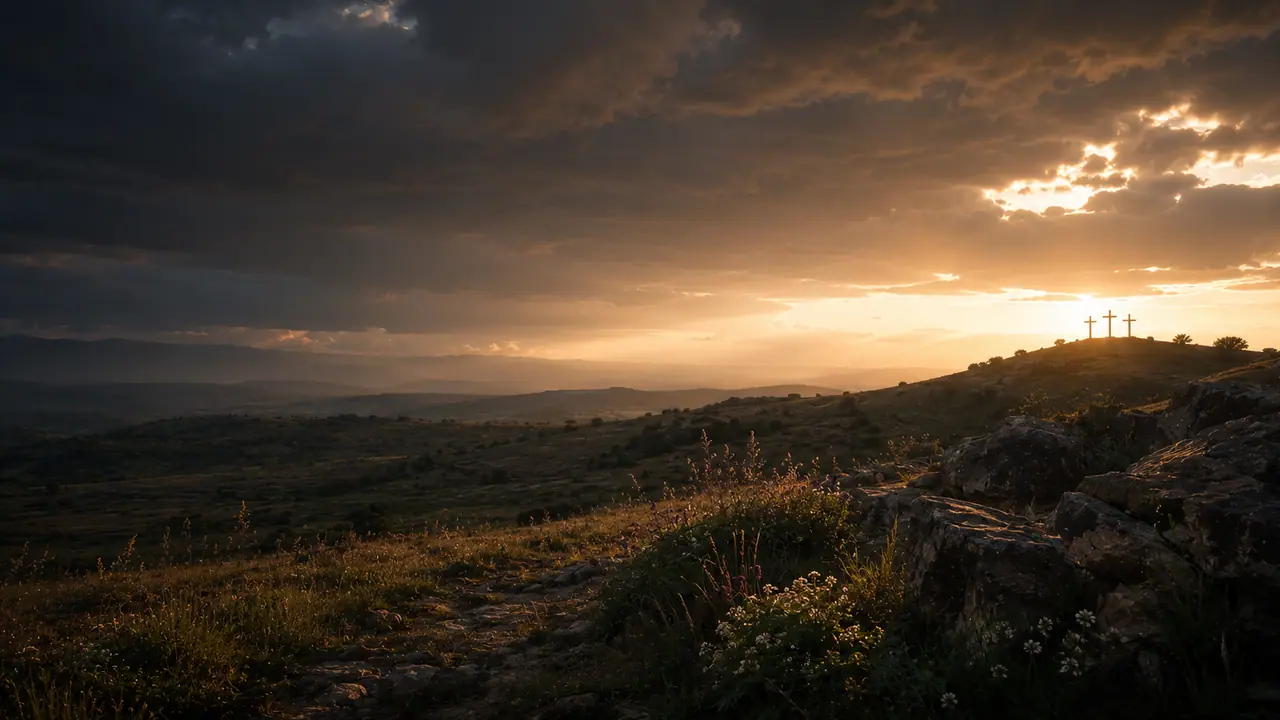
Good Friday Countdown
(v) Scroll to discover more insights
How many days until
Good Friday
Good Friday is observed on the Friday before Easter Sunday. This countdown calculates it as two days before Western Easter and updates automatically each year.
More holidays in April
224Days
00Hours
00Minutes
00Seconds
Quick Facts
About Good Friday
Good Friday is a solemn Christian observance remembering the crucifixion of Jesus. It is often marked with prayer, fasting, quiet services, scripture readings, and reflection rather than celebration.
History of Good Friday
Introduction
Good Friday is the Christian commemoration of the crucifixion and death of Jesus. It falls on the Friday before Easter and belongs to Holy Week and the Easter Triduum. The day is marked by scripture, prayer, silence, fasting, veneration of the cross, processions, music, and restrained worship.
Its history developed gradually from early Christian remembrance of Jesus’ Passion. Biblical texts, pilgrimage in Jerusalem, liturgical calendars, medieval devotion, Reformation debates, colonial expansion, and modern public-holiday law all shaped its observance.
The crucifixion in early Christian memory
The canonical Gospels place Jesus’ death in Jerusalem under Roman authority near Passover. Their narratives differ in chronology and detail, but all present the crucifixion as central to the story of Jesus.
Early Christian letters show that the cross already held theological importance before the Gospels reached final form. Historical study examines texts and Roman execution practices, while Christian worship interprets the event through faith.
Passover and the Passion
The Passion narratives are linked to Jewish Passover, but Christian Good Friday and Jewish Passover are distinct observances. Christian interpretation developed within Jewish scripture and first-century Jewish life, yet later Christian liturgies followed their own calendars and theology.
Responsible history avoids using Good Friday to blame Jewish people collectively for Jesus’ death, a claim that contributed to centuries of antisemitism.
Friday in the weekly Christian rhythm
Early Christians associated Friday with fasting and remembrance of the crucifixion. Weekly practice helped establish a recurring pattern before one annual Good Friday liturgy became universal.
Local churches differed in fasting rules, readings, and terminology.
Jerusalem and the growth of Holy Week
By late antiquity, Christians in Jerusalem followed a detailed sequence of worship at places associated with Jesus’ final days. Pilgrims described readings, processions, vigils, and prayers that connected sacred narrative with landscape.
These practices influenced other churches, though they were adapted rather than copied without change.
The name Good Friday
The English phrase may use good in an older sense associated with holy or pious observance. Other languages use names meaning Holy Friday, Great Friday, or Friday of the Passion.
The name does not imply that suffering and execution were good in themselves; Christian usage refers to the salvific meaning assigned to the event.
Medieval liturgy
Medieval Western churches developed solemn rites involving scripture, intercession, the cross, and communion from elements consecrated earlier. Churches were stripped of decoration, bells could fall silent, and worship emphasized grief and contemplation.
Practice varied by diocese, monastery, and period.
Veneration of the cross
Veneration of the cross became a major Good Friday practice. Worshippers might approach, bow, kneel, touch, or kiss a cross while prayers or chants were offered.
Christians distinguish veneration of the symbol from worship of the material object, though reformers later debated the practice intensely.
The solemn intercessions
Extended prayers developed for the church, rulers, those in need, and the wider world. Some historic formulations about Jews reflected Christian hostility and were later revised by several churches.
Modern changes demonstrate how liturgy can preserve ancient form while responding to ethical and theological criticism.
Passion drama and public procession
Public reenactments and processions made the Passion visible beyond church walls. Stations of the Cross, mystery plays, penitential brotherhoods, and city processions became important in parts of Europe and later Latin America and the Philippines.
These traditions differ widely and should not be treated as one universal custom.
Reformation changes
Protestant reformers challenged images, compulsory fasting, sacramental practice, and ceremonies they believed lacked scriptural authority. Some communities simplified or rejected Good Friday observance, while Lutheran and Anglican traditions often retained a major service centered on scripture and preaching.
Catholic reform standardized aspects of worship while maintaining the day’s liturgical importance.
The Three Hours’ Devotion
A devotional service from noon to 3 p.m. developed in the early modern period and spread widely in the nineteenth century. It commonly uses the sayings of Jesus from the cross as a framework for meditation.
The practice is influential but not an ancient universal liturgy.
Music and sacred art
Passion settings, hymns, spirituals, and sacred compositions shaped Good Friday memory. Works by composers such as Bach transformed Gospel narrative into extended musical meditation.
Visual art likewise influenced how worshippers imagined the crucifixion, often reflecting the clothing, politics, and artistic conventions of the artist’s own period.
Good Friday in Orthodox traditions
Eastern Orthodox churches observe Great and Holy Friday through services that may include Gospel readings, processions, hymns, and the epitaphios, a cloth icon representing Christ in the tomb.
Calendar differences can place Orthodox Holy Friday on a different civil date from Western Good Friday, though the dates sometimes coincide.
Public holiday development
Good Friday became a civil holiday in many Christian-majority societies through the interaction of church calendars and state law. Its legal status now varies by country and region.
A public holiday does not mean all residents observe the day religiously, nor does it guarantee identical private-sector leave rights.
Fasting and food customs
Catholic and some other traditions prescribe fasting or abstinence, while local custom produced meals based on fish, bread, legumes, or simple foods. Hot cross buns became associated with the period in Britain and elsewhere.
These foods are historically layered and not required across all Christianity.
Good Friday and antisemitism
Passion preaching and drama sometimes encouraged hostility toward Jewish communities. Violence and exclusion were justified through collective blame that distorted the historical and theological context of Roman execution and first-century conflict.
Modern churches have revised teaching and prayer to reject antisemitism and collective guilt.
Historical timeline
First century: Jesus is crucified in Jerusalem under Roman rule, and early Christians interpret his death as central to faith.
Second and third centuries: Friday fasting and annual Paschal remembrance become visible in Christian sources.
Fourth century: Jerusalem develops detailed Holy Week pilgrimage liturgies.
Medieval period: Veneration of the cross, Passion drama, processions, and solemn intercessions expand.
Sixteenth century: Reformation movements reshape or reject inherited Good Friday ceremonies.
Seventeenth century: The Three Hours’ Devotion develops in the Americas.
Eighteenth century: Major Passion compositions deepen the musical tradition.
Nineteenth century: Three Hours services and public devotion spread widely.
Twentieth century: Liturgical reforms revise rites and language, including prayers connected with Jewish people.
Late twentieth century: Ecumenical services and public processions grow in many communities.
Twenty-first century: Global observance combines ancient liturgy, local culture, digital worship, and secular public-holiday practice.
Today: Good Friday remains a solemn Christian remembrance within the movement toward Easter.
Good Friday today
Good Friday is observed through church services, silence, fasting, music, processions, and private prayer. Some communities gather at noon or 3 p.m.; others hold evening worship or ecumenical walks.
Its meaning is inseparable from Easter, but its solemn character gives the crucifixion its own place in the Christian liturgical year.
Sources and further reading
Traditions
Stations of the Cross
Quiet reflection
Solemn church services
How It Is Celebrated
Many communities observe Good Friday through reverent services, silence, prayer, and reduced festivities. In some countries it is also a public holiday.
Interesting Facts
- Good Friday is the Friday before Easter.
- It is two days before Easter Sunday.
- The date changes every year.
- It is solemn rather than festive.
- Some countries observe it as a public holiday.
Related Holiday Guides
Easter guide → Easter GuideA clear overview of Easter dates, Holy Week, symbols and traditions.→
Easter TraditionsExplore eggs, services, meals, spring customs and family rituals.→
Easter GuideA clear overview of Easter dates, Holy Week, symbols and traditions.→
Easter TraditionsExplore eggs, services, meals, spring customs and family rituals.→
 Holy Week CountdownMove through Palm Sunday, Maundy Thursday, Good Friday and Easter.→
 Holiday DirectoryReturn to the full holiday countdown library.→
Questions
Good Friday FAQ
Clear answers about the date, countdown target and seasonal context.
When is Good Friday?
Good Friday is the Friday before Easter Sunday.
How does this countdown calculate the date?
It counts two days backward from Western Easter.
Is Good Friday a public holiday?
It is a public holiday in some countries, but not everywhere.
Is Good Friday part of Holy Week?
Yes. It is one of the central days of Holy Week.
Why does it move each year?
It moves because Easter Sunday moves.