Latin American Independence Days Countdown
(v) Scroll to discover more insights
How many days until
Carnival Brazil
Carnival Brazil is tracked through Carnival Tuesday reference, 47 days before Western Easter, with this page written for Latin America and diaspora communities and the Latin American Independence Days cluster.
More holidays in February
179Days
00Hours
00Minutes
00Seconds
Quick Facts
About Carnival Brazil
Carnival Brazil is a Latin American Independence Days observance page in Holiday Countdown Library. Its useful planning context is the combination of Carnival Tuesday reference, 47 days before Western Easter, Latin America and diaspora communities, Latin America classification and related routes such as cinco-de-mayo, mexican-independence-day, brazil-independence-day, carnival-brazil.
History of Carnival in Brazil
Introduction
Brazilian Carnival is not one single festival but a national season of celebration expressed through samba-school parades, street blocos, frevo, maracatu, afoxé, trio elétrico, masquerade, dance, satire, and regional tradition. It occurs before Lent in the Christian calendar, but its Brazilian forms were shaped by Portuguese colonial customs, African and Afro-Brazilian culture, Indigenous presence, urban politics, migration, media, and tourism.
The history of Carnival is also a history of power. Authorities alternately regulated, suppressed, sponsored, and marketed popular celebration, while Black communities and working-class associations created many of its most influential forms.
European carnival and the pre-Lenten calendar
European carnival traditions developed around the period before Lenten fasting. Feasting, disguise, inversion, and public play appeared in many regions.
Brazilian Carnival inherited the calendar but not one unchanged European ceremony.
The Portuguese entrudo
Colonial Brazil practiced entrudo, a noisy street custom involving water, powders, scent, mud, and thrown objects. Participants ranged from elites to enslaved people, though social hierarchy shaped who could act freely and who faced punishment.
Officials repeatedly tried to regulate entrudo because of disorder, violence, and public-health concerns.
African and Afro-Brazilian foundations
Enslaved and free Africans and their descendants transformed Brazilian music, dance, procession, religion, and urban culture. Rhythms, instruments, performance communities, and mutual-aid associations contributed decisively to Carnival.
It is misleading to describe these contributions as decoration added to an otherwise European festival; they helped create the festival’s central forms.
Elite balls and masquerade
Nineteenth-century elites promoted masked balls and European-style processions as supposedly more civilized alternatives to entrudo. Theaters and clubs became important Carnival spaces.
Popular participation continued in streets, producing interaction and conflict between elite reform and community practice.
Cordões, ranchos, and street groups
Organized groups known as cordões and ranchos developed music, costumes, themes, and processional structure. They created collective identities by neighborhood, occupation, and cultural affiliation.
These groups helped establish the organizational groundwork from which samba schools later emerged.
The rise of samba
Samba developed through Afro-Brazilian musical worlds, especially in Bahia and Rio de Janeiro. Homes and gathering spaces associated with Black women from Bahia were important to early urban samba networks.
Police and elite prejudice often treated Black music and gathering as suspicious, even as samba later became a national symbol.
The first samba schools
Rio samba schools formed in the late 1920s and early 1930s. They were community associations rather than schools in the ordinary educational sense.
They developed percussion sections, themed songs, costumes, wings, floats, and judged competition.
State nationalism and cultural recognition
During the Vargas era, the state promoted selected cultural forms as national symbols. Samba gained official visibility through radio, recording, competition, and tourism.
Recognition brought opportunity but also regulation. Authorities and sponsors influenced acceptable themes, routes, schedules, and representations of national identity.
The samba-enredo
The samba-enredo is the theme song through which a school narrates its annual subject. Themes may concern history, religion, Black identity, Indigenous peoples, politics, famous individuals, or social criticism.
Parades therefore function as public storytelling as well as entertainment.
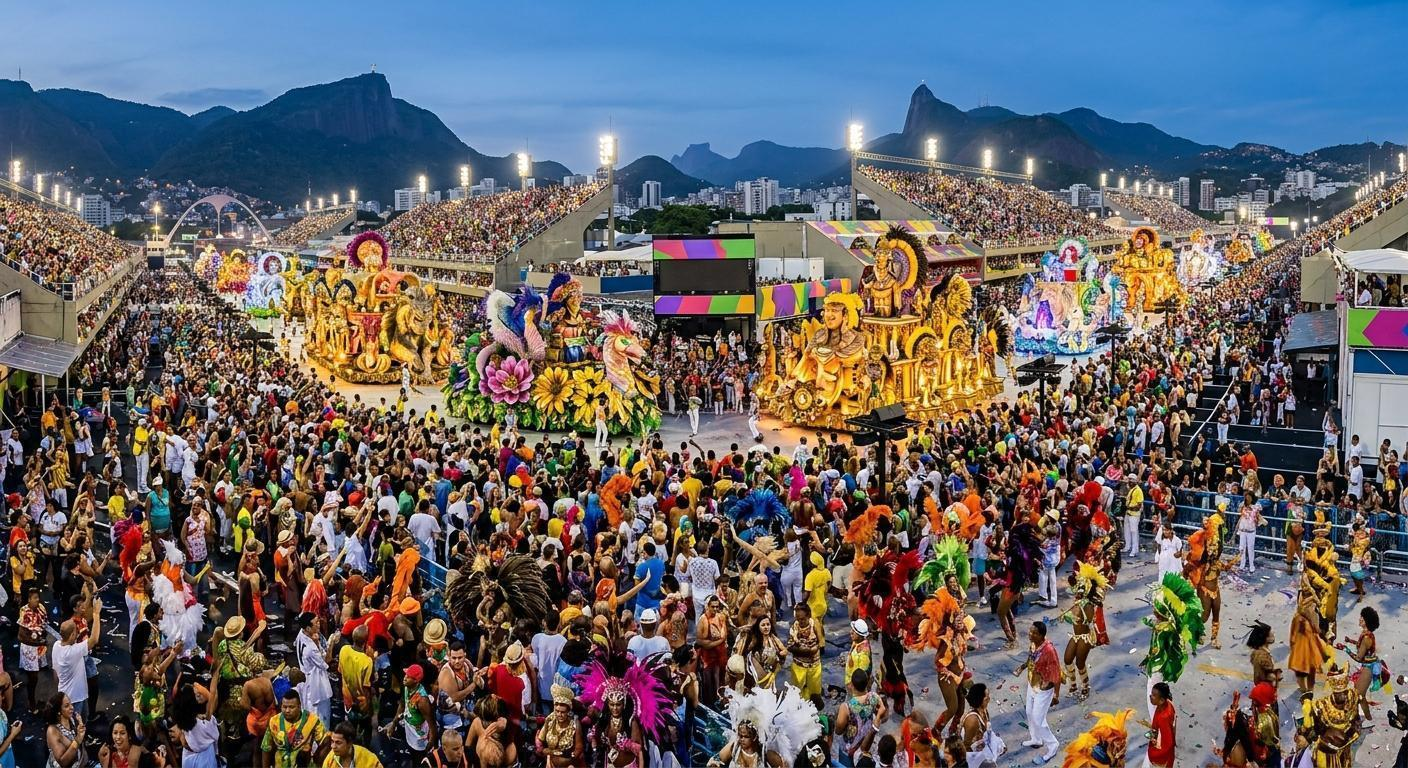
The Sambadrome
Rio’s Sambadrome, designed by Oscar Niemeyer and opened in 1984, created a permanent monumental setting for elite samba-school competition.
It improved infrastructure and television production but also reinforced the distinction between ticketed spectacle and free street Carnival.
Blocos and street revival
Street groups known as blocos range from small neighborhood gatherings to events attracting enormous crowds. Rio experienced a major bloco revival from the late twentieth century.
Street Carnival allows experimentation, satire, and broad participation, while also creating challenges involving safety, sanitation, transport, and commercialization.
Salvador and the trio elétrico
In Salvador, amplified music performed from moving vehicles transformed Carnival. The trio elétrico became central to mass street participation.
Afro blocos such as Ilê Aiyê emphasized Black pride, African heritage, antiracism, and cultural autonomy.
Recife and Olinda
Pernambuco Carnival is associated with frevo, maracatu, giant puppets, and dense street participation. Recife’s Galo da Madrugada became one of the world’s largest Carnival groups.
These traditions demonstrate why Brazilian Carnival cannot be represented only by Rio samba schools.
Religion and Carnival
Carnival’s placement before Lent comes from the Christian calendar, but participants may experience it as religious, secular, cultural, or commercial. Afro-Brazilian religious imagery also appears in music, costume, and community identity.
Relations between churches and Carnival have ranged from opposition to engagement.
Race, class, and labor
Carnival depends on year-round labor by musicians, seamstresses, designers, welders, dancers, carpenters, vendors, cleaners, and administrators. Many workers come from communities historically excluded from wealth and political power.
The festival creates income and visibility while reproducing inequalities in sponsorship, media attention, policing, and access.
Dictatorship, satire, and resistance
During Brazil’s military dictatorship, censorship affected music and public performance. Carnival groups used allegory, historical themes, humor, and coded criticism.
The festival could serve both official nationalism and popular resistance.
Television, tourism, and global image
Television transformed parades into national and international media events. Tourism boards and sponsors promoted Carnival as an image of Brazil.
This visibility generated revenue but risked reducing diverse traditions to spectacle, sexuality, and stereotype.
Safety, public health, and cancellation
Epidemics and crises have interrupted or reshaped Carnival. The COVID-19 pandemic led to cancellations and postponements, severely affecting cultural workers.
Modern planning also addresses crowd safety, harassment, heat, waste, and emergency care.
Historical timeline
Colonial era: Portuguese entrudo becomes widespread in Brazil.
Nineteenth century: Masked balls, elite societies, cordões, and ranchos reshape urban Carnival.
Late nineteenth century: Afro-Brazilian music and community associations become increasingly influential.
1910s: Recorded samba gains national attention.
Late 1920s: Early samba schools form in Rio de Janeiro.
1930s: Official competitions, radio, and state cultural policy expand samba’s national role.
1950s: The trio elétrico transforms Salvador Carnival.
1970s: Afro blocos strengthen Black cultural and political expression.
1984: Rio’s Sambadrome opens.
Late twentieth century: Television and tourism globalize Carnival imagery.
2020–2022: The COVID-19 pandemic interrupts major celebrations.
Today: Carnival combines heritage, labor, performance, protest, commerce, and regional diversity.
Carnival in Brazil today
Brazilian Carnival includes stadium-scale competition, neighborhood processions, religious and cultural expression, tourism, and informal celebration. Each city and community creates its own relationship to the season.
Its history is not a straight path from Europe to modern samba. It is a contested and creative history in which Afro-Brazilian communities, regional traditions, states, media, and workers continually remake the festival.
Sources and further reading
- Biblioteca Nacional Digital, Carnaval
- Fundação Cultural Palmares, Carnaval: Resistência e Identidade
- Presidência da República, Lei 15.188/2025
- Museu do Samba, Collections and Research
- Riotur, Carnaval do Rio
- IPHAN, Brazilian Cultural Heritage
- Encyclopaedia Britannica, Carnival
- Fundação Joaquim Nabuco, Histórias Possíveis do Carnaval Brasileiro
Traditions
Related comparison routes: cinco-de-mayo, mexican-independence-day, brazil-independence-day, carnival-brazil.
Slug-specific editorial cue: carnival brazil.
Carnival Brazil planning focus: Carnival Tuesday reference, 47 days before Western Easter.
How It Is Celebrated
People may use the Carnival Brazil countdown for planning, education, community calendars, awareness work, family schedules or official observance research. The visible customs depend on Latin America and diaspora communities, so this page does not assume one universal form.
Interesting Facts
- Carnival Brazil uses Carnival Tuesday reference, 47 days before Western Easter.
- Primary region or audience: Latin America and diaspora communities.
- Content cluster: Latin American Independence Days.
- Related countdowns include cinco-de-mayo, mexican-independence-day, brazil-independence-day, carnival-brazil.
- The canonical slug remains carnival-brazil.
Related Holiday Guides
Christmas guide → Christmas GuideA clear overview of Christmas history, dates, symbols and traditions.→
Christmas TraditionsExplore trees, gifts, meals, carols and family rituals.→
Christmas HistoryLearn how Christmas developed through religious and cultural history.→
Christmas Around the WorldSee how Christmas customs vary across countries and communities.→
Christmas GuideA clear overview of Christmas history, dates, symbols and traditions.→
Christmas TraditionsExplore trees, gifts, meals, carols and family rituals.→
Christmas HistoryLearn how Christmas developed through religious and cultural history.→
Christmas Around the WorldSee how Christmas customs vary across countries and communities.→Questions
Carnival Brazil FAQ
Clear answers about the date, countdown target and seasonal context.
When is Carnival Brazil?
Carnival Brazil uses Carnival Tuesday reference, 47 days before Western Easter for this countdown.
Who is this Carnival Brazil page for?
It is written for visitors comparing Latin America and diaspora communities dates and Latin American Independence Days countdowns. This guidance applies specifically to Carnival Brazil.
What should I compare with Carnival Brazil?
Start with cinco-de-mayo, mexican-independence-day, brazil-independence-day, carnival-brazil, then use the directory filters for more Latin America pages. This guidance applies specifically to Carnival Brazil.
Does Carnival Brazil have identical customs everywhere?
No. Local public status, community events and calendar notes can differ across Latin America and diaspora communities. This guidance applies specifically to Carnival Brazil.
Did this update change the Carnival Brazil route?
No. The page keeps the existing carnival-brazil URL and date rule. This guidance applies specifically to Carnival Brazil.