Southeast Asian National Holidays Countdown
(v) Scroll to discover more insights
How many days until
Cambodia Independence Day
Cambodia Independence Day is tracked through November 9, with the page centered on Cambodia's independence anniversary.
More holidays in November
87Days
00Hours
00Minutes
00Seconds
Quick Facts
About Cambodia Independence Day
Cambodia's independence anniversary is the defining context for Cambodia Independence Day. The site's calendar target is November 9, and common public activity includes monument ceremonies, flags and national remembrance. Cambodia Independence Day needs its own November 9 context. The page identifies Southeast Asia as the primary context for Cambodia Independence Day.
History of Cambodia Independence Day
Introduction
Cambodia Independence Day is observed on November 9. It commemorates the end of French colonial rule in 1953 and the restoration of full Cambodian sovereignty under King Norodom Sihanouk.
The holiday belongs to a wider history that includes the Khmer Empire, French protectorate, Japanese wartime occupation, postwar negotiations, civil war, the Khmer Rouge genocide, foreign intervention, and reconstruction.
The Khmer Empire
The Khmer Empire centered on Angkor became one of mainland Southeast Asia's most influential states.
Its temples, irrigation systems, religious traditions, and political institutions remain central to Cambodian identity.
Regional change before colonization
After Angkor's decline, Cambodian rulers faced pressure from Siam and Vietnam.
Territorial loss, court rivalry, and regional diplomacy shaped the kingdom before French intervention.
The French protectorate
Cambodia became a French protectorate in 1863.
France controlled foreign affairs and increasingly influenced administration, taxation, education, and economic policy.
Colonial administration
Cambodia was incorporated into French Indochina.
Colonial authorities built infrastructure and formal institutions while limiting political participation and directing economic resources toward imperial priorities.
King Norodom Sihanouk
Norodom Sihanouk became king in 1941 while still young.
French authorities initially expected him to be politically manageable, but he later became the leading figure in the campaign for independence.
Japanese occupation and 1945 independence
Japan occupied French Indochina during the Second World War and removed French authority in March 1945.
Cambodia briefly declared independence, but French control returned after Japan's defeat.
Postwar nationalism
Political parties, Buddhist networks, students, and armed groups demanded greater autonomy and independence.
The Khmer Issarak included diverse nationalist and revolutionary factions.
The Royal Crusade for Independence
Sihanouk launched a diplomatic and political campaign commonly called the Royal Crusade for Independence.
He traveled abroad, mobilized public support, and pressed France to transfer full authority.
November 9, 1953
France transferred remaining military and political powers, and Cambodia achieved full independence on November 9, 1953.
The date became the national anniversary of sovereignty.
The 1954 Geneva Conference
The Geneva agreements confirmed Cambodia's independence and neutrality in the settlement of the First Indochina War.
Foreign forces were to withdraw, though regional conflict continued.
Sihanouk's political system
Sihanouk abdicated in 1955 and built a dominant political movement known as Sangkum.
His government pursued neutrality and development but also restricted opposition.
Coup and civil war
Lon Nol overthrew Sihanouk in 1970 and proclaimed the Khmer Republic.
Civil war intensified amid the Vietnam War, U.S. bombing, rural disruption, and the rise of the Khmer Rouge.
The Khmer Rouge regime
The Khmer Rouge took Phnom Penh in April 1975.
Forced evacuation, mass execution, starvation, overwork, and disease killed an estimated 1.5 to 2 million people.
Vietnamese intervention and prolonged conflict
Vietnamese forces removed the Khmer Rouge government in 1979.
Conflict, displacement, international rivalry, and competing governments continued through the 1980s.
Peace process and monarchy restored
The 1991 Paris Peace Agreements created a UN-supported transition.
Elections were held in 1993, and the monarchy was restored with Sihanouk again serving as king.
Historical timeline
1863: Cambodia becomes a French protectorate.
1887: Cambodia is incorporated into French Indochina.
1941: Norodom Sihanouk becomes king.
March 1945: Japanese forces end French administration and Cambodia briefly declares independence.
1946: French control returns under a revised arrangement.
1952–1953: Sihanouk intensifies the independence campaign.
November 9, 1953: Cambodia gains full independence.
1954: The Geneva agreements confirm Cambodian sovereignty.
1970–1975: Civil war expands.
1975–1979: The Khmer Rouge commits genocide and mass atrocities.
1993: Elections and constitutional monarchy are restored.
Cambodia Independence Day today
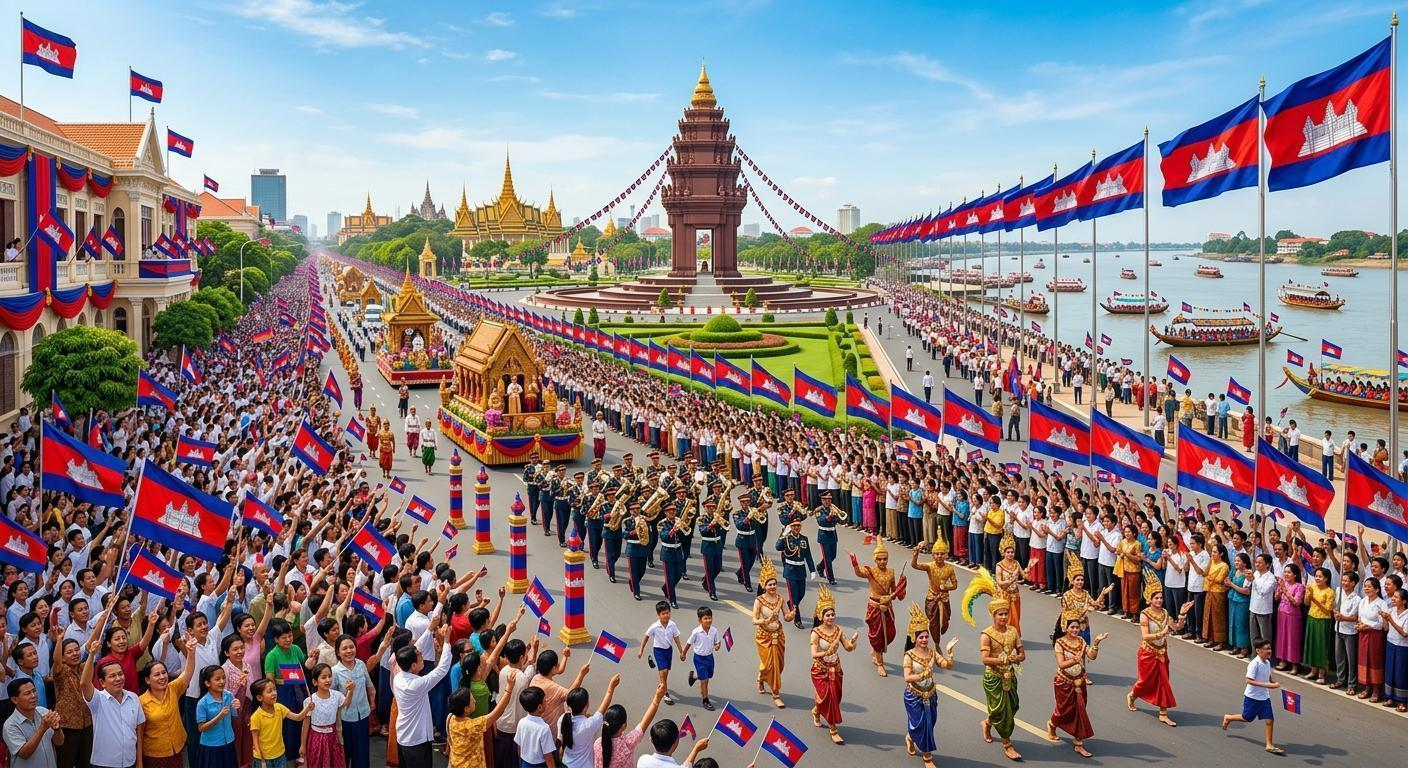
The day is marked by ceremonies at the Independence Monument, royal participation, flags, fireworks, school programs, and public events.
The holiday celebrates sovereignty while Cambodia's modern history remains inseparable from colonialism, authoritarianism, genocide, war, and reconstruction.
Sources and further reading
- Labour Rights Cambodia, Annual Holiday Calendar
- Ministry of Foreign Affairs and International Cooperation of Cambodia
- Encyclopaedia Britannica, Cambodia
- United Nations, Cambodia
- Extraordinary Chambers in the Courts of Cambodia
- United States Holocaust Memorial Museum, Cambodia
- United Nations, UNTAC
- UNESCO, Angkor
Traditions
Historical focus: Cambodia's independence anniversary.
Cluster context: Southeast Asian National Holidays.
monument ceremonies, flags and national remembrance.
How It Is Celebrated
monument ceremonies, flags and national remembrance are associated with Cambodia Independence Day. They reflect Cambodia's independence anniversary. Cambodia Independence Day needs its own November 9 context. Closure rules, school programs, travel patterns, and ceremony schedules depend on the responsible authority.
Interesting Facts
- Date focus: November 9.
- Cambodia Independence Day needs its own November 9 context.
- Primary context: Cambodia's independence anniversary.
- Observed cluster: Southeast Asian National Holidays.
- Cambodia Independence Day authorities may publish additional observed-day or event details.
Related Holiday Guides
New Year guide →

Questions
Cambodia Independence Day FAQ
Clear answers about the date, countdown target and seasonal context.
When is Cambodia Independence Day?
Cambodia Independence Day uses November 9 for this countdown.
What is Cambodia Independence Day mainly about?
This page focuses on Cambodia's independence anniversary, with common public context including monument ceremonies, flags and national remembrance. This guidance applies specifically to Cambodia Independence Day.
How is Cambodia Independence Day different from related countdowns?
Cambodia Independence Day needs its own November 9 context. Its own calendar focus is November 9.
How is Cambodia Independence Day commonly marked?
Common activity includes monument ceremonies, flags and national remembrance. Cambodia Independence Day needs its own November 9 context.
Why does this page use this date?
November 9 is the stored rule because the page concerns Cambodia's independence anniversary. This guidance applies specifically to Cambodia Independence Day.