Central and Eastern European Holidays Countdown
(v) Scroll to discover more insights
How many days until
Bulgaria Liberation Day
Bulgaria Liberation Day is tracked through March 3, with the page centered on Bulgaria's liberation commemoration and the historical transition from Ottoman rule.
More holidays in March
201Days
00Hours
00Minutes
00Seconds
Quick Facts
About Bulgaria Liberation Day
Bulgaria's liberation commemoration and the historical transition from Ottoman rule is the defining context for Bulgaria Liberation Day. The site's calendar target is March 3, and common public activity includes official ceremonies, wreath laying, flags, historical education, and memorial events. Bulgaria Liberation Day is a liberation anniversary with a specific nineteenth-century context, not a general national-day celebration.
History of Bulgaria Liberation Day
Introduction
Bulgaria Liberation Day is observed on March 3. It commemorates the preliminary Treaty of San Stefano signed in 1878 after the Russo-Turkish War. The treaty created a large autonomous Bulgarian principality and became the symbolic foundation of liberation from Ottoman rule.
The settlement did not immediately create the fully independent Bulgarian state known today. The Congress of Berlin revised the treaty only months later, dividing the projected territory. Bulgaria remained formally under Ottoman sovereignty until independence was proclaimed in 1908.
Medieval Bulgarian states
Bulgarian political history includes medieval empires that played major roles in southeastern Europe.
The Second Bulgarian Empire fell gradually to Ottoman conquest during the late fourteenth century.
Centuries under Ottoman rule
Bulgarian-speaking Orthodox communities lived within the Ottoman Empire for nearly five centuries.
They retained religious, village, craft, commercial, and family institutions while facing unequal legal status and imperial taxation.
The Bulgarian National Revival
During the eighteenth and nineteenth centuries, education, publishing, trade, church reform, and historical writing strengthened Bulgarian national identity.
Teachers, clergy, merchants, revolutionaries, and community organizations created schools and cultural institutions.
The struggle for church independence
Bulgarian activists sought an autonomous church separate from the Greek-dominated Ecumenical Patriarchate.
The creation of the Bulgarian Exarchate in 1870 became a major step in national organization.
Revolutionary movements
Figures such as Georgi Rakovski, Vasil Levski, Hristo Botev, and Lyuben Karavelov promoted different revolutionary strategies.
Levski's internal network sought an uprising organized within Bulgarian lands rather than dependence only on foreign intervention.
The April Uprising
Revolutionaries launched the April Uprising in 1876.
Ottoman forces and irregular units suppressed it with extreme violence, causing civilian massacres that attracted international outrage.
The Eastern Crisis
Reports of atrocities intensified European debate over Ottoman rule and intervention.
Diplomatic attempts failed to produce an accepted reform settlement.
The Russo-Turkish War
Russia declared war on the Ottoman Empire in 1877.
Romanian forces, Bulgarian volunteers, Russian troops, and other participants fought in a conflict that caused major military and civilian suffering.
Shipka Pass
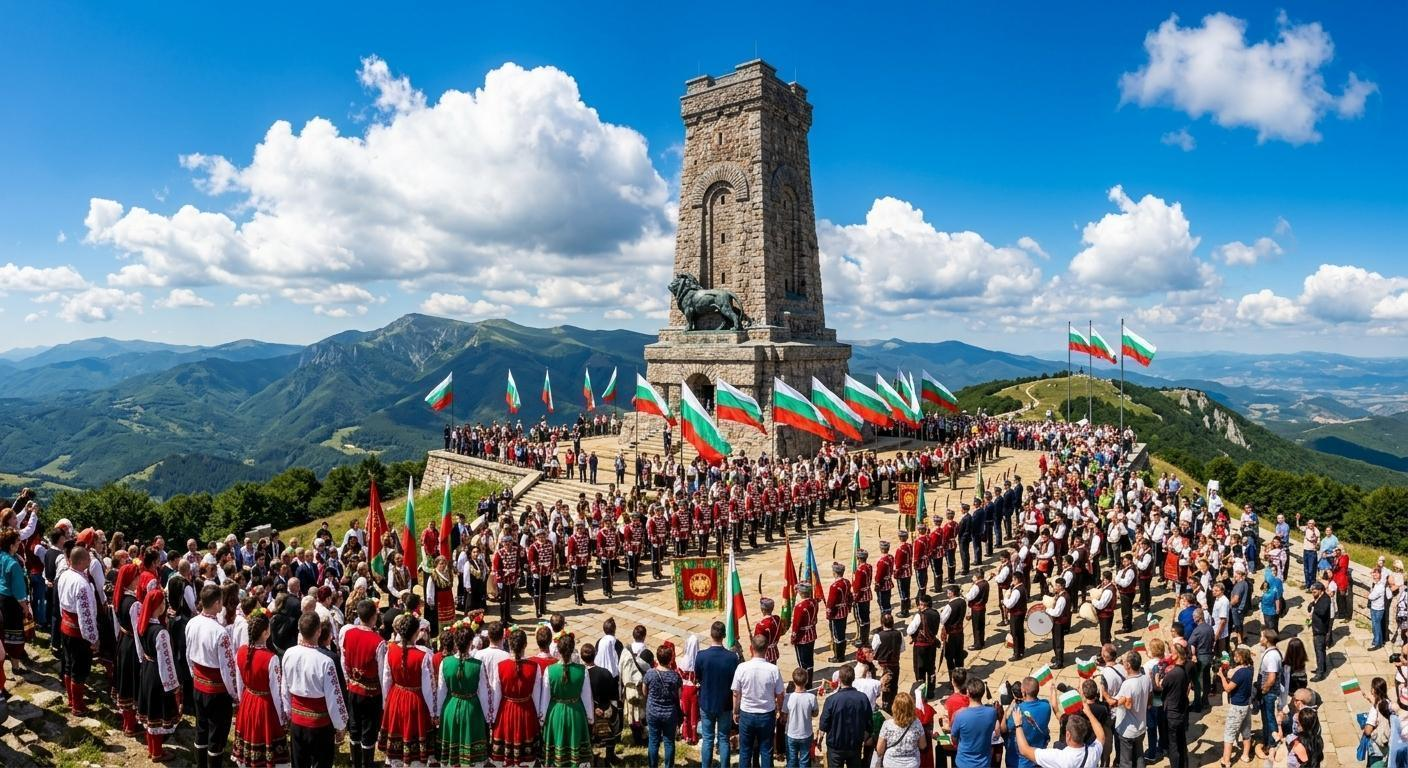
The defense of Shipka Pass became one of the central military symbols of liberation.
Russian soldiers and Bulgarian volunteers resisted repeated Ottoman attacks and protected a strategically important route.
The Treaty of San Stefano
The preliminary peace treaty was signed on March 3, 1878 under the modern Gregorian calendar.
It proposed a large autonomous Bulgarian principality but remained subject to revision by the Great Powers.
The Congress of Berlin
Britain, Austria-Hungary, Russia, Germany, France, Italy, and the Ottoman Empire revised the settlement in 1878.
The Treaty of Berlin created the Principality of Bulgaria, the autonomous province of Eastern Rumelia, and returned Macedonia and other territories to direct Ottoman control.
Unification
In 1885, the Principality of Bulgaria united with Eastern Rumelia.
The unification succeeded despite international opposition and war with Serbia.
Independence in 1908
Prince Ferdinand proclaimed the full independence of Bulgaria on September 22, 1908.
The country became a kingdom, ending the remaining formal relationship of Ottoman suzerainty.
Creating the March 3 holiday
The anniversary was first publicly celebrated in the years after 1878.
Calendar reform shifted the old-style February 19 date to March 3 under the Gregorian calendar.
Suppression and restoration of the holiday
The holiday was removed from the official calendar during the communist period after 1949, except for special commemorations.
It was restored in the late 1980s and declared Bulgaria's national holiday in 1990.
Contested memory
March 3 honors liberation and sacrifice, but public debate also examines Russian imperial interests, the role of other armies and volunteers, civilian suffering, and the later political use of the anniversary.
A complete history avoids treating liberation as the action of one state alone.
Historical timeline
Late fourteenth century: Ottoman conquest ends the medieval Bulgarian state.
Eighteenth–nineteenth centuries: The Bulgarian National Revival expands.
1870: The Bulgarian Exarchate is established.
1876: The April Uprising is violently suppressed.
1877–1878: The Russo-Turkish War is fought.
March 3, 1878: The Treaty of San Stefano is signed.
July 1878: The Treaty of Berlin revises the settlement.
1885: Bulgaria and Eastern Rumelia unite.
September 22, 1908: Bulgaria proclaims full independence.
1917: The anniversary is first observed on March 3 under the new calendar.
1990: March 3 becomes the national holiday.
Bulgaria Liberation Day today
The holiday is marked by wreath-laying, military ceremonies, church services, speeches, flags, historical reenactments, and commemorations at Shipka and other sites.
It celebrates liberation while remaining distinct from the 1908 Independence Day and from later unification anniversaries.
Sources and further reading
- Council of Ministers of Bulgaria, History
- Ministry of Tourism of Bulgaria, History of March 3
- President of the Republic of Bulgaria
- National Assembly of Bulgaria
- Encyclopaedia Britannica, Bulgaria
- Encyclopaedia Britannica, Treaty of San Stefano
- Imperial War Museums, Russo-Turkish War
- United Nations, Bulgaria
Traditions
Historical focus: Bulgaria's liberation commemoration and the historical transition from Ottoman rule.
Cluster context: Southeast European National Days.
official ceremonies, wreath laying, flags, historical education, and memorial events.
How It Is Celebrated
official ceremonies, wreath laying, flags, historical education, and memorial events are associated with Bulgaria Liberation Day. They reflect Bulgaria's liberation commemoration and the historical transition from Ottoman rule. Bulgaria Liberation Day is a liberation anniversary with a specific nineteenth-century context, not a general national-day celebration. Closure rules, school programs, travel patterns, and ceremony schedules depend on the responsible authority.
Interesting Facts
- Date focus: March 3.
- Bulgaria Liberation Day is a liberation anniversary with a specific nineteenth-century context, not a general national-day celebration.
- Primary context: Bulgaria's liberation commemoration and the historical transition from Ottoman rule.
- Observed cluster: Southeast European National Days.
- Bulgaria Liberation Day authorities may publish additional observed-day or event details.
Related Holiday Guides
Christmas guide → Christmas GuideA clear overview of Christmas history, dates, symbols and traditions.→
Christmas TraditionsExplore trees, gifts, meals, carols and family rituals.→
Christmas HistoryLearn how Christmas developed through religious and cultural history.→
Christmas Around the WorldSee how Christmas customs vary across countries and communities.→
Christmas GuideA clear overview of Christmas history, dates, symbols and traditions.→
Christmas TraditionsExplore trees, gifts, meals, carols and family rituals.→
Christmas HistoryLearn how Christmas developed through religious and cultural history.→
Christmas Around the WorldSee how Christmas customs vary across countries and communities.→Questions
Bulgaria Liberation Day FAQ
Clear answers about the date, countdown target and seasonal context.
When is Bulgaria Liberation Day?
Bulgaria Liberation Day uses March 3 for this countdown.
What is Bulgaria Liberation Day mainly about?
This page focuses on Bulgaria's liberation commemoration and the historical transition from Ottoman rule, with common public context including official ceremonies, wreath laying, flags, historical education, and memorial events. This guidance applies specifically to Bulgaria Liberation Day.
How is Bulgaria Liberation Day different from related countdowns?
Bulgaria Liberation Day is a liberation anniversary with a specific nineteenth-century context, not a general national-day celebration. Its own calendar focus is March 3.
How is Bulgaria Liberation Day commonly marked?
Common activity includes official ceremonies, wreath laying, flags, historical education, and memorial events. Bulgaria Liberation Day is a liberation anniversary with a specific nineteenth-century context, not a general national-day celebration.
Why does this page use this date?
March 3 is the stored rule because the page concerns Bulgaria's liberation commemoration and the historical transition from Ottoman rule. This guidance applies specifically to Bulgaria Liberation Day.