East and Southeast Asian Festivals Countdown
(v) Scroll to discover more insights
How many days until
Buddha Birthday Korea
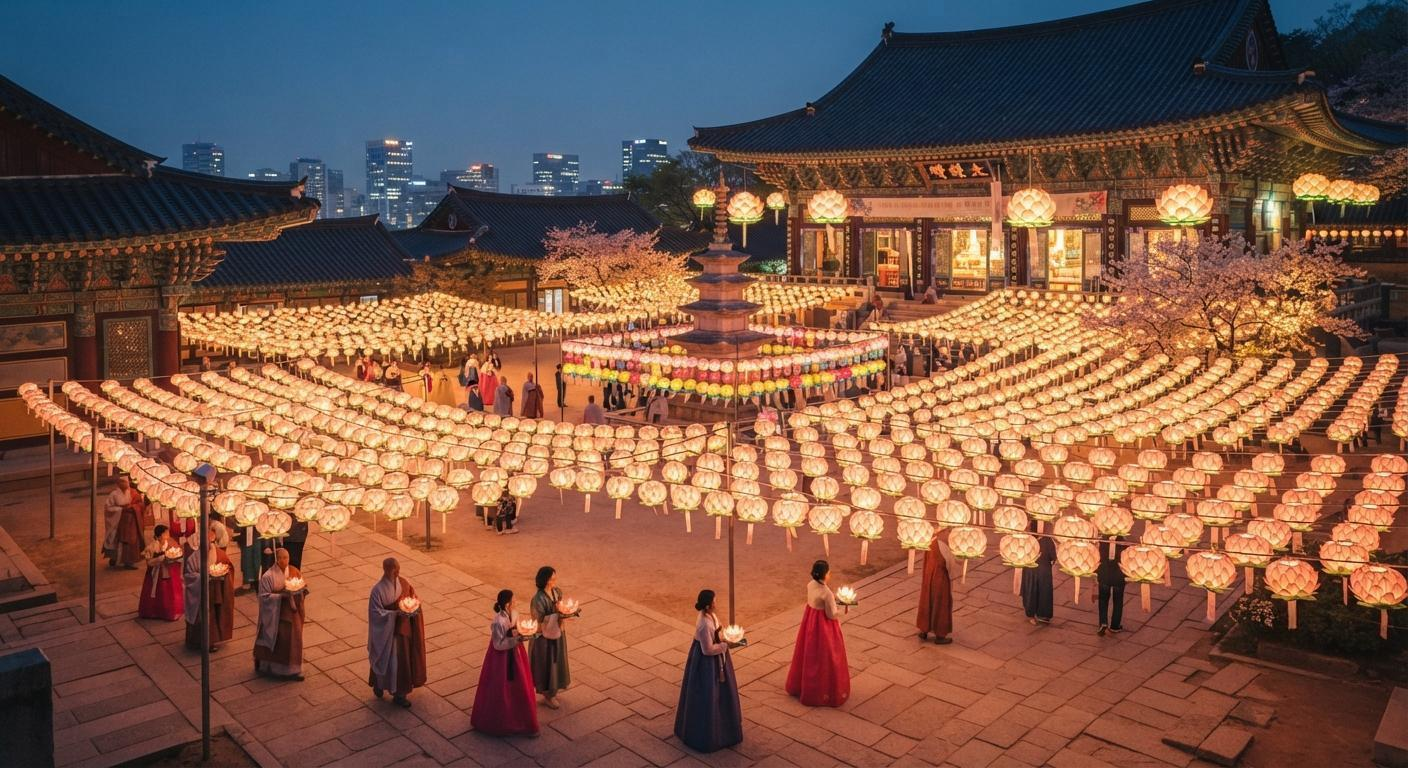
Buddha Birthday Korea is tracked through the mapped Korean Buddha Birthday date, with the page centered on Buddhist temple lanterns and Korean public holiday context.
More holidays in May
272Days
00Hours
00Minutes
00Seconds
Quick Facts
About Buddha Birthday Korea
Buddhist temple lanterns and Korean public holiday context defines the subject of Buddha Birthday Korea. Its the mapped Korean Buddha Birthday date calendar reference belongs to East and Southeast Asian Festivals. Buddha Birthday Korea is religious and regional, not a general spring festival. Lantern displays are common at temples and public events. These details are the basis for comparing the date with neighboring festivals.
History of Buddha's Birthday in Korea
Introduction
Buddha's Birthday in Korea, known as Bucheonnim Osin Nal, commemorates the birth of Siddhartha Gautama, the historical Buddha. In South Korea it is observed on the eighth day of the fourth month of the Korean lunar calendar, so its Gregorian date changes each year.
The holiday combines Buddhist worship, lantern traditions, temple visits, charity, public culture, and reflection on compassion. It is a national public holiday in South Korea, but practices vary among Buddhist schools, temples, families, and regions.
The historical Buddha
Siddhartha Gautama is traditionally understood to have lived in South Asia during the first millennium BCE.
Buddhist communities remember his birth, awakening, teaching, and death through different festivals and calendars.
Buddhism reaches Korea
Buddhism entered the Korean kingdoms through diplomatic, scholarly, and religious exchange with China.
It became influential in Goguryeo, Baekje, and Silla at different times.
Three Kingdoms and Unified Silla
Kings and elites supported temples, monks, scriptures, and Buddhist art.
During Unified Silla, Korean Buddhism developed major schools, monasteries, sculptures, pilgrimage traditions, and influential teachers such as Wonhyo.
Goryeo Buddhism
The Goryeo dynasty closely connected Buddhism with state ritual, art, printing, and national protection.
The Tripitaka Koreana became one of the most celebrated achievements of Korean Buddhist culture.
Joseon restrictions
The Joseon dynasty promoted Neo-Confucian institutions and reduced Buddhist influence at court.
Temples and monks nevertheless preserved religious practice, mountain monasteries, art, ritual, and community service.
Lantern traditions
Lanterns symbolize wisdom, awakening, and the dispelling of ignorance.
Korean Buddhist communities developed processions, temple displays, and offerings of light around the Buddha's birthday.
Yeondeunghoe
Yeondeunghoe, the lantern-lighting festival, has deep roots in Korean history.
It has appeared in royal, temple, community, and modern civic settings and has changed with politics and urban life.
Colonial rule
Japanese colonial rule transformed Korean Buddhist administration, temple property, and clerical institutions.
Buddhists responded through cooperation, reform, cultural preservation, and resistance in different combinations.
Division and war
The division of Korea and the Korean War destroyed temples, displaced communities, and separated religious institutions.
Buddhist life developed differently in North and South Korea afterward.
Modern South Korean Buddhism
Major orders rebuilt temples and expanded education, social welfare, media, and international activity.
Buddhist communities also debated modernization, clerical authority, politics, gender, and commercialization.
Becoming a public holiday
South Korea designated Buddha's Birthday as a public holiday in the twentieth century.
The official holiday follows the lunar calendar rather than a fixed Gregorian date.
Temple rituals
Temples hold chanting, sermons, offerings, bathing-the-Buddha ceremonies, meditation, and communal meals.
Specific ritual forms vary across temples and Buddhist traditions.
Lotus lanterns
Lotus-shaped lanterns are especially prominent and are often associated with purity and awakening.
Modern festivals also feature large artistic lanterns, community workshops, and nighttime parades.
Charity and public service
Many temples organize food distribution, donations, hospital visits, and community support.
These activities connect devotion with compassion and social responsibility.
North Korean context
Buddhist heritage sites remain in North Korea, but religious life operates under very different political conditions.
Public observance there should not be assumed to match South Korean practice.
UNESCO recognition
Yeondeunghoe was inscribed on UNESCO's Representative List of the Intangible Cultural Heritage of Humanity.
The recognition highlights community participation, craftsmanship, continuity, and adaptation.
Historical timeline
Fourth century: Buddhism gains official recognition in several Korean kingdoms.
Unified Silla period: Buddhist thought, art, and monastic culture flourish.
Goryeo period: State-supported Buddhism and lantern festivals expand.
Joseon period: Court support declines, but temple traditions continue.
1910–1945: Colonial rule reshapes Buddhist institutions.
Post-1945: Korean Buddhism develops differently in North and South.
1970s: Buddha's Birthday becomes a South Korean public holiday.
2020: Yeondeunghoe receives UNESCO intangible-heritage recognition.
Today: The holiday combines worship, lanterns, charity, and public culture.
Buddha's Birthday in Korea today
People visit temples, light lanterns, join processions, attend ceremonies, eat temple food, volunteer, and participate in cultural programs.
The strongest observances use the official lunar year-map date, distinguish South and North Korean contexts, and avoid presenting all Korean Buddhists as following one identical practice.
Sources and further reading
Traditions
Lantern displays are common at temples and public events.
East and Southeast Asian Festivals communities may publish event-specific details.
Buddhist temple lanterns and Korean public holiday context.
How It Is Celebrated
Buddhist temple lanterns and Korean public holiday context shapes how Buddha Birthday Korea is recognized. Lantern displays are common at temples and public events. Buddha Birthday Korea is religious and regional, not a general spring festival. Visitors should use community or organizer information for local ceremonies, travel periods, worship, food, decorations, and public events.
Interesting Facts
- Date focus: the mapped Korean Buddha Birthday date.
- Lantern displays are common at temples and public events.
- Buddha Birthday Korea is religious and regional, not a general spring festival.
- Cluster: East and Southeast Asian Festivals.
- Buddha Birthday Korea timing and customs can vary by region, language and community.
Related Holiday Guides
New Year guide →
Questions
Buddha Birthday Korea FAQ
Clear answers about the date, countdown target and seasonal context.
When is Buddha Birthday Korea?
Buddha Birthday Korea uses official year-map Korean date for this countdown.
What is Buddha Birthday Korea mainly associated with?
This page focuses on Buddhist temple lanterns and Korean public holiday context. This guidance applies specifically to Buddha Birthday Korea.
How is Buddha Birthday Korea different from nearby festivals?
Buddha Birthday Korea is religious and regional, not a general spring festival.
Which detail is especially useful for Buddha Birthday Korea?
Lantern displays are common at temples and public events. This guidance applies specifically to Buddha Birthday Korea.
Why does this countdown use this date?
the mapped Korean Buddha Birthday date is the stored calendar reference. Buddha Birthday Korea is religious and regional, not a general spring festival.