Caribbean Independence Days Countdown
(v) Scroll to discover more insights
How many days until
Belize Independence Day
Belize Independence Day is tracked through September 21, with this page written for Caribbean states and diaspora communities and the Caribbean Independence Days cluster.
More holidays in September
38Days
00Hours
00Minutes
00Seconds
Quick Facts
About Belize Independence Day
Belize Independence Day is a national observance page in Holiday Countdown Library. Its useful planning context is the combination of September 21, Caribbean states and diaspora communities, Caribbean classification and related routes such as jamaica-independence-day, bahamas-independence-day, haiti-independence-day, saint-lucia-independence-day. The page identifies Caribbean states and diaspora communities as the primary context for Belize Independence Day.
History of Belize Independence Day
Introduction
Belize Independence Day is observed on September 21. It commemorates the end of British colonial rule and the establishment of Belize as an independent state in 1981. Independence followed decades of constitutional reform, labor activism, nationalist politics, and negotiation over a long-running territorial claim by Guatemala.
The holiday does not mark the beginning of Belizean history. The territory has deep Maya roots and later became a multilingual Caribbean and Central American society shaped by British settlement, slavery, migration, forestry, trade, and regional diplomacy.
Maya civilizations
Long before European colonization, Maya communities built cities, trade networks, agricultural systems, and political institutions across the region now called Belize.
Maya peoples remain part of contemporary Belizean society, and the country's history cannot be reduced to British settlement alone.
Spanish claims and limited control
Spain claimed the wider region during the colonial period but never established the same level of permanent settlement in Belize that it developed elsewhere in Central America.
Maya resistance, geography, disease, and competing European interests limited Spanish authority.
British logwood settlers
British settlers, often called Baymen, established logging settlements along the coast and rivers.
They harvested logwood and later mahogany for export, gradually creating a colonial economy tied to British markets.
Slavery and the timber economy
Enslaved Africans and their descendants performed much of the dangerous labor that sustained the timber economy.
Slavery shaped wealth, race, landholding, and social hierarchy long after formal emancipation.
The Battle of St. George's Caye
In 1798, British settlers and their allies defeated a Spanish expedition near St. George's Caye.
The battle became an important national commemoration, though modern historical discussion also examines the roles of enslaved people, free people of color, and competing colonial interests.
British Honduras
The settlement developed into the colony known as British Honduras.
British colonial administration expanded through law, taxation, education, forestry regulation, and control over land.
Emancipation and post-slavery society
Slavery was abolished in the British Empire in the 1830s.
Formerly enslaved people gained legal freedom but continued to face economic inequality, limited land access, and racial discrimination.
Migration and cultural diversity
Garifuna communities, Maya groups, Creole people, Mestizos, Mennonites, and migrants from the Caribbean, Central America, Asia, and elsewhere contributed to Belize's cultural and linguistic diversity.
English became the official language, while Kriol, Spanish, Garifuna, Maya languages, and others remained widely used.
Labor movements and political reform
Economic hardship, hurricanes, unemployment, and colonial inequality encouraged labor organizing during the twentieth century.
Trade unions and political movements demanded better wages, representation, and self-government.
The nationalist movement
The People's United Party, led for many years by George Price, became the principal force demanding constitutional reform and independence.
The movement linked political sovereignty with social and economic development.
Self-government
British Honduras gained internal self-government in 1964.
Local ministers controlled many domestic matters while Britain retained responsibility for defense and foreign affairs.
The name Belize
The colony officially changed its name from British Honduras to Belize in 1973.
The change strengthened a national identity distinct from colonial terminology.
Guatemala's territorial claim
Guatemala maintained a claim to Belize based on competing interpretations of nineteenth-century agreements and colonial boundaries.
The dispute complicated independence negotiations because security and international recognition remained major concerns.
International support for independence
Belize pursued support through the United Nations, the Commonwealth, the Caribbean, and the Non-Aligned Movement.
International resolutions increasingly backed Belize's right to self-determination and territorial integrity.
September 21, 1981
Belize became independent on September 21, 1981, with George Price as the first prime minister.
The country remained a constitutional monarchy within the Commonwealth, with its own elected government and international legal personality.
Post-independence statehood
After independence, Belize developed democratic institutions, tourism, agriculture, education, conservation, and regional partnerships.
The Guatemala dispute continued, eventually moving toward international legal processes and bilateral confidence-building measures.
Historical timeline
Precolonial era: Maya civilizations flourish across the region.
Seventeenth–eighteenth centuries: British logging settlements expand.
1798: The Battle of St. George's Caye takes place.
1862: British Honduras becomes a formal British colony.
1930s–1950s: Labor and nationalist movements grow.
1964: Internal self-government begins.
1973: British Honduras is renamed Belize.
1970s: Belize gains increasing international support for independence.
September 21, 1981: Belize becomes independent.
Post-1981: Democratic state-building and diplomacy over the Guatemala claim continue.
Belize Independence Day today
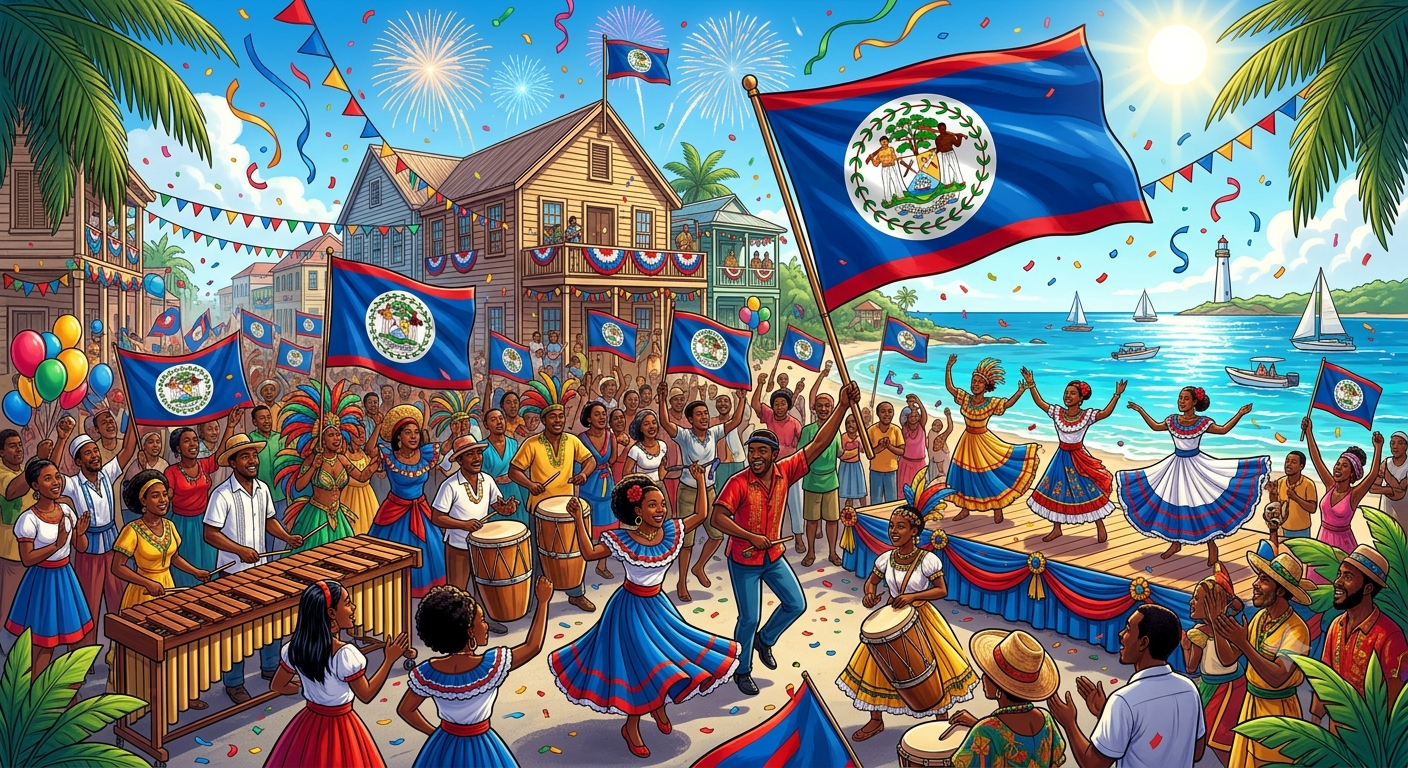
The day is marked by flag ceremonies, parades, concerts, cultural performances, school events, speeches, and community celebrations.
It forms part of Belize's September Celebrations, linking independence with the Battle of St. George's Caye while also encouraging broader reflection on colonialism, slavery, diversity, and national sovereignty.
Sources and further reading
Traditions
Related comparison routes: jamaica-independence-day, bahamas-independence-day, haiti-independence-day, saint-lucia-independence-day.
Slug-specific editorial cue: belize independence day.
Belize Independence Day planning focus: September 21.
How It Is Celebrated
People may use the Belize Independence Day countdown for planning, education, community calendars, awareness work, family schedules or official observance research. The visible customs depend on Caribbean states and diaspora communities, so this page does not assume one universal form.
Interesting Facts
- Belize Independence Day uses September 21.
- Primary region or audience: Caribbean states and diaspora communities.
- Content cluster: Caribbean Independence Days.
- Related countdowns include jamaica-independence-day, bahamas-independence-day, haiti-independence-day, saint-lucia-independence-day.
- The canonical slug remains belize-independence-day.
Related Holiday Guides
Christmas guide → Christmas GuideA clear overview of Christmas history, dates, symbols and traditions.→
Christmas TraditionsExplore trees, gifts, meals, carols and family rituals.→
Christmas HistoryLearn how Christmas developed through religious and cultural history.→
Christmas Around the WorldSee how Christmas customs vary across countries and communities.→
Christmas GuideA clear overview of Christmas history, dates, symbols and traditions.→
Christmas TraditionsExplore trees, gifts, meals, carols and family rituals.→
Christmas HistoryLearn how Christmas developed through religious and cultural history.→
Christmas Around the WorldSee how Christmas customs vary across countries and communities.→Questions
Belize Independence Day FAQ
Clear answers about the date, countdown target and seasonal context.
When is Belize Independence Day?
Belize Independence Day uses September 21 for this countdown.
Who is this Belize Independence Day page for?
It is written for visitors comparing Caribbean states and diaspora communities dates and Caribbean Independence Days countdowns. This guidance applies specifically to Belize Independence Day.
What should I compare with Belize Independence Day?
Start with jamaica-independence-day, bahamas-independence-day, haiti-independence-day, saint-lucia-independence-day, then use the directory filters for more Caribbean pages. This guidance applies specifically to Belize Independence Day.
Does Belize Independence Day have identical customs everywhere?
No. Local public status, community events and calendar notes can differ across Caribbean states and diaspora communities. This guidance applies specifically to Belize Independence Day.
Did this update change the Belize Independence Day route?
No. The page keeps the existing belize-independence-day URL and date rule. This guidance applies specifically to Belize Independence Day.