European National Days Countdown
(v) Scroll to discover more insights
How many days until
Belgian National Day
Belgian National Day is tracked through July 21, with the page centered on Belgium's monarchy and constitutional national day.
More holidays in July
341Days
00Hours
00Minutes
00Seconds
Quick Facts
About Belgian National Day
Belgium's monarchy and constitutional national day is the defining context for Belgian National Day. The site's calendar target is July 21, and common public activity includes military parade, royal events, fireworks and civic ceremonies. Belgian National Day has a monarchy-linked July 21 focus.
History of Belgian National Day
Introduction
Belgian National Day is observed on July 21. It commemorates July 21, 1831, when Leopold I took the constitutional oath as the first King of the Belgians. Belgium had declared independence from the Kingdom of the Netherlands during the revolution of 1830.
The holiday therefore marks the establishment of the constitutional monarchy rather than the first revolutionary declaration itself. July 21 was formally fixed as the national holiday by law in 1890.
The Southern Netherlands
The territories of modern Belgium were governed over time by Burgundian, Habsburg, Spanish, Austrian, French, and Dutch rulers.
Regional identities, languages, cities, churches, and legal traditions remained diverse.
French rule
Revolutionary and Napoleonic France annexed the region during the 1790s.
French administration introduced legal and institutional changes while also imposing taxation, conscription, and political control.
The United Kingdom of the Netherlands
After Napoleon's defeat, the Congress of Vienna joined the northern and southern Netherlands under King William I.
The state was intended to form a strong barrier against France but contained major religious, linguistic, economic, and political divisions.
Sources of opposition
Catholics opposed state influence over education and religion, while liberals demanded greater political freedom.
French-speaking elites, Dutch-language policy, taxation, representation, and economic interests all contributed to dissatisfaction.
The Belgian Revolution
Revolutionary unrest began in Brussels in August 1830 and spread to other cities.
Fighting between insurgents and Dutch forces led to the collapse of royal authority in much of the south.
The declaration of independence
A provisional government declared Belgian independence on October 4, 1830.
A National Congress was elected to write a constitution and determine the form of government.
The constitution of 1831
The Belgian Constitution established a constitutional monarchy with a parliament and protected several civil freedoms.
Political participation remained limited by property qualifications and did not initially include most men or any women.
Choosing a king
European diplomacy influenced the selection of a monarch acceptable to the major powers.
Leopold of Saxe-Coburg accepted the Belgian throne after earlier candidates proved unsuitable or controversial.
July 21, 1831
Leopold I took the constitutional oath in Brussels on July 21.
The oath symbolized the relationship between monarchy, constitution, parliament, and the new state.
The Ten Days' Campaign
Dutch forces invaded Belgium in August 1831 during the Ten Days' Campaign.
French military intervention prevented the collapse of the new kingdom, showing that independence was not secure immediately.
International recognition
European powers negotiated Belgium's status, borders, neutrality, and financial obligations.
The Treaty of London in 1839 provided final international recognition and divided Limburg and Luxembourg.
Industrialization and social conflict
Belgium became one of continental Europe's earliest industrial economies.
Rapid growth was accompanied by dangerous labor, poverty, child labor, and demands for social and political reform.
Language and federalism
French dominated the early state despite a large Dutch-speaking population.
The Flemish movement, Walloon identity, German-speaking community, and regional political differences eventually transformed Belgium into a federal state.
Colonial history
King Leopold II controlled the Congo Free State before Belgium annexed it as a colony.
Forced labor, violence, exploitation, and colonial racism are central to the country's historical legacy and modern public debate.
The world wars
Germany invaded Belgium in both world wars.
Occupation, resistance, collaboration, persecution, and the Holocaust shaped national memory.
Creating the July 21 holiday
Belgium used different national commemorative dates during the nineteenth century.
A law of May 27, 1890 established July 21 as the national holiday, connecting the state with Leopold I's constitutional oath.
Historical timeline
1815: The southern and northern Netherlands are united.
August–September 1830: The Belgian Revolution spreads.
October 4, 1830: The provisional government declares independence.
February 1831: The constitution is adopted.
July 21, 1831: Leopold I takes the constitutional oath.
August 1831: The Ten Days' Campaign threatens the new state.
1839: The Treaty of London settles international recognition.
1890: July 21 is legally fixed as the national holiday.
Twentieth century: World wars, democratization, and language conflict reshape Belgium.
1970s–1990s: Constitutional reforms transform Belgium into a federal state.
Belgian National Day today
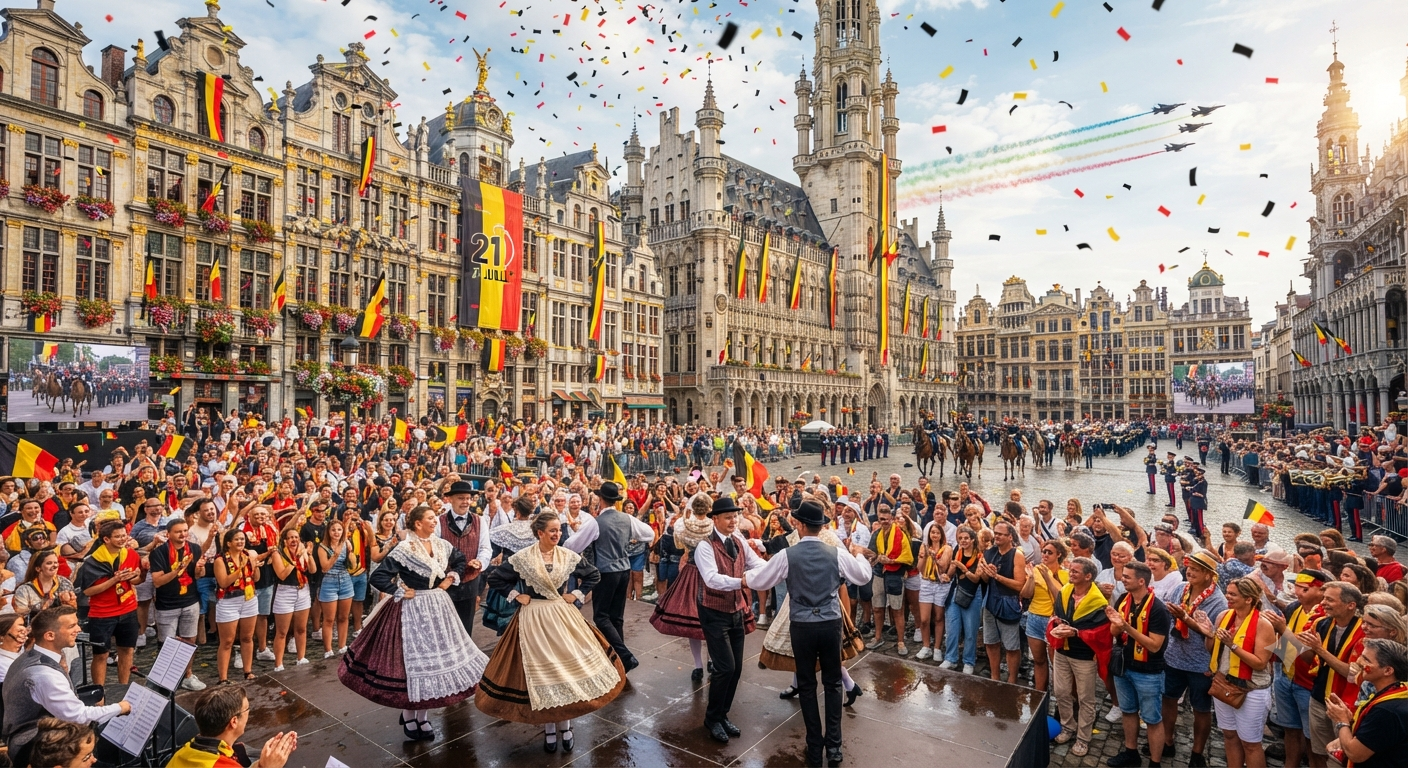
The holiday is marked by a Te Deum service, official ceremonies, a military and civilian parade, concerts, public events, and fireworks.
It celebrates the constitutional state while Belgium's history continues to involve debate about monarchy, federalism, colonialism, language, migration, and national identity.
Sources and further reading
Traditions
Historical focus: Belgium's monarchy and constitutional national day.
Cluster context: European National Days.
military parade, royal events, fireworks and civic ceremonies.
How It Is Celebrated
military parade, royal events, fireworks and civic ceremonies are associated with Belgian National Day. They reflect Belgium's monarchy and constitutional national day. Belgian National Day has a monarchy-linked July 21 focus. Closure rules, school programs, travel patterns, and ceremony schedules depend on the responsible authority.
Interesting Facts
- Date focus: July 21.
- Belgian National Day has a monarchy-linked July 21 focus.
- Primary context: Belgium's monarchy and constitutional national day.
- Observed cluster: European National Days.
- Belgian National Day authorities may publish additional observed-day or event details.
Related Holiday Guides
Christmas guide → Christmas GuideA clear overview of Christmas history, dates, symbols and traditions.→
Christmas TraditionsExplore trees, gifts, meals, carols and family rituals.→
Christmas HistoryLearn how Christmas developed through religious and cultural history.→
Christmas Around the WorldSee how Christmas customs vary across countries and communities.→
Christmas GuideA clear overview of Christmas history, dates, symbols and traditions.→
Christmas TraditionsExplore trees, gifts, meals, carols and family rituals.→
Christmas HistoryLearn how Christmas developed through religious and cultural history.→
Christmas Around the WorldSee how Christmas customs vary across countries and communities.→Questions
Belgian National Day FAQ
Clear answers about the date, countdown target and seasonal context.
When is Belgian National Day?
Belgian National Day uses July 21 for this countdown.
What is Belgian National Day mainly about?
This page focuses on Belgium's monarchy and constitutional national day, with common public context including military parade, royal events, fireworks and civic ceremonies. This guidance applies specifically to Belgian National Day.
How is Belgian National Day different from related countdowns?
Belgian National Day has a monarchy-linked July 21 focus. Its own calendar focus is July 21.
How is Belgian National Day commonly marked?
Common activity includes military parade, royal events, fireworks and civic ceremonies. Belgian National Day has a monarchy-linked July 21 focus.
Why does this page use this date?
July 21 is the stored rule because the page concerns Belgium's monarchy and constitutional national day. This guidance applies specifically to Belgian National Day.