Europe and UK Countdown
(v) Scroll to discover more insights
How many days until
Bastille Day
Bastille Day is tracked through July 14, with the page centered on France's national day and the public memory of the French Revolution.
More holidays in July
334Days
00Hours
00Minutes
00Seconds
Quick Facts
About Bastille Day
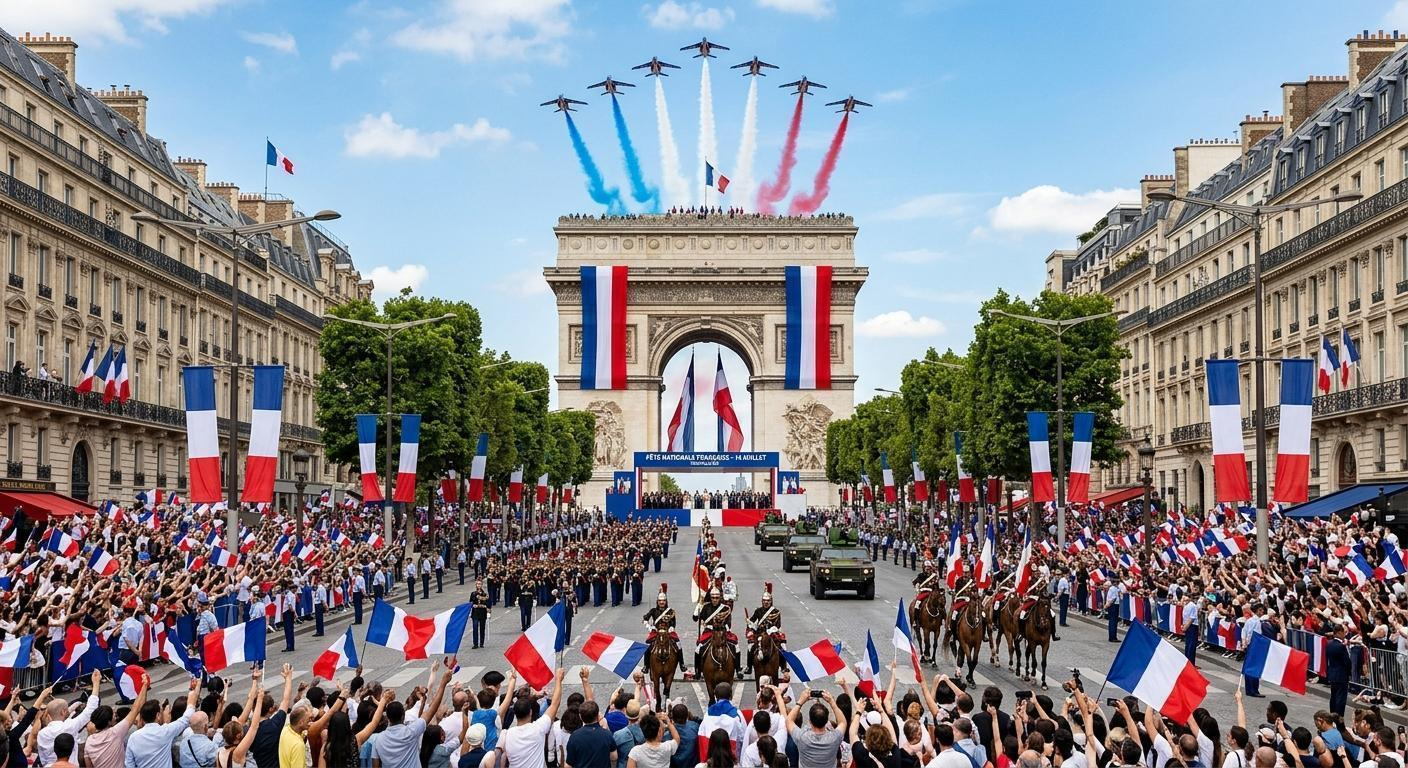
France's national day and the public memory of the French Revolution is the defining context for Bastille Day. The site's calendar target is July 14, and common public activity includes military parade imagery, fireworks, local dances and civic ceremonies. This page is France-focused and should not read like a general European bank holiday.
History of Bastille Day
Introduction
Bastille Day is the common English name for France’s national holiday on July 14. In France, it is usually called le Quatorze Juillet or the Fête nationale. The date is associated with two revolutionary anniversaries: the storming of the Bastille on July 14, 1789, and the Festival of the Federation on July 14, 1790.
The holiday did not become official during the Revolution itself. The French Republic adopted July 14 as the national holiday in 1880, nearly a century later. Its history therefore connects popular revolution, national unity, republican government, military ceremony, war memory, local festivals, and continuing debate over the meaning of liberty and citizenship.
France before the Revolution
Late eighteenth-century France was governed by an absolute monarchy and divided into legal orders with unequal privileges. The crown faced a severe financial crisis caused by war debts, taxation problems, and an inefficient fiscal system.
Poor harvests and rising bread prices intensified hardship. Political writers challenged inherited privilege, while disputes over representation and taxation pushed the monarchy to summon the Estates-General in 1789.
The Estates-General and the National Assembly
The Estates-General met at Versailles in May 1789. Representatives of the Third Estate, claiming to speak for the nation, declared themselves the National Assembly. The Tennis Court Oath expressed their determination to create a constitution.
Royal troop movements and the dismissal of finance minister Jacques Necker increased fears that the king would dissolve the Assembly by force. Paris entered a period of intense political mobilization.
Why the Bastille mattered
The Bastille was a medieval fortress used as a state prison. By 1789 it held only a small number of prisoners, but it symbolized arbitrary royal authority, especially imprisonment by lettres de cachet.
Parisians were also searching for weapons and gunpowder. The attack was therefore both practical and symbolic: the crowd wanted military supplies and challenged a fortress associated with royal power.
The storming of July 14, 1789
On July 14, armed Parisians surrounded the Bastille. Negotiations failed, fighting broke out, and the fortress surrendered after several hours. Governor Bernard-René de Launay was killed, and the prison’s defenders suffered casualties.
The event was violent and politically decisive. It showed that the monarchy could not control Paris and that popular action would shape the Revolution alongside debates in the Assembly.
From revolt to revolution
News of the Bastille’s fall spread across France and Europe. The king withdrew troops and recognized new authorities in Paris. Municipal revolutions and rural unrest followed.
During the summer of 1789, the National Assembly abolished many feudal privileges and adopted the Declaration of the Rights of Man and of the Citizen. These changes did not resolve every conflict, but they transformed the political order.
The Festival of the Federation in 1790
One year after the Bastille’s fall, France held the Festival of the Federation. Representatives of National Guard federations gathered in Paris, and ceremonies presented the nation, king, and constitution as reconciled.
The event emphasized unity rather than insurrection. Its peaceful symbolism later helped republicans support July 14 as a national date capable of recalling both revolution and national federation.
Revolutionary conflict and the end of monarchy
The unity displayed in 1790 did not last. War, political division, economic crisis, royal resistance, and popular radicalization led to the fall of the monarchy in 1792.
The Revolution entered periods of republic, terror, reaction, and military rule. July 14 did not remain a continuously celebrated national holiday under every revolutionary government.
Changing national holidays
Successive French regimes selected dates that suited their political identities. Napoleon associated public ceremony with imperial rule, restored monarchies honored royal and religious occasions, and later republics experimented with other anniversaries.
This changing calendar shows that national holidays are political choices. A date becomes official because a government decides which history should represent the nation.
The Third Republic chooses July 14
By the late 1870s, republicans controlled major institutions of the Third Republic. They sought symbols that would strengthen republican identity after monarchy, empire, war, and the Paris Commune.
A law adopted on July 6, 1880 established July 14 as the annual national holiday. Parliamentary discussion allowed the date to evoke both 1789 and the 1790 Festival of the Federation without requiring the law to name only one event.
The first official celebration in 1880
The first official national celebration included military reviews, public ceremonies, flags, music, illuminations, and popular festivities. The Republic used the holiday to present itself as both heir to the Revolution and guardian of national unity.
Local governments and communities developed their own practices. Fireworks, dances, concerts, banquets, and civic speeches made the holiday more than a state ceremony.
The military parade
Military display became a central feature of July 14. The parade connected the armed forces with the Republic and honored national service, wartime sacrifice, and state authority.
The location and form changed over time. After the First World War, the Champs-Élysées became especially associated with victory and remembrance parades. Modern ceremonies may include French and invited foreign units.
World wars and liberation
During the world wars, July 14 served as a day of patriotism, mourning, and resistance. Free French and resistance groups used republican symbols against occupation and authoritarian rule.
The 1919 victory parade and the 1945 liberation-era celebration gave the holiday additional layers of military and national memory.
Firefighters’ balls and popular celebration
Local bals des pompiers, or firefighters’ balls, became a familiar part of July 13 and 14 celebrations. Fire stations host music, dancing, and community gatherings, although practices differ by city and year.
Municipal fireworks, concerts, meals, and public dances make the holiday accessible beyond official ceremonies in Paris. The national day is experienced through both state ritual and neighborhood celebration.
Liberty, equality, and unfinished citizenship
July 14 celebrates republican ideals, but French history includes exclusions that complicate a simple story of universal liberty. Women, colonial subjects, enslaved people, workers, and religious minorities did not immediately receive equal rights from the Revolution.
The abolition and restoration of slavery, colonial expansion, struggles over suffrage, and modern debates about race and citizenship show that revolutionary principles have always required interpretation and political struggle.
Why English speakers say Bastille Day
The phrase Bastille Day emphasizes the dramatic event of 1789 and is widely used in English. French official usage generally favors July 14 or the national holiday.
The difference matters because the official date also recalls the Federation of 1790. The holiday represents more than the fall of a prison; it represents changing ideas about sovereignty, unity, republic, and nation.
Historical timeline
May 1789: The Estates-General meets amid financial and political crisis.
June 1789: The Third Estate forms the National Assembly and takes the Tennis Court Oath.
July 14, 1789: Parisians storm the Bastille.
August 1789: The Assembly abolishes privileges and adopts the Declaration of Rights.
July 14, 1790: The Festival of the Federation celebrates national unity.
1792: The monarchy falls and France becomes a republic.
July 6, 1880: A law establishes July 14 as the national holiday.
July 14, 1880: France holds the first official national celebration.
1919: A major victory parade marks the end of the First World War.
1989: France commemorates the bicentenary of the Revolution.
Bastille Day today
Modern July 14 observance includes the Paris military parade, official speeches, fireworks, concerts, public dances, and local festivals across France and its territories. French communities abroad also organize celebrations.
The holiday endures because it can hold several meanings at once: popular revolt, national unity, republican government, military service, and public celebration. Its history also invites reflection on how fully the promises of liberty, equality, and fraternity have been realized.
Sources and further reading
- Élysée, Bastille Day, 14 July
- Élysée, La fête nationale du 14 juillet
- Vie-publique.fr, Que célèbre-t-on le 14 juillet?
- Bibliothèque nationale de France, Prise de la Bastille
- Bibliothèque nationale de France, Archives de la Bastille
- Assemblée nationale, La Marseillaise: hymne national
- Assemblée nationale, Law of 6 July 1880
- Vie-publique.fr, La fête nationale du 14 juillet
Traditions
Historical focus: France's national day and the public memory of the French Revolution.
Cluster context: Europe and UK.
military parade imagery, fireworks, local dances and civic ceremonies.
How It Is Celebrated
military parade imagery, fireworks, local dances and civic ceremonies are associated with Bastille Day. They reflect France's national day and the public memory of the French Revolution. This page is France-focused and should not read like a general European bank holiday. Closure rules, school programs, travel patterns, and ceremony schedules depend on the responsible authority.
Interesting Facts
- Date focus: July 14.
- This page is France-focused and should not read like a general European bank holiday.
- Primary context: France's national day and the public memory of the French Revolution.
- Observed cluster: Europe and UK.
- Bastille Day authorities may publish additional observed-day or event details.
Related Holiday Guides
Christmas guide → Christmas GuideA clear overview of Christmas history, dates, symbols and traditions.→
Christmas TraditionsExplore trees, gifts, meals, carols and family rituals.→
Christmas HistoryLearn how Christmas developed through religious and cultural history.→
Christmas Around the WorldSee how Christmas customs vary across countries and communities.→
Christmas GuideA clear overview of Christmas history, dates, symbols and traditions.→
Christmas TraditionsExplore trees, gifts, meals, carols and family rituals.→
Christmas HistoryLearn how Christmas developed through religious and cultural history.→
Christmas Around the WorldSee how Christmas customs vary across countries and communities.→Questions
Bastille Day FAQ
Clear answers about the date, countdown target and seasonal context.
When is Bastille Day?
Bastille Day uses July 14 for this countdown.
What is Bastille Day mainly about?
This page focuses on France's national day and the public memory of the French Revolution, with common public context including military parade imagery, fireworks, local dances and civic ceremonies. This guidance applies specifically to Bastille Day.
How is Bastille Day different from related countdowns?
This page is France-focused and should not read like a general European bank holiday. Its own calendar focus is July 14. This guidance applies specifically to Bastille Day.
How is Bastille Day commonly marked?
Common activity includes military parade imagery, fireworks, local dances and civic ceremonies. This page is France-focused and should not read like a general European bank holiday. This guidance applies specifically to Bastille Day.
Why does this page use this date?
July 14 is the stored rule because the page concerns France's national day and the public memory of the French Revolution. This guidance applies specifically to Bastille Day.