Caribbean Independence Days Countdown
(v) Scroll to discover more insights
How many days until
Barbados Independence Day
Barbados Independence Day is tracked through November 30, with this page written for Caribbean states and diaspora communities and the Caribbean Independence Days cluster.
More holidays in November
108Days
00Hours
00Minutes
00Seconds
Quick Facts
About Barbados Independence Day
Barbados Independence Day is a national observance page in Holiday Countdown Library. Its useful planning context is the combination of November 30, Caribbean states and diaspora communities, Caribbean classification and related routes such as jamaica-independence-day, bahamas-independence-day, haiti-independence-day, saint-lucia-independence-day. The page identifies Caribbean states and diaspora communities as the primary context for Barbados Independence Day.
History of Barbados Independence Day
Introduction
Barbados Independence Day is observed on November 30. It commemorates the country's independence from the United Kingdom in 1966.
On November 30, 2021, Barbados also became a republic and replaced the British monarch with a Barbadian president as head of state. The same date now connects two constitutional milestones: independence in 1966 and republican status in 2021.
Indigenous Barbados
Indigenous peoples from the wider Caribbean and South America inhabited Barbados before European colonization.
Archaeological evidence reflects migration, agriculture, fishing, pottery, and regional exchange.
European arrival and English settlement
English settlers established a permanent colony in 1627.
Colonial government, private land ownership, and export agriculture developed rapidly.
Tobacco, cotton, and sugar
Early settlers produced tobacco and cotton before shifting toward sugar in the seventeenth century.
Sugar transformed the economy and created one of the Caribbean's most intensive plantation societies.
Slavery and the plantation system
Barbadian sugar production depended on the forced labor of enslaved Africans.
Plantation law, violence, family separation, disease, and exhausting labor generated enormous wealth for planters and merchants.
The Barbados Slave Code
The 1661 slave code formalized racialized control over enslaved people.
It influenced slave law in other English colonies and became part of a wider Atlantic system of coercion.
Resistance and Bussa's Rebellion
Enslaved Barbadians resisted through work slowdowns, escape, cultural survival, and open revolt.
Bussa's Rebellion in 1816 became one of the island's most important antislavery uprisings.
Emancipation
Slavery was abolished in the British Empire in the 1830s, followed by a period of apprenticeship.
Formerly enslaved people gained legal freedom but remained constrained by landlessness, low wages, and planter control.
Representative institutions and restricted voting
Barbados had a long-established House of Assembly, but political participation was limited to a small property-owning minority.
Formal representative government therefore existed alongside slavery and profound inequality.
The 1937 labor rebellion
Economic hardship, unemployment, poor housing, and political exclusion led to major unrest in 1937.
The rebellion became a turning point in labor organization, social reform, and mass politics.
Grantley Adams
Grantley Adams became a major labor and political leader and helped found the Barbados Labour Party.
He later became premier of Barbados and prime minister of the West Indies Federation.
Universal adult suffrage
Voting rights expanded until universal adult suffrage was introduced in 1951.
The change shifted political power toward the Black majority and working population.
The West Indies Federation
Barbados joined the West Indies Federation in 1958.
The federation collapsed in 1962, ending one proposed path to regional independence.
Errol Barrow and self-government
Errol Barrow and the Democratic Labour Party led the final move toward independence.
Barrow promoted education, social development, regional cooperation, and national sovereignty.
The 1966 constitutional conference
Barbadian representatives negotiated independence with the British government in London.
The agreement established a new constitution and transferred full sovereign authority.
November 30, 1966
Barbados became independent on November 30, 1966.
Errol Barrow became the first prime minister of the independent state.
Independence within the Commonwealth
Barbados retained the British monarch as head of state, represented by a governor-general.
It developed an independent foreign policy while maintaining Commonwealth membership.
Becoming a republic
On November 30, 2021, Barbados became a parliamentary republic.
Sandra Mason, the final governor-general, became the country's first president.
Historical timeline
1627: English permanent settlement begins.
Seventeenth century: Sugar and plantation slavery transform the island.
1661: The Barbados Slave Code is enacted.
1816: Bussa's Rebellion challenges slavery.
1830s: Slavery is abolished.
1937: Labor rebellion accelerates political reform.
1951: Universal adult suffrage is introduced.
1958–1962: Barbados participates in the West Indies Federation.
November 30, 1966: Barbados becomes independent.
November 30, 2021: Barbados becomes a republic.
Barbados Independence Day today
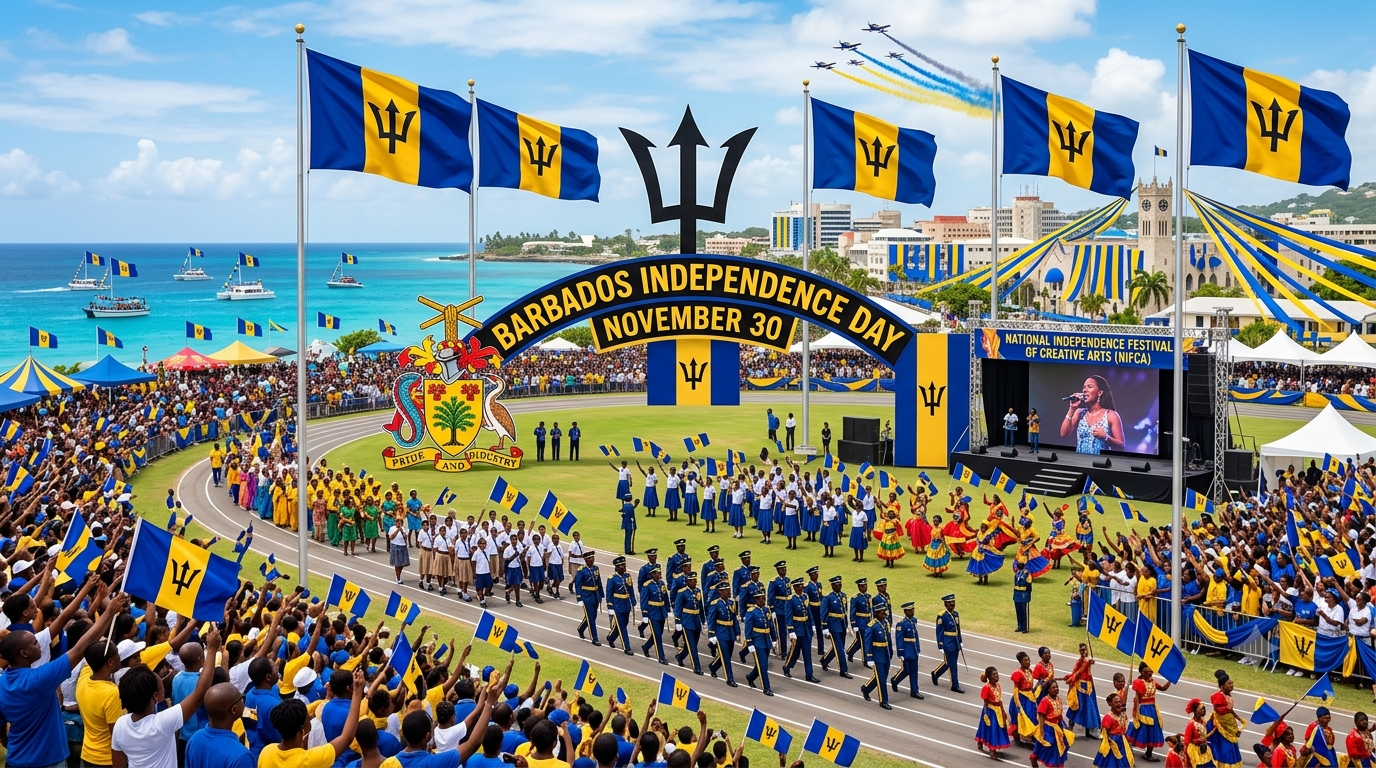
The month of November features community programs, lights, cultural events, school activities, music, food, and national ceremonies, culminating on November 30.
The date now celebrates independence and republican statehood while also inviting reflection on Indigenous loss, slavery, emancipation, labor struggle, democratic participation, and Caribbean identity.
Sources and further reading
Traditions
Related comparison routes: jamaica-independence-day, bahamas-independence-day, haiti-independence-day, saint-lucia-independence-day.
Slug-specific editorial cue: barbados independence day.
Barbados Independence Day planning focus: November 30.
How It Is Celebrated
People may use the Barbados Independence Day countdown for planning, education, community calendars, awareness work, family schedules or official observance research. The visible customs depend on Caribbean states and diaspora communities, so this page does not assume one universal form.
Interesting Facts
- Barbados Independence Day uses November 30.
- Primary region or audience: Caribbean states and diaspora communities.
- Content cluster: Caribbean Independence Days.
- Related countdowns include jamaica-independence-day, bahamas-independence-day, haiti-independence-day, saint-lucia-independence-day.
- The canonical slug remains barbados-independence-day.
Related Holiday Guides
Christmas guide → Christmas GuideA clear overview of Christmas history, dates, symbols and traditions.→
Christmas TraditionsExplore trees, gifts, meals, carols and family rituals.→
Christmas HistoryLearn how Christmas developed through religious and cultural history.→
Christmas Around the WorldSee how Christmas customs vary across countries and communities.→
Christmas GuideA clear overview of Christmas history, dates, symbols and traditions.→
Christmas TraditionsExplore trees, gifts, meals, carols and family rituals.→
Christmas HistoryLearn how Christmas developed through religious and cultural history.→
Christmas Around the WorldSee how Christmas customs vary across countries and communities.→Questions
Barbados Independence Day FAQ
Clear answers about the date, countdown target and seasonal context.
When is Barbados Independence Day?
Barbados Independence Day uses November 30 for this countdown.
Who is this Barbados Independence Day page for?
It is written for visitors comparing Caribbean states and diaspora communities dates and Caribbean Independence Days countdowns. This guidance applies specifically to Barbados Independence Day.
What should I compare with Barbados Independence Day?
Start with jamaica-independence-day, bahamas-independence-day, haiti-independence-day, saint-lucia-independence-day, then use the directory filters for more Caribbean pages. This guidance applies specifically to Barbados Independence Day.
Does Barbados Independence Day have identical customs everywhere?
No. Local public status, community events and calendar notes can differ across Caribbean states and diaspora communities. This guidance applies specifically to Barbados Independence Day.
Did this update change the Barbados Independence Day route?
No. The page keeps the existing barbados-independence-day URL and date rule. This guidance applies specifically to Barbados Independence Day.