South Asian National Holidays Countdown
(v) Scroll to discover more insights
How many days until
Bangladesh Independence Day
Bangladesh Independence Day counts down to March 26, giving visitors a clear annual reference for civic observance, school programming, historical reflection, and comparison with other South Asian national dates.
More holidays in March
224Days
00Hours
00Minutes
00Seconds
Quick Facts
About Bangladesh Independence Day
Bangladesh Independence Day marks the declaration of independence in 1971 and is one of the key national dates in Bangladesh's civic calendar. This page is written as a Bangladesh-specific reference rather than a generic holiday template, and it keeps the distinction clear between Independence Day on March 26 and Victory Day on December 16. That distinction matters because visitors often search for one date while accidentally landing on the other.
History of Bangladesh Independence Day
Introduction
Bangladesh Independence Day is observed on March 26. It commemorates the declaration of independence in 1971 and the beginning of the Bangladesh Liberation War.
The holiday is distinct from Victory Day on December 16, which marks the surrender of Pakistani forces after nine months of war. Independence Day remembers the political crisis, the military crackdown of March 25, the declaration of sovereignty, resistance, mass violence, refugee displacement, and the creation of Bangladesh.
Partition and East Bengal
British India was partitioned in 1947 into India and Pakistan. Muslim-majority eastern Bengal became East Bengal, part of Pakistan, despite being separated from West Pakistan by more than a thousand miles of Indian territory.
The two wings differed in language, culture, economy, political history, and social structure. Power remained concentrated in West Pakistan's military, bureaucracy, and political elite.
The Bengali language movement
Conflict emerged when Urdu was promoted as the sole national language even though Bengali was spoken by the majority of Pakistan's population.
Students and activists demanded recognition of Bengali. On February 21, 1952, police killed demonstrators in Dhaka, turning the Language Movement into a central source of Bengali political identity.
Economic and political inequality
East Pakistan generated major export earnings through products such as jute, but many Bengalis believed investment, military spending, and administrative power favored West Pakistan.
Underrepresentation in the armed forces and central government deepened demands for autonomy.
Military rule
Pakistan experienced repeated constitutional crises and military rule.
Ayub Khan's government promoted centralized development but restricted democratic participation. Protests in East Pakistan grew around language, economic justice, and provincial autonomy.
The Six-Point Movement
Sheikh Mujibur Rahman and the Awami League advanced the Six-Point Program in 1966.
It called for a federal structure with strong provincial autonomy, separate fiscal powers, and control over economic policy. Supporters viewed it as necessary protection; opponents in the central state treated it as a threat to national unity.
The 1970 cyclone
The Bhola cyclone devastated coastal East Pakistan in November 1970 and killed large numbers of people.
The central government's widely criticized response intensified anger and the belief that East Pakistan's population was treated as politically secondary.
The 1970 general election
Pakistan held national elections in December 1970. The Awami League won an overwhelming victory in East Pakistan and secured a majority in the National Assembly.
Under a parliamentary transfer of power, Sheikh Mujibur Rahman should have been in a position to form the government, but negotiations stalled.
The March 1971 crisis
President Yahya Khan postponed the opening of the National Assembly, triggering strikes, mass demonstrations, and civil disobedience in East Pakistan.
Sheikh Mujib's March 7 speech called on the population to prepare for struggle while negotiations continued.
Operation Searchlight
On the night of March 25, 1971, the Pakistan Army launched Operation Searchlight in Dhaka and other locations.
Students, political activists, police, soldiers, intellectuals, and civilians were attacked. The campaign expanded into mass killing, detention, village destruction, rape, and persecution.
The declaration of independence
Bangladesh's independence is dated to March 26, 1971. Messages declaring independence were transmitted after the military crackdown and the arrest of Sheikh Mujibur Rahman.
Different individuals relayed announcements during the chaotic opening of the war, but the constitutional and national narrative centers the proclamation of independence by the Bengali leadership.
The provisional government
The Provisional Government of Bangladesh was formed in April 1971 and took its oath at Mujibnagar.
It organized administration, diplomacy, military resistance, relief, and international advocacy while operating largely from exile.
The Mukti Bahini
The Mukti Bahini included defecting military personnel, students, workers, villagers, political activists, and other resistance fighters.
Guerrilla warfare, local intelligence, conventional military units, and popular support weakened Pakistani control over time.
Mass atrocities
The war involved widespread atrocities against civilians, including targeted violence against Bengali nationalists, Hindus, intellectuals, students, and rural communities.
Scholars and governments continue to debate terminology and casualty estimates, but the scale of killing, sexual violence, forced displacement, and destruction is not in doubt.
Refugees in India
Millions of refugees crossed into India during the conflict.
The crisis placed enormous pressure on border states and contributed to India's political and military involvement.
Women and the war
Women experienced sexual violence, displacement, loss, imprisonment, and economic hardship.
Women also served as organizers, nurses, fighters, messengers, broadcasters, cultural workers, and providers of food and shelter. Postwar recognition of survivors has remained incomplete and politically contested.
International politics
The conflict unfolded during the Cold War. India supported the Bengali resistance, while Pakistan retained important relations with the United States and China. The Soviet Union supported India diplomatically.
International responses were shaped by strategic interests as well as humanitarian evidence.
December 1971 and victory
War between India and Pakistan began openly in December. Indian forces and the Bangladesh resistance advanced rapidly.
Pakistani forces in Dhaka surrendered on December 16, 1971, establishing the military victory commemorated as Victory Day.
The Constitution of Bangladesh
Bangladesh adopted a constitution in 1972. Its preamble states that the people proclaimed independence on March 26, 1971 after a historic struggle for national liberation.
The new state faced the enormous tasks of reconstruction, refugee return, justice, political institution building, and economic recovery.
Historical timeline
1947: East Bengal becomes part of Pakistan.
February 21, 1952: Language Movement demonstrators are killed in Dhaka.
1966: The Six-Point Movement advances demands for autonomy.
November 1970: The Bhola cyclone devastates East Pakistan.
December 1970: The Awami League wins a national parliamentary majority.
March 25, 1971: Operation Searchlight begins.
March 26, 1971: Bangladesh's independence is proclaimed.
April 1971: The provisional government is formed.
December 16, 1971: Pakistani forces surrender in Dhaka.
1972: Bangladesh adopts its Constitution.
Bangladesh Independence Day today
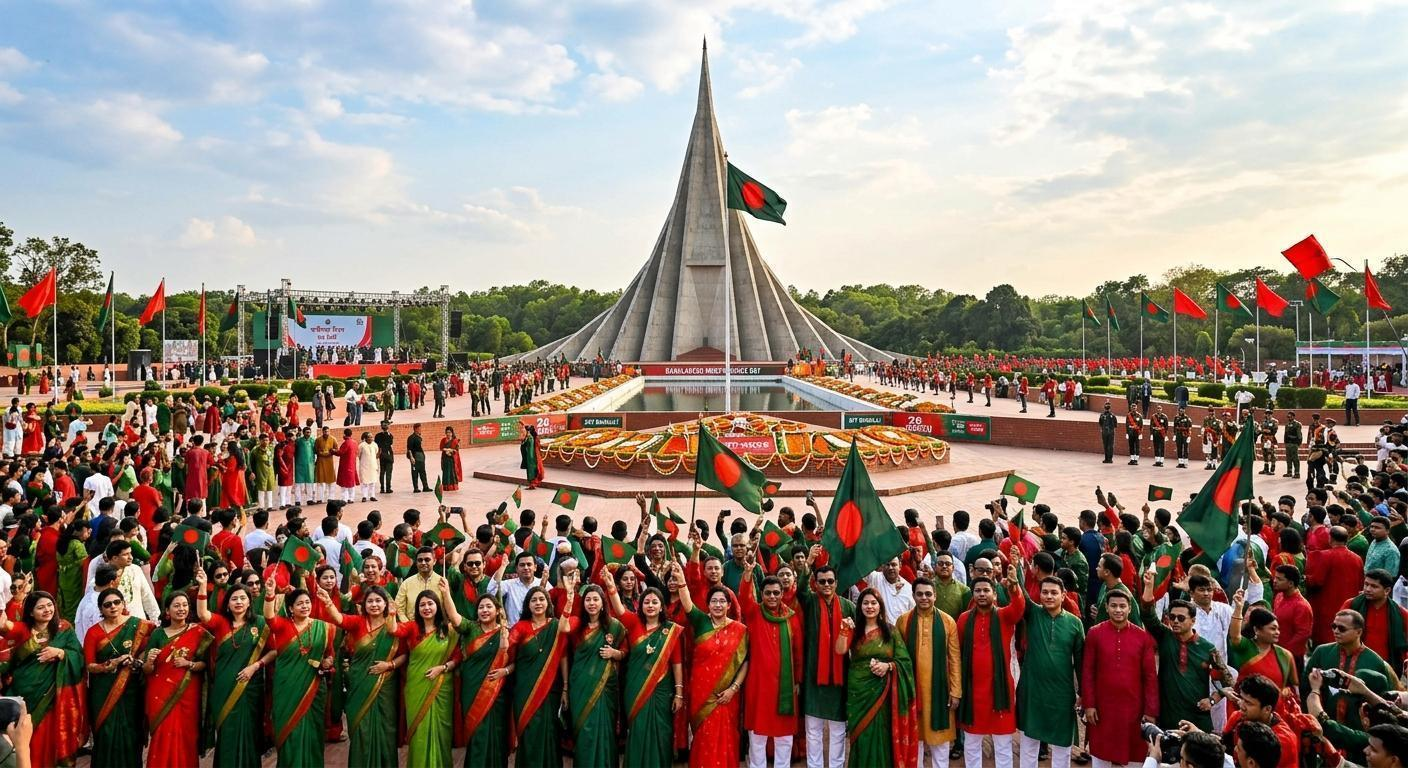
The day is marked by flag raising, memorial ceremonies, cultural programs, military displays, speeches, school events, and visits to the National Martyrs' Memorial at Savar.
The strongest observances distinguish independence from military victory, center the experiences of civilians and survivors, and acknowledge the continuing importance of language, democracy, minority rights, historical documentation, and accountability.
Sources and further reading
- Government of Bangladesh, Independence Day
- Government of Bangladesh, Constitution of the People's Republic of Bangladesh
- Liberation War Museum, Bangladesh
- Encyclopaedia Britannica, Bangladesh
- Encyclopaedia Britannica, Bangladesh Liberation War
- United Nations, Bangladesh
- Library of Congress, Bangladesh: A Country Study
- United States Holocaust Memorial Museum, Bangladesh
Traditions
Community events, speeches, or cultural programming
Comparing March 26 with Victory Day later in the year
Flag displays and civic observance
How It Is Celebrated
Bangladesh Independence Day may be marked with public ceremonies, educational programming, remembrance, media coverage, community events, and national symbolism. The exact scale varies, but the page keeps the focus on the country's civic and historical context rather than on generic seasonal celebration language.
Interesting Facts
- Bangladesh Independence Day is fixed on March 26.
- The day is distinct from Bangladesh Victory Day on December 16.
- This page is written for the Bangladesh national context rather than a broad international template.
- Visitors often compare the date with other South Asian national days.
- The countdown rolls forward to the next March 26 after the date passes.
Related Holiday Guides
Holiday directory →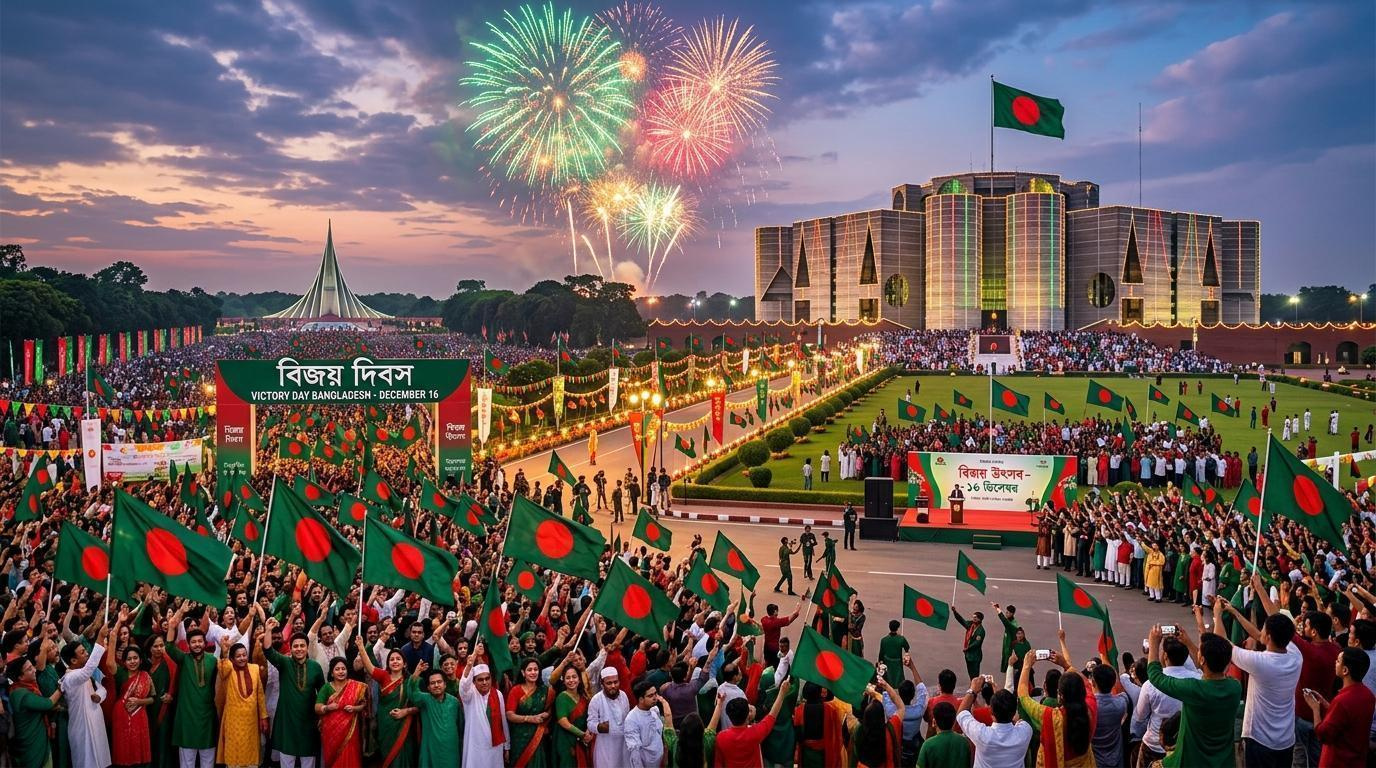 South Asia HolidaysBrowse national countdowns connected to South Asian civic dates and observances.→
Bangladesh Victory DayCompare Bangladesh's March 26 Independence Day with the December 16 Victory Day page.→
Upcoming HolidaysSee which national and seasonal countdowns are arriving next.→
India Independence DayCompare nearby South Asian national date pages and civic references.→
South Asia HolidaysBrowse national countdowns connected to South Asian civic dates and observances.→
Bangladesh Victory DayCompare Bangladesh's March 26 Independence Day with the December 16 Victory Day page.→
Upcoming HolidaysSee which national and seasonal countdowns are arriving next.→
India Independence DayCompare nearby South Asian national date pages and civic references.→Questions
Bangladesh Independence Day FAQ
Clear answers about the date, countdown target and seasonal context.
When is Bangladesh Independence Day?
Bangladesh Independence Day is March 26 every year.
Is Bangladesh Independence Day the same as Victory Day?
No. Independence Day is March 26, while Bangladesh Victory Day is December 16.
What does this page count down to?
It counts down to the next March 26, the annual Independence Day date.
Why is this page separate from other independence-day countdowns?
The page is intended to keep Bangladesh's specific national context and date distinctions clear.
What should I compare with this page?
Bangladesh Victory Day, India Independence Day, Pakistan Independence Day, and other South Asian national-date countdowns are the most useful nearby references.