Caribbean Independence Days Countdown
(v) Scroll to discover more insights
How many days until
Bahamas Independence Day
Bahamas Independence Day is tracked through July 10, with this page written for Caribbean states and diaspora communities and the Caribbean Independence Days cluster.
More holidays in July
330Days
00Hours
00Minutes
00Seconds
Quick Facts
About Bahamas Independence Day
Bahamas Independence Day is a national observance page in Holiday Countdown Library. Its useful planning context is the combination of July 10, Caribbean states and diaspora communities, Caribbean classification and related routes such as jamaica-independence-day, haiti-independence-day, saint-lucia-independence-day, belize-independence-day. The page identifies Caribbean states and diaspora communities as the primary context for Bahamas Independence Day.
History of Bahamas Independence Day
Introduction
Bahamas Independence Day is observed on July 10. It commemorates the country's achievement of full independence from the United Kingdom in 1973.
The Bahamas remained a constitutional monarchy within the Commonwealth, with the British monarch serving as head of state. Independence followed centuries of Indigenous history, European conquest, slavery, British colonial rule, loyalist migration, economic transformation, majority rule, and constitutional negotiation.
Lucayan society
Before European arrival, the islands were inhabited by the Lucayan people, part of the wider Taíno cultural world.
They developed fishing, farming, seafaring, trade, and settlements adapted to the island environment.
European conquest and depopulation
Christopher Columbus reached the Bahamas in 1492.
Spanish slave raiding and disease devastated the Lucayan population, and the islands were largely depopulated within decades.
English settlement
English Puritan settlers known as the Eleutheran Adventurers established communities in the seventeenth century.
Settlement remained difficult because of limited soil, storms, isolation, and conflict.
Piracy and imperial control
Nassau became associated with piracy during the early eighteenth century.
Britain imposed stronger colonial government in 1718 to restore imperial control.
Slavery and plantation society
Enslaved Africans and their descendants became central to the population and economy.
Plantation agriculture was less successful than in some Caribbean colonies, but slavery shaped land, labor, law, race, and political power.
Loyalist migration
After the American Revolution, British loyalists migrated to the Bahamas with enslaved people.
The movement greatly increased the population and expanded cotton cultivation before soil exhaustion and pests undermined the industry.
Emancipation
Slavery was abolished in the British Empire in the 1830s.
Formerly enslaved Bahamians gained legal freedom but continued to face unequal access to land, wealth, education, and political power.
Wrecking, sponging, and maritime work
Bahamians developed livelihoods through fishing, wrecking, shipbuilding, salt, sponging, and regional trade.
These industries tied the islands closely to maritime markets and the nearby United States.
Prohibition and tourism
U.S. Prohibition created a major trade in alcohol through the Bahamas.
After Prohibition ended, tourism, finance, construction, and services became increasingly important.
Colonial political inequality
Political and economic power remained concentrated among a white mercantile elite often known as the Bay Street Boys.
Most Black Bahamians faced restricted access to political influence and economic opportunity.
The Burma Road Riot
In 1942, Black Bahamian workers protested unequal pay on a wartime construction project.
The Burma Road Riot became a major symbol of labor and civil-rights struggle.
Political organization and majority rule
The Progressive Liberal Party organized against racial and political inequality.
Universal adult suffrage, party competition, and the 1967 election brought majority rule under Lynden Pindling.
The road to independence
The Bahamas gained internal self-government and entered constitutional negotiations with Britain.
Supporters viewed independence as the completion of majority rule, while opponents debated economic and institutional risks.
July 10, 1973
The Bahamas became a free and sovereign country on July 10, 1973.
The new flag was raised at midnight, and Lynden Pindling became the first prime minister of the independent state.
Constitutional monarchy
The Bahamas retained the monarch as head of state, represented by a governor-general.
The country joined the Commonwealth and established its own international diplomatic relations.
Tourism, finance, and vulnerability
Tourism and financial services became central to the economy.
Dependence on external markets, hurricanes, climate change, inequality, and migration continues to shape national development.
Historical timeline
Before 1492: Lucayan communities inhabit the islands.
1490s–1500s: Spanish enslavement and disease devastate the Indigenous population.
1640s: English settlement begins.
1718: Britain establishes stronger Crown administration.
1780s: Loyalists and enslaved people arrive after the American Revolution.
1830s: Slavery is abolished.
1942: The Burma Road Riot challenges labor inequality.
1967: Majority rule begins.
July 10, 1973: The Bahamas becomes independent.
Today: Independence Day celebrates sovereignty, majority rule, and national identity.
Bahamas Independence Day today
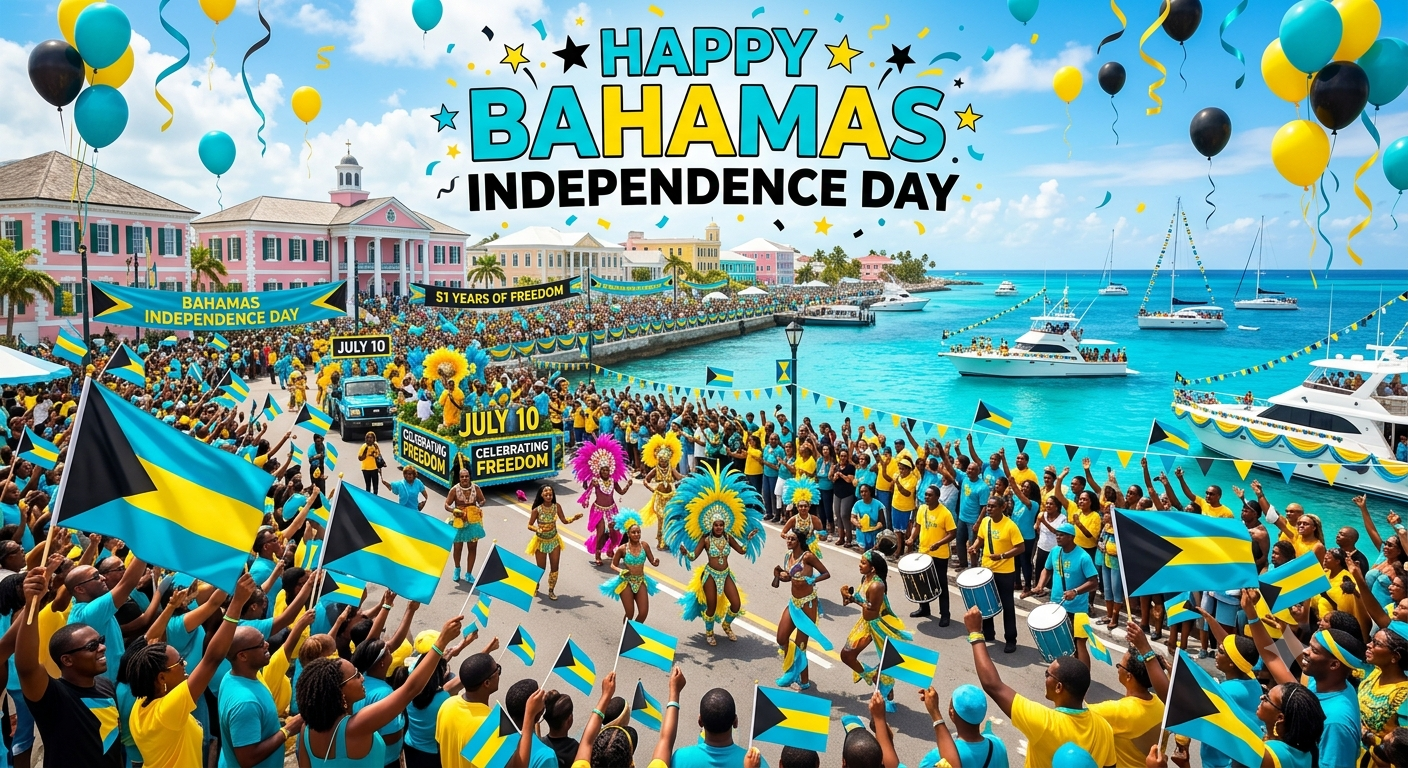
Celebrations include flag ceremonies, cultural performances, church services, concerts, fireworks, Junkanoo events, and community gatherings.
The holiday honors independence while the country's deeper history includes Lucayan destruction, slavery, emancipation, labor protest, majority rule, and modern environmental vulnerability.
Sources and further reading
Traditions
Related comparison routes: jamaica-independence-day, haiti-independence-day, saint-lucia-independence-day, belize-independence-day.
Slug-specific editorial cue: bahamas independence day.
Bahamas Independence Day planning focus: July 10.
How It Is Celebrated
People may use the Bahamas Independence Day countdown for planning, education, community calendars, awareness work, family schedules or official observance research. The visible customs depend on Caribbean states and diaspora communities, so this page does not assume one universal form.
Interesting Facts
- Bahamas Independence Day uses July 10.
- Primary region or audience: Caribbean states and diaspora communities.
- Content cluster: Caribbean Independence Days.
- Related countdowns include jamaica-independence-day, haiti-independence-day, saint-lucia-independence-day, belize-independence-day.
- The canonical slug remains bahamas-independence-day.
Related Holiday Guides
Christmas guide → Christmas GuideA clear overview of Christmas history, dates, symbols and traditions.→
Christmas TraditionsExplore trees, gifts, meals, carols and family rituals.→
Christmas HistoryLearn how Christmas developed through religious and cultural history.→
Christmas Around the WorldSee how Christmas customs vary across countries and communities.→
Christmas GuideA clear overview of Christmas history, dates, symbols and traditions.→
Christmas TraditionsExplore trees, gifts, meals, carols and family rituals.→
Christmas HistoryLearn how Christmas developed through religious and cultural history.→
Christmas Around the WorldSee how Christmas customs vary across countries and communities.→Questions
Bahamas Independence Day FAQ
Clear answers about the date, countdown target and seasonal context.
When is Bahamas Independence Day?
Bahamas Independence Day uses July 10 for this countdown.
Who is this Bahamas Independence Day page for?
It is written for visitors comparing Caribbean states and diaspora communities dates and Caribbean Independence Days countdowns. This guidance applies specifically to Bahamas Independence Day.
What should I compare with Bahamas Independence Day?
Start with jamaica-independence-day, haiti-independence-day, saint-lucia-independence-day, belize-independence-day, then use the directory filters for more Caribbean pages. This guidance applies specifically to Bahamas Independence Day.
Does Bahamas Independence Day have identical customs everywhere?
No. Local public status, community events and calendar notes can differ across Caribbean states and diaspora communities. This guidance applies specifically to Bahamas Independence Day.
Did this update change the Bahamas Independence Day route?
No. The page keeps the existing bahamas-independence-day URL and date rule. This guidance applies specifically to Bahamas Independence Day.