Caribbean Independence Days Countdown
(v) Scroll to discover more insights
How many days until
Antigua and Barbuda Independence Day
Antigua and Barbuda Independence Day is tracked through November 1, with this page written for Caribbean states and diaspora communities and the Caribbean Independence Days cluster.
More holidays in November
79Days
00Hours
00Minutes
00Seconds
Quick Facts
About Antigua and Barbuda Independence Day
Antigua and Barbuda Independence Day is a national observance page in Holiday Countdown Library. Its useful planning context is the combination of November 1, Caribbean states and diaspora communities, Caribbean classification and related routes such as jamaica-independence-day, bahamas-independence-day, haiti-independence-day, saint-lucia-independence-day.
History of Antigua and Barbuda Independence Day
Introduction
Antigua and Barbuda Independence Day is observed on November 1. It commemorates the end of British colonial rule and the establishment of the independent state of Antigua and Barbuda in 1981.
The holiday celebrates sovereignty, but the country's history also includes Indigenous settlement, European conquest, plantation slavery, emancipation, labor rebellion, constitutional reform, and continuing debate over the relationship between Antigua and Barbuda.
Indigenous peoples
The islands were inhabited by Indigenous peoples long before European arrival, including communities often identified with the Arawak and Kalinago cultural worlds.
They developed agriculture, fishing, trade, seafaring, and village life across the eastern Caribbean.
European conquest
European colonization brought warfare, disease, forced removal, and demographic collapse.
Britain established lasting control of Antigua in the seventeenth century and later administered Barbuda under related colonial arrangements.
Sugar plantations
Antigua became a major sugar-producing colony.
Plantation wealth depended on the forced labor of enslaved Africans and their descendants.
Slavery and resistance
Enslaved people resisted through work slowdowns, flight, cultural survival, sabotage, and organized revolt.
The 1736 conspiracy associated with Prince Klaas became one of the best-known episodes of resistance in Antigua.
Barbuda's distinct history
Barbuda developed a distinct communal relationship to land and local governance.
Its residents have repeatedly defended collective land rights and greater political autonomy within the state.
Emancipation
Slavery ended in the British Caribbean in the 1830s.
Freedom did not bring equal land access or economic power, and plantation owners continued to dominate much of the economy.
Labor unrest
Low wages, poor housing, unemployment, and racial inequality fueled labor protest during the twentieth century.
The 1930s Caribbean labor uprisings helped create trade unions and mass political movements.
V. C. Bird and organized labor
Vere Cornwall Bird emerged as a major labor leader and politician.
The Antigua Trades and Labour Union and later the Antigua Labour Party linked worker organization with demands for political representation.
Universal suffrage
Voting rights expanded during the mid-twentieth century.
Representative government created a path from colonial administration toward ministerial responsibility and self-government.
The West Indies Federation
Antigua and Barbuda joined the West Indies Federation in 1958.
The federation collapsed in 1962, ending one proposed route to regional independence.
Associated statehood
In 1967, Antigua became an associated state with Britain.
It gained full control over internal affairs while Britain retained responsibility for defense and foreign relations.
The road to independence
Negotiations continued over constitutional arrangements, economic capacity, and Barbuda's position.
Opposition parties and Barbudan leaders raised concerns about central power and local rights.
November 1, 1981
Antigua and Barbuda became independent on November 1, 1981.
V. C. Bird became the first prime minister, and the country remained a constitutional monarchy within the Commonwealth.
Tourism and economic change
Tourism replaced sugar as the dominant economic sector.
Development brought employment and infrastructure but also increased dependence on foreign investment, coastal land, and global travel.
Hurricanes and climate vulnerability
The islands face major risks from hurricanes, sea-level rise, drought, and coastal erosion.
Hurricane Irma devastated Barbuda in 2017 and intensified debate over evacuation, rebuilding, land ownership, and self-government.
Historical timeline
Precolonial era: Indigenous communities inhabit and trade across the islands.
Seventeenth century: Britain establishes colonial control.
Seventeenth–nineteenth centuries: Sugar plantations and slavery dominate Antigua.
1736: Authorities suppress the Prince Klaas conspiracy.
1834: Emancipation begins under British law.
1930s: Labor movements transform colonial politics.
1951: Universal adult suffrage is introduced.
1958–1962: The islands participate in the West Indies Federation.
1967: Associated statehood begins.
November 1, 1981: Antigua and Barbuda becomes independent.
2017: Hurricane Irma devastates Barbuda.
Independence Day today
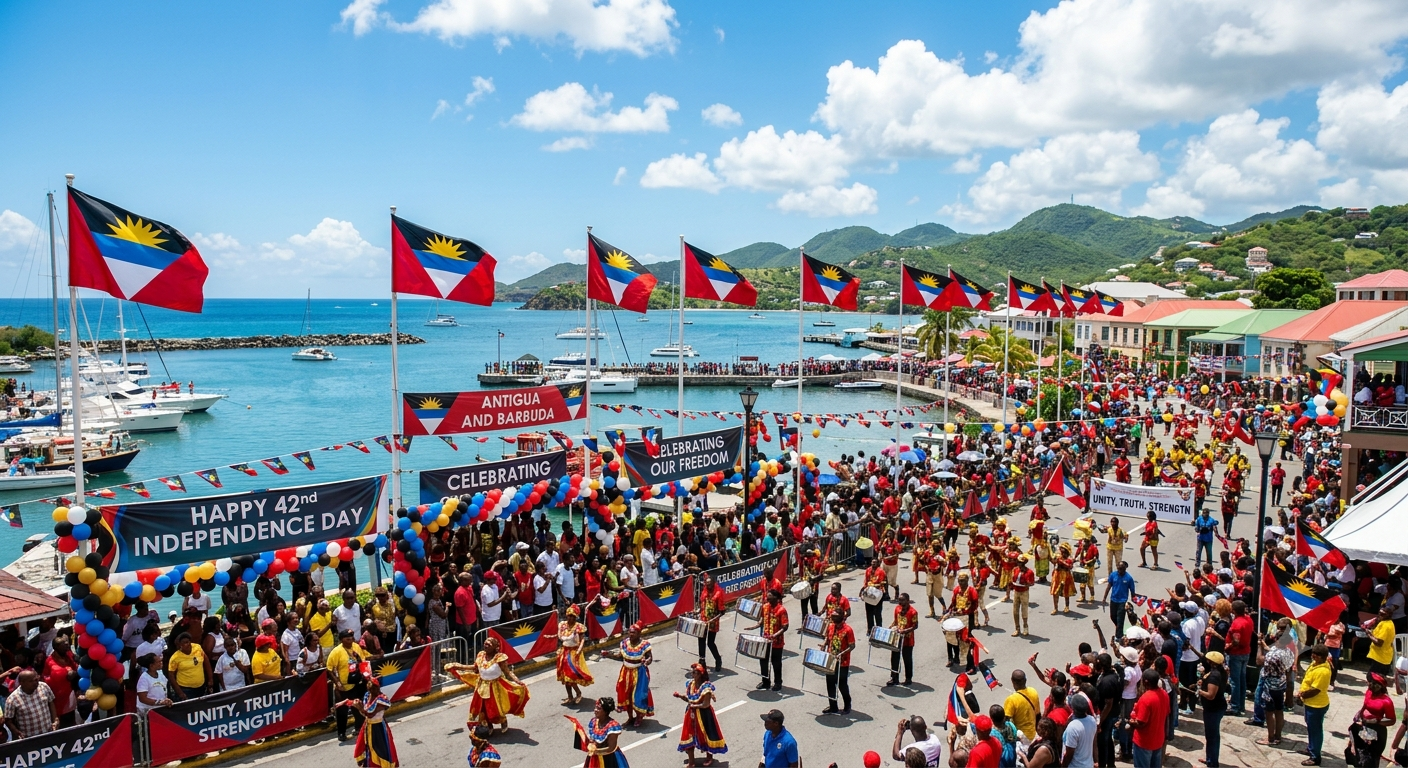
The holiday is marked by flags, official ceremonies, parades, church services, school programs, music, food, and cultural events.
It celebrates sovereignty while national debate continues over Barbuda's land rights, climate resilience, economic dependence, and democratic representation.
Sources and further reading
- Government of Antigua and Barbuda
- Government of Antigua and Barbuda, National Holidays
- Ministry of Foreign Affairs of Antigua and Barbuda
- Encyclopaedia Britannica, Antigua and Barbuda
- The Commonwealth, Antigua and Barbuda
- United Nations, Antigua and Barbuda
- CARICOM, Antigua and Barbuda
- Eastern Caribbean Supreme Court
Traditions
Related comparison routes: jamaica-independence-day, bahamas-independence-day, haiti-independence-day, saint-lucia-independence-day.
Slug-specific editorial cue: antigua and barbuda.
Antigua and Barbuda Independence Day planning focus: November 1.
How It Is Celebrated
People may use the Antigua and Barbuda Independence Day countdown for planning, education, community calendars, awareness work, family schedules or official observance research. The visible customs depend on Caribbean states and diaspora communities, so this page does not assume one universal form.
Interesting Facts
- Antigua and Barbuda Independence Day uses November 1.
- Primary region or audience: Caribbean states and diaspora communities.
- Content cluster: Caribbean Independence Days.
- Related countdowns include jamaica-independence-day, bahamas-independence-day, haiti-independence-day, saint-lucia-independence-day.
- The canonical slug remains antigua-and-barbuda-independence-day.
Related Holiday Guides
Christmas guide → Christmas GuideA clear overview of Christmas history, dates, symbols and traditions.→
Christmas TraditionsExplore trees, gifts, meals, carols and family rituals.→
Christmas HistoryLearn how Christmas developed through religious and cultural history.→
Christmas Around the WorldSee how Christmas customs vary across countries and communities.→
Christmas GuideA clear overview of Christmas history, dates, symbols and traditions.→
Christmas TraditionsExplore trees, gifts, meals, carols and family rituals.→
Christmas HistoryLearn how Christmas developed through religious and cultural history.→
Christmas Around the WorldSee how Christmas customs vary across countries and communities.→Questions
Antigua and Barbuda Independence Day FAQ
Clear answers about the date, countdown target and seasonal context.
When is Antigua and Barbuda Independence Day?
Antigua and Barbuda Independence Day uses November 1 for this countdown.
Who is this Antigua and Barbuda Independence Day page for?
It is written for visitors comparing Caribbean states and diaspora communities dates and Caribbean Independence Days countdowns. This guidance applies specifically to Antigua and Barbuda Independence Day.
What should I compare with Antigua and Barbuda Independence Day?
Start with jamaica-independence-day, bahamas-independence-day, haiti-independence-day, saint-lucia-independence-day, then use the directory filters for more Caribbean pages. This guidance applies specifically to Antigua and Barbuda Independence Day.
Does Antigua and Barbuda Independence Day have identical customs everywhere?
No. Local public status, community events and calendar notes can differ across Caribbean states and diaspora communities. This guidance applies specifically to Antigua and Barbuda Independence Day.
Did this update change the Antigua and Barbuda Independence Day route?
No. The page keeps the existing antigua-and-barbuda-independence-day URL and date rule. This guidance applies specifically to Antigua and Barbuda Independence Day.