Mediterranean National Days Countdown
(v) Scroll to discover more insights
How many days until
Andalusia Day
Andalusia Day is tracked through February 28, with this page written for Southern Europe and Mediterranean regions and the Mediterranean National Days cluster.
More holidays in February
198Days
00Hours
00Minutes
00Seconds
Quick Facts
About Andalusia Day
Andalusia Day is a national observance page in Holiday Countdown Library. Its useful planning context is the combination of February 28, Southern Europe and Mediterranean regions, Mediterranean classification and related routes such as portugal-day, greece-independence-day, spain-constitution-day, malta-independence-day. The page identifies Southern Europe and Mediterranean regions as the primary context for Andalusia Day.
History of Andalusia Day
Introduction
Andalusia Day, or Día de Andalucía, is observed on February 28. It commemorates the 1980 referendum through which Andalusians pursued the highest level of regional self-government then available under Spain’s 1978 Constitution. The day is both a civic holiday and a reflection on Andalusia’s identity, institutions, historical inequalities, cultural diversity, and place within democratic Spain.
The holiday does not mark Andalusia becoming an independent country. It marks a decisive stage in the creation of the Autonomous Community of Andalusia. Its history belongs to Spain’s transition from the dictatorship of Francisco Franco to parliamentary democracy and a decentralized system of autonomous communities.
Andalusian identity before autonomy
Andalusia has been shaped by many societies, including ancient Iberian and Tartessian communities, Roman rule, Visigothic kingdoms, centuries of Islamic government in al-Andalus, Christian conquest, Atlantic trade, migration, agriculture, and industrial change. Modern regional identity drew on this layered past but was also influenced by poverty, unequal land ownership, labor movements, and demands for political reform.
During the late nineteenth and early twentieth centuries, writers and political activists developed forms of Andalusian regionalism. Blas Infante became its best-known figure. He promoted recognition of Andalusia as a historical community and helped popularize symbols such as the green-and-white flag, the coat of arms, and the anthem. Infante was killed by Francoist forces in 1936 during the Spanish Civil War. He is officially remembered as the “Father of the Andalusian Fatherland,” though Andalusian political identity has always contained many perspectives.
Dictatorship and democratic transition
Under Franco’s dictatorship, regional autonomy was suppressed and political organization was tightly controlled. After Franco’s death in 1975, Spain began a negotiated transition to democracy. The 1977 general election opened space for regional demands. On December 4, 1977, large demonstrations took place across Andalusia calling for autonomy. In Málaga, the young demonstrator Manuel José García Caparrós was shot and killed, becoming an enduring symbol of the movement.
A pre-autonomous Andalusian government was established in 1978. The new Spanish Constitution, approved that year, created routes through which regions could form autonomous communities. Andalusian leaders sought the route under Article 151, which offered faster access to a broad range of powers but required demanding referendum thresholds.
The referendum of February 28, 1980
The referendum asked voters in the eight provinces whether Andalusia should begin the autonomy process through Article 151. A majority supported the proposal across the region, but the legal threshold was not reached in Almería province. The result created a constitutional and political crisis because the overall vote clearly demonstrated wide support for full autonomy.
Spain’s parliament subsequently changed the legal framework so that Almería could be incorporated into the process. This allowed all eight provinces—Almería, Cádiz, Córdoba, Granada, Huelva, Jaén, Málaga, and Seville—to form one autonomous community under the same statute.
The Statute and autonomous institutions
The Statute of Autonomy was approved by referendum in 1981 and entered into force after parliamentary approval. Elections to the Andalusian Parliament followed in 1982, and the autonomous institutions developed powers in fields including education, health, culture, social services, and territorial administration.
Autonomy did not eliminate economic inequality, unemployment, rural disadvantage, or disputes over public policy. Nor did it produce a single definition of Andalusian identity. The region includes distinct provincial, rural, urban, coastal, migrant, Roma, working-class, religious, linguistic, and political experiences. Modern commemorations increasingly recognize this diversity.
Historical timeline
1918: The Assembly of Ronda helps establish the green-and-white flag and other symbols associated with modern Andalusian regionalism.
1936: Blas Infante is killed during the opening months of the Spanish Civil War.
December 4, 1977: Mass demonstrations across Andalusia demand political autonomy; Manuel José García Caparrós is killed in Málaga.
1978: A pre-autonomous Junta of Andalusia is established, and Spain’s new Constitution provides legal routes to self-government.
June 1979: The Andalusian government chooses to pursue autonomy through Article 151.
February 28, 1980: Andalusians vote in the autonomy referendum that becomes the basis of Andalusia Day.
1981: The first Statute of Autonomy for Andalusia is approved.
1982: The first elections to the Parliament of Andalusia are held.
2007: A reformed Statute of Autonomy enters into force after approval by referendum and the Spanish parliament.
Andalusia Day today
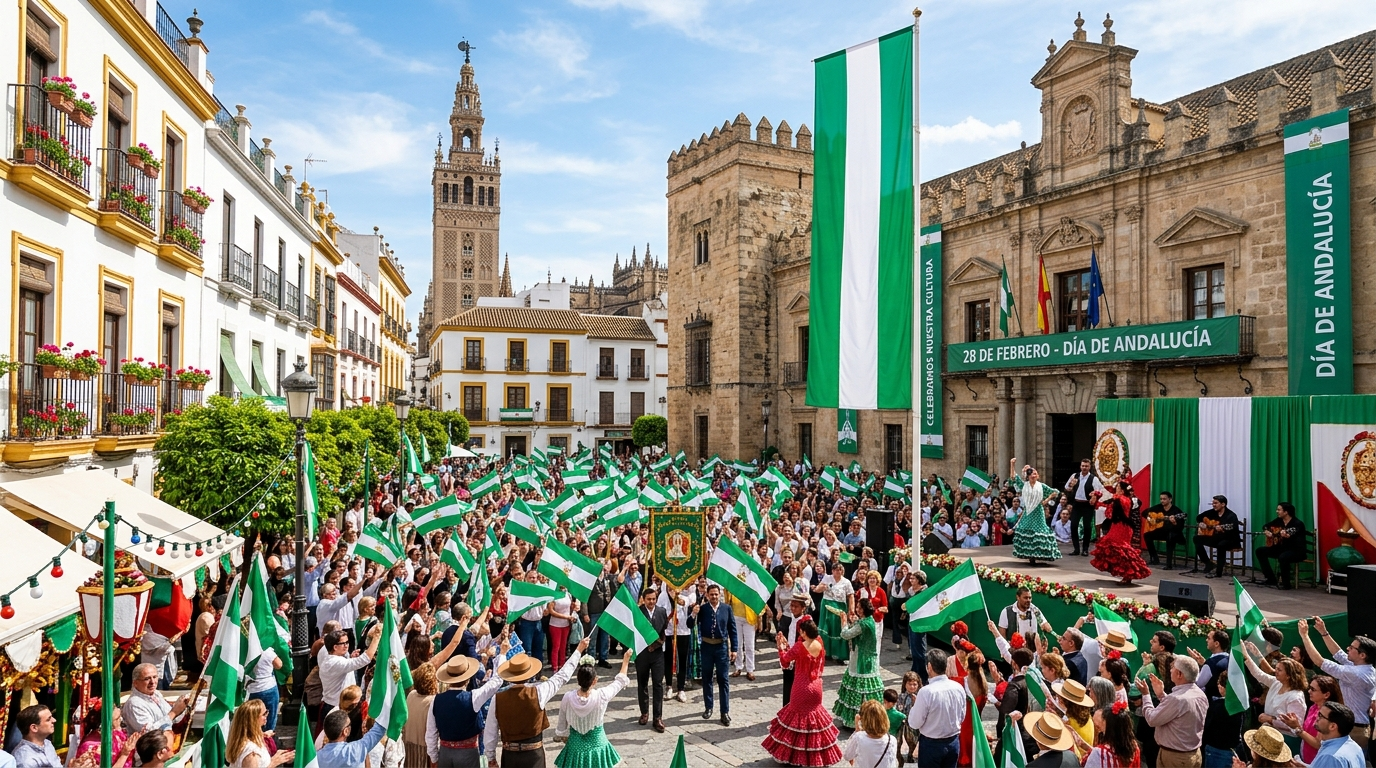
Andalusia Day is a public holiday across the autonomous community. Institutional ceremonies may include the presentation of regional honors, the raising of the green-and-white flag, performances of the anthem, educational activities, exhibitions, concerts, and public events. Schools often teach the history and symbols of autonomy, sometimes sharing bread with olive oil as a regional food tradition.
Celebrations vary from year to year and should not be described as fixed everywhere. The date remains an opportunity to discuss democratic participation, the legacy of the transition, social and economic challenges, cultural heritage, and the meaning of self-government within Spain and the European Union.
Sources and further reading
Traditions
Related comparison routes: portugal-day, greece-independence-day, spain-constitution-day, malta-independence-day.
Slug-specific editorial cue: andalusia day.
Andalusia Day planning focus: February 28.
How It Is Celebrated
People may use the Andalusia Day countdown for planning, education, community calendars, awareness work, family schedules or official observance research. The visible customs depend on Southern Europe and Mediterranean regions, so this page does not assume one universal form.
Interesting Facts
- Andalusia Day uses February 28.
- Primary region or audience: Southern Europe and Mediterranean regions.
- Content cluster: Mediterranean National Days.
- Related countdowns include portugal-day, greece-independence-day, spain-constitution-day, malta-independence-day.
- The canonical slug remains andalusia-day.
Related Holiday Guides
Christmas guide → Christmas GuideA clear overview of Christmas history, dates, symbols and traditions.→
Christmas TraditionsExplore trees, gifts, meals, carols and family rituals.→
Christmas HistoryLearn how Christmas developed through religious and cultural history.→
Christmas Around the WorldSee how Christmas customs vary across countries and communities.→
Christmas GuideA clear overview of Christmas history, dates, symbols and traditions.→
Christmas TraditionsExplore trees, gifts, meals, carols and family rituals.→
Christmas HistoryLearn how Christmas developed through religious and cultural history.→
Christmas Around the WorldSee how Christmas customs vary across countries and communities.→Questions
Andalusia Day FAQ
Clear answers about the date, countdown target and seasonal context.
When is Andalusia Day?
Andalusia Day uses February 28 for this countdown.
Who is this Andalusia Day page for?
It is written for visitors comparing Southern Europe and Mediterranean regions dates and Mediterranean National Days countdowns. This guidance applies specifically to Andalusia Day.
What should I compare with Andalusia Day?
Start with portugal-day, greece-independence-day, spain-constitution-day, malta-independence-day, then use the directory filters for more Mediterranean pages. This guidance applies specifically to Andalusia Day.
Does Andalusia Day have identical customs everywhere?
No. Local public status, community events and calendar notes can differ across Southern Europe and Mediterranean regions. This guidance applies specifically to Andalusia Day.
Did this update change the Andalusia Day route?
No. The page keeps the existing andalusia-day URL and date rule. This guidance applies specifically to Andalusia Day.