Central and Eastern European Holidays Countdown
(v) Scroll to discover more insights
How many days until
Albania Independence Day
Albania Independence Day is tracked through November 28, with the page centered on Albania's 1912 declaration of independence and national flag tradition.
More holidays in November
106Days
00Hours
00Minutes
00Seconds
Quick Facts
About Albania Independence Day
Albania's 1912 declaration of independence and national flag tradition is the defining context for Albania Independence Day. The site's calendar target is November 28, and common public activity includes flag ceremonies, official events, concerts, diaspora gatherings, and historical education. Albania Independence Day has a November 28 declaration and flag context distinct from neighboring Balkan statehood dates.
History of Albania Independence Day
Introduction
Albania Independence Day is observed on November 28. It commemorates the declaration of independence adopted at Vlorë in 1912, when Albanian representatives announced that the country would separate from the Ottoman Empire.
The holiday is also known as Flag Day because November 28 is associated with the raising of the red flag bearing the black double-headed eagle. The date carries several layers of national memory, including the medieval legacy of Skanderbeg, the Albanian national movement, the Balkan Wars, the creation of the modern state, and later debates over territory, language, religion, and political identity.
Albanian lands under Ottoman rule
Most Albanian-speaking regions came under Ottoman control during the late medieval period. Ottoman administration linked the region with a vast imperial system of taxation, military service, trade, law, religion, and provincial government.
Albanians participated in imperial institutions in many different ways. Some became soldiers, officials, landholders, merchants, clergy, or political leaders, while local communities also defended regional autonomy and customary practices.
Skanderbeg and medieval memory
Gjergj Kastrioti, known as Skanderbeg, led a fifteenth-century resistance against Ottoman expansion. His alliances and military campaigns became central to later Albanian national memory.
Modern commemoration often connects November 28 with the date on which Skanderbeg is traditionally said to have raised his banner at Krujë in 1443. Historians distinguish the medieval political world from the modern nation-state, but the symbolism strongly influenced the independence movement.
Religious and regional diversity
Albanian society included Muslim, Orthodox Christian, and Catholic communities. Regional identities, clan structures, dialects, urban networks, and mountain communities shaped political life.
The national movement therefore faced the challenge of creating a shared identity that crossed religious and regional boundaries. Language became one of its most important unifying claims.
The Albanian national awakening
During the nineteenth century, intellectuals, merchants, clergy, teachers, and political activists developed what became known as the Albanian National Awakening, or Rilindja Kombëtare.
They promoted education in Albanian, published books and newspapers, collected folklore, debated alphabets, and argued that Albanian-speaking lands required political rights and cultural recognition.
The League of Prizren
The League of Prizren was formed in 1878 amid fears that the decisions of the Congress of Berlin would divide Ottoman territories inhabited by Albanians among neighboring states.
The League initially sought to defend territorial integrity within the empire, but parts of the movement developed stronger demands for autonomy. Ottoman forces eventually suppressed it, yet it became a major symbol of organized Albanian political action.
The alphabet and education movement
Albanian writers used several scripts, reflecting religious, regional, and foreign influences.
The Congress of Manastir in 1908 helped standardize a Latin-based alphabet, strengthening education, publishing, and political communication across communities.
Revolts before independence
Armed uprisings and political negotiations intensified during the early twentieth century. Albanian leaders demanded schools, local administration, military reforms, and recognition of national rights.
The weakening of the Ottoman Empire and the Young Turk government's centralizing policies contributed to growing confrontation.
The First Balkan War
In October 1912, Serbia, Montenegro, Greece, and Bulgaria went to war against the Ottoman Empire.
As neighboring armies advanced into Albanian-inhabited territories, Albanian leaders feared partition and concluded that independence had become urgent.
Ismail Qemali
Ismail Qemali, an experienced Ottoman statesman and Albanian political leader, traveled to gather support for independence.
He reached Vlorë with delegates from different regions and became the leading figure of the provisional government formed after the declaration.
November 28, 1912
On November 28, 1912, representatives meeting in Vlorë declared Albania independent.
The declaration asserted political separation from the Ottoman Empire and established a provisional government. The flag became the most visible symbol of the new state.
International recognition and borders
Independence did not immediately guarantee internationally accepted borders or effective authority.
The Great Powers addressed Albania's status at the London Conference of Ambassadors. In 1913 they recognized an autonomous and later independent Albanian principality, while drawing borders that left many Albanians outside the new state.
The question of Kosovo and other Albanian communities
The new borders excluded Kosovo and other Albanian-populated regions that became part of Serbia, Montenegro, or Greece.
This created enduring political, cultural, and humanitarian questions. A careful account distinguishes the independence of Albania in 1912 from the later and separate history of Kosovo.
Prince Wilhelm and state instability
European powers selected Prince Wilhelm of Wied to rule Albania in 1914.
His government lasted only a few months amid internal conflict, foreign intervention, financial weakness, and the outbreak of the First World War.
The First World War and renewed statehood
During the First World War, Albanian territory was occupied by several foreign armies.
After the war, Albanian leaders worked to prevent partition and restore sovereignty. The Congress of Lushnjë in 1920 created new institutions and strengthened the international position of the state.
Monarchy, occupation, and communism
Albania later experienced the rule of Ahmet Zogu, who became King Zog I, followed by Italian occupation in 1939 and German occupation during the Second World War.
Communist partisans took power in 1944 under Enver Hoxha. November 28 remained an important national date, although the state added its own revolutionary interpretation.
Post-communist remembrance
The communist system collapsed in the early 1990s, and Albania moved toward multiparty politics and a market economy.
Independence Day continued as a central public holiday, with new attention to Ismail Qemali, Vlorë, the national flag, the Albanian diaspora, and connections among Albanian communities across borders.
Historical timeline
1443: Skanderbeg is traditionally associated with raising his banner at Krujë on November 28.
1878: The League of Prizren is formed.
1908: The Congress of Manastir advances a unified Albanian alphabet.
1910–1912: Albanian revolts increase pressure for political change.
October 1912: The First Balkan War begins.
November 28, 1912: Independence is declared at Vlorë.
1913: Great Power decisions recognize Albania and define contested borders.
1920: The Congress of Lushnjë strengthens Albanian statehood.
1939–1944: Albania experiences Italian and German occupation.
Today: November 28 is celebrated as Independence and Flag Day.
Albania Independence Day today
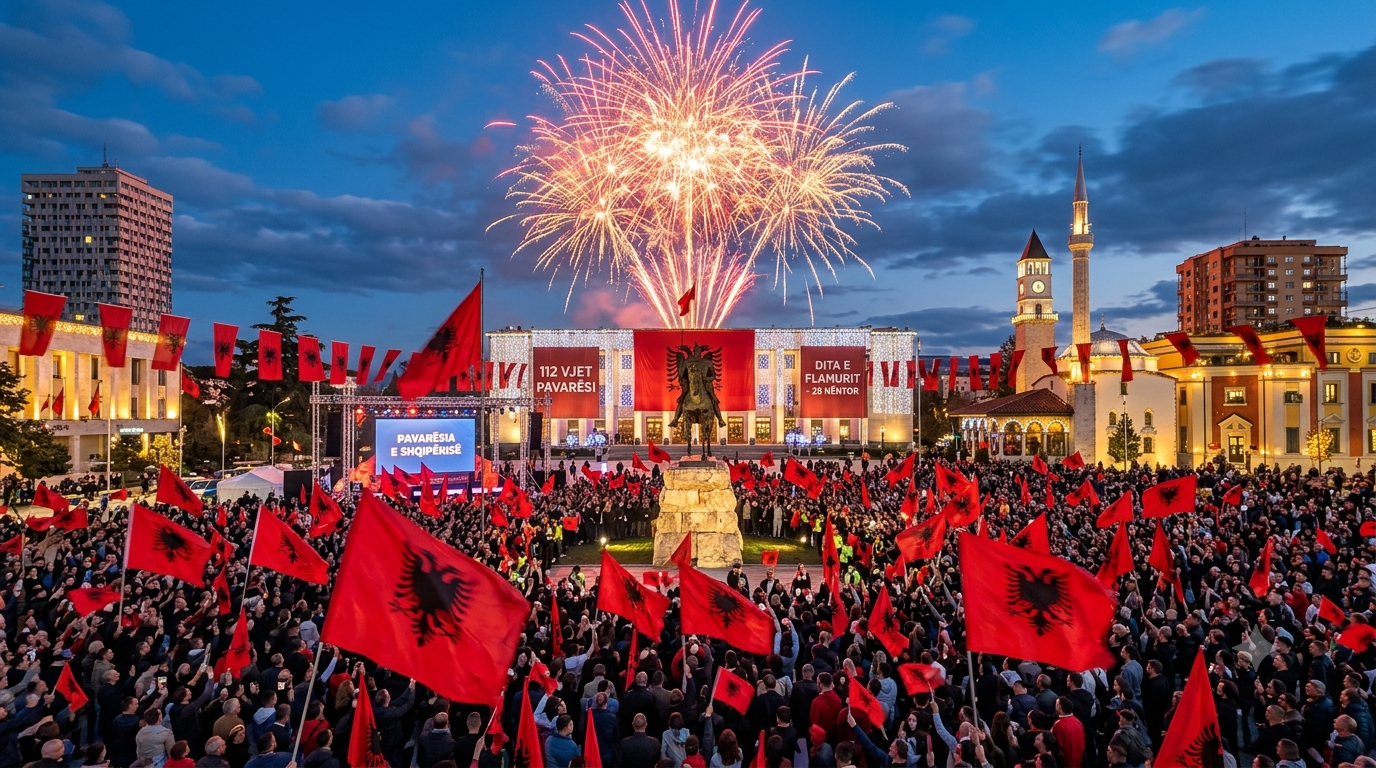
The holiday is marked by flag raising, official ceremonies, school programs, concerts, exhibitions, visits to Vlorë, and celebrations among Albanian communities abroad.
The strongest observances celebrate sovereignty while acknowledging the complexity of Ottoman history, the diversity of Albanian society, the uncertainty of early statehood, and the long consequences of borders drawn in 1913.
Sources and further reading
- President of Albania, Independence Day
- Ministry for Europe and Foreign Affairs of Albania, History of Albania
- Encyclopaedia Britannica, Albania
- Encyclopaedia Britannica, Ismail Qemali
- Encyclopaedia Britannica, Skanderbeg
- Library of Congress, Albania: A Country Study
- United Nations, Albania
- OSCE Presence in Albania
Traditions
Historical focus: Albania's 1912 declaration of independence and national flag tradition.
Cluster context: Southeast European National Days.
flag ceremonies, official events, concerts, diaspora gatherings, and historical education.
How It Is Celebrated
flag ceremonies, official events, concerts, diaspora gatherings, and historical education are associated with Albania Independence Day. They reflect Albania's 1912 declaration of independence and national flag tradition. Albania Independence Day has a November 28 declaration and flag context distinct from neighboring Balkan statehood dates. Closure rules, school programs, travel patterns, and ceremony schedules depend on the responsible authority.
Interesting Facts
- Date focus: November 28.
- Albania Independence Day has a November 28 declaration and flag context distinct from neighboring Balkan statehood dates.
- Primary context: Albania's 1912 declaration of independence and national flag tradition.
- Observed cluster: Southeast European National Days.
- Albania Independence Day authorities may publish additional observed-day or event details.
Related Holiday Guides
Christmas guide → Christmas GuideA clear overview of Christmas history, dates, symbols and traditions.→
Christmas TraditionsExplore trees, gifts, meals, carols and family rituals.→
Christmas HistoryLearn how Christmas developed through religious and cultural history.→
Christmas Around the WorldSee how Christmas customs vary across countries and communities.→
Christmas GuideA clear overview of Christmas history, dates, symbols and traditions.→
Christmas TraditionsExplore trees, gifts, meals, carols and family rituals.→
Christmas HistoryLearn how Christmas developed through religious and cultural history.→
Christmas Around the WorldSee how Christmas customs vary across countries and communities.→Questions
Albania Independence Day FAQ
Clear answers about the date, countdown target and seasonal context.
When is Albania Independence Day?
Albania Independence Day uses November 28 for this countdown.
What is Albania Independence Day mainly about?
This page focuses on Albania's 1912 declaration of independence and national flag tradition, with common public context including flag ceremonies, official events, concerts, diaspora gatherings, and historical education. This guidance applies specifically to Albania Independence Day.
How is Albania Independence Day different from related countdowns?
Albania Independence Day has a November 28 declaration and flag context distinct from neighboring Balkan statehood dates. Its own calendar focus is November 28.
How is Albania Independence Day commonly marked?
Common activity includes flag ceremonies, official events, concerts, diaspora gatherings, and historical education. Albania Independence Day has a November 28 declaration and flag context distinct from neighboring Balkan statehood dates.
Why does this page use this date?
November 28 is the stored rule because the page concerns Albania's 1912 declaration of independence and national flag tradition. This guidance applies specifically to Albania Independence Day.