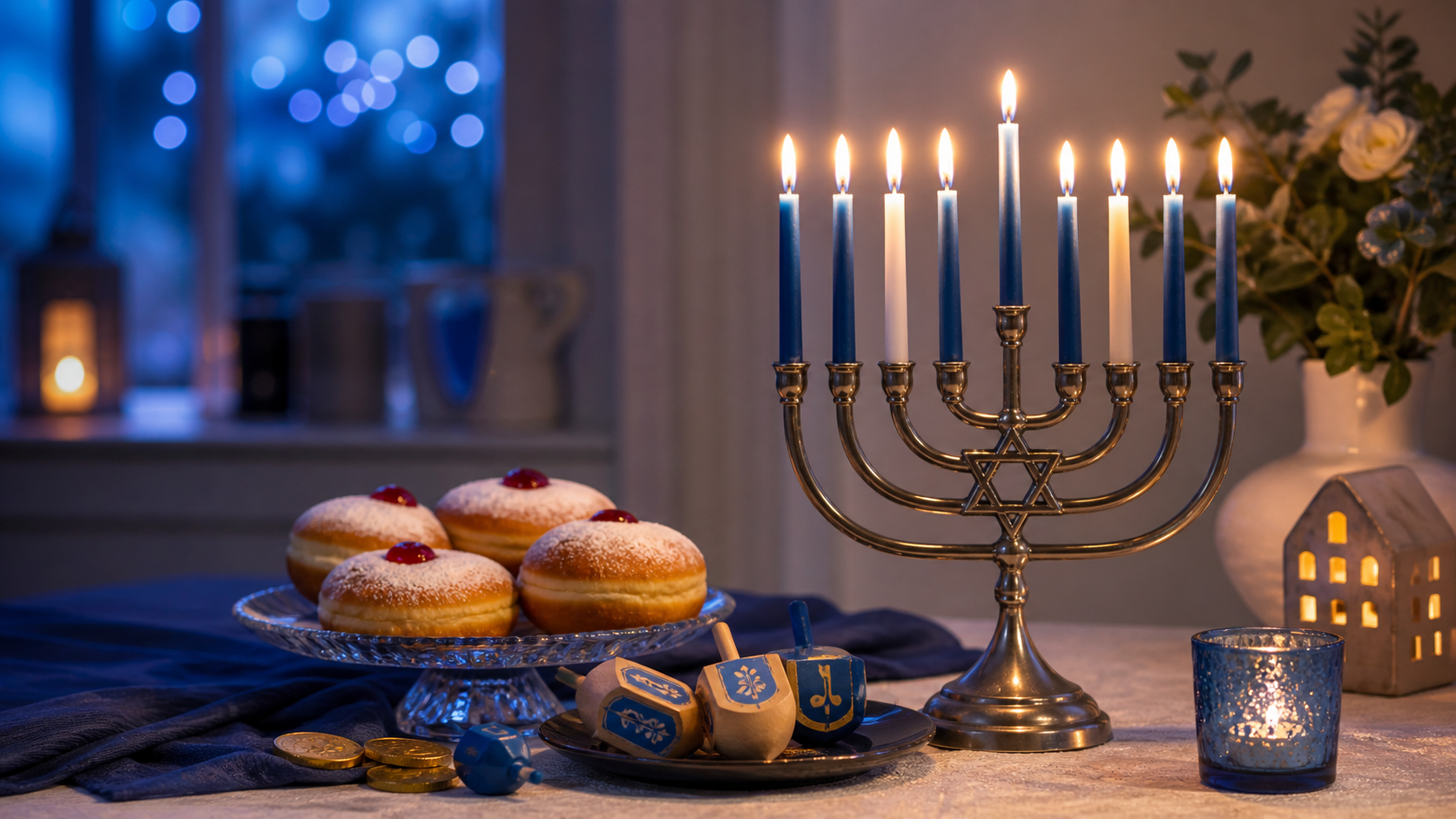
Hanukkah is observed in Jewish communities across many countries, but there is no single worldwide performance of the holiday. The eight-night festival keeps a shared calendar framework and the lighting of the hanukkiah at its center; language, public setting, food and the balance between home and synagogue change with place.
This page compares those differences without treating one Ashkenazi, Sephardi, Mizrahi, Israeli or North American practice as the universal model.
One calendar, many local settings
Hanukkah begins on the twenty-fifth day of Kislev in the Hebrew calendar and lasts eight nights. Because the Hebrew calendar is lunisolar, its dates move against the Gregorian calendar. That movement affects the public setting in which the festival appears. In one year the first candle may fall in late November; in another it may fall close to Christmas. The religious date is calculated through the Hebrew calendar, while work, school and public events are organized through local civil calendars.
That contrast is especially visible in the diaspora. A Jewish family may light candles at home each night even when a community event is held on a weekend, or when a school recognizes Hanukkah on a different day for scheduling reasons. A public program is therefore not a replacement for the household ritual. It is one way a local community makes the festival visible within the time available to its members.
Israel: public culture and a Hebrew calendar
In Israel, Hanukkah is part of a public environment in which Hebrew dates, school calendars and national institutions are familiar parts of daily life. Schools often close for the festival period, and families may encounter hanukkiot in homes, community spaces and public displays. The story of the Maccabean revolt and the rededication of the Temple is also connected to modern discussions of Jewish sovereignty and the history of the land, although families and institutions place different emphasis on those themes.
Israeli observance is not a single national script. Religious communities may give more time to prayer and study, while secular families may focus on candle lighting, children’s activities, sufganiyot and visits. The visibility of the holiday in public life does not mean that every household interprets it in the same way. It means that the festival’s calendar and symbols are widely legible in the society around it.
North America: home lighting and public recognition
In the United States and Canada, Hanukkah is often observed through nightly candle lighting, blessings, songs, gifts, children’s games and gatherings with relatives or friends. Synagogues, Jewish community centers, museums and schools may organize public menorah lightings or educational events. The public visibility of these events is partly shaped by the holiday’s proximity to Christmas, a major public and commercial season in North America.
That proximity has produced both adaptation and debate. Some families give gifts on several nights; others give few or none. Some participate in public interfaith or civic events; others keep the festival centered on home, synagogue and Jewish study. Presenting Hanukkah as a Jewish version of Christmas misses the festival’s own historical and liturgical structure. Gifts and decorations are contemporary choices that can coexist with, but do not define, the candle-lighting ritual.
Europe: local histories and changing communities
European Hanukkah observance reflects the histories of older Jewish communities, postwar rebuilding and more recent migration. In cities with established synagogues, families may attend communal lighting, concerts or educational programs; in smaller communities, home observance can be the most practical setting. Public visibility may depend on local security conditions, municipal relationships and the size of the Jewish population.
Language changes with place as well. English speakers may say menorah, while many Jewish educators use hanukkiah to distinguish the eight-night Hanukkah lamp from the seven-branched Temple menorah. Hebrew, Yiddish, French, German, Spanish and other languages can appear in songs, blessings and community announcements. These linguistic differences do not create separate holidays, but they show how a shared ritual is carried through local Jewish life.
Sephardi and Mizrahi family traditions
Hanukkah is also shaped by Jewish histories from North Africa, the Middle East, the Balkans and the Mediterranean. Sephardi and Mizrahi families may carry distinct melodies, foods, stories and community customs. A North African Jewish household, for example, may preserve family recipes and piyyutim that are not part of a typical Ashkenazi description of Hanukkah. The existence of these differences is not a regional footnote: migration and family memory are part of how the holiday is transmitted.
Modern communities often combine those inherited practices with the institutions of a new country. A family can light candles according to its own tradition, attend a synagogue using another musical style, and join a citywide event organized in the local language. That layered experience is common in diaspora life and cannot be captured by a single checklist of foods or symbols.
Public menorah lightings and civic space
Public menorah lightings are found in many places, but they do not all have the same purpose. A synagogue event may serve members of the congregation; a city ceremony may present Hanukkah as part of a plural civic calendar; and a school program may explain the holiday to children from many backgrounds. The organizer, audience and setting determine what the event is trying to do.
Lighting in public does not make a private ritual less important. The blessings, the order of the candles and the decision to place the hanukkiah where it can be seen remain connected to household practice and Jewish law. In some communities, the public ceremony is an invitation to learn; in others, the central experience remains lighting at home after sunset and sharing the story with family.
What remains shared, and what changes
Across countries, the strongest common thread is the eight-night cycle and the memory of rededication. Beyond that core, observance is shaped by denomination, family history, local Jewish institutions, civil calendars and the relationship with surrounding society. Dreidels, gifts, fried foods, songs and public displays may be prominent in one setting and modest in another.
A careful comparison therefore asks four questions: Which Jewish community is being described? Which local calendar controls school and work? Is the practice happening at home, in a synagogue or in civic space? What historical memory does the family emphasize? Those questions produce a more accurate picture than saying that Hanukkah is celebrated “the same way around the world.”
Hanukkah travels through migration without becoming a blank template. Israeli public culture, North American winter scheduling, European community histories and Sephardi or Mizrahi family traditions all add context to the same eight-night festival. The shared candle lighting is meaningful precisely because communities continue to interpret and carry it in their own settings.
These differences also explain why photographs of a public menorah or a plate of latkes cannot tell the whole story. They show one setting at one moment. The calendar, community and purpose behind the practice are what make the comparison historically useful.
It is also important to separate visibility from uniformity. A large public display may be the most noticeable sign of Hanukkah in a city, but many observances remain quiet and domestic. Some households follow a detailed blessing and lighting practice; others emphasize family memory, synagogue attendance or Jewish education. The range is evidence of living community practice, not a failure to follow one global model.